- Probably way more than you want to know about food security in Yemen, but stunning nonetheless.
- NordGen tells us how to measure seed moisture content. In Russian.
- The Irish have benefited from at least one bank. Alas, that bank is Pavlovsk.
- Indian farmers turning their back on traditional crops because of climate change. Hope NBPGR is on the case.
- Goji berries only as good as other fruit and veg, with “significant placebo effect”.
- [W]e are in the midst of shaping a new perspective on sustainable agriculture, it says here. Right.
- All you ever wanted to know about Green Revolution 2.0, thanks to Anastasia.
- Speaking of which .. sustainable ag under discussion.
Mapping rice agrobiodiversity from around the world
Ooooh, nice article from our friends at IRRI on mapping rice genebank accessions, something close to our hearts here at the Agricultural Biodiversity Weblog, as regular readers will testify.
I guess the main point made by the money map, reproduced below, is that while IRRI may be managing on behalf of us all (under Article 15 of the International Treaty on Plant Genetic Resources for Food and Agriculture, no less) the largest and most diverse collection of rice germplasm in the world, it doesn’t have everything.
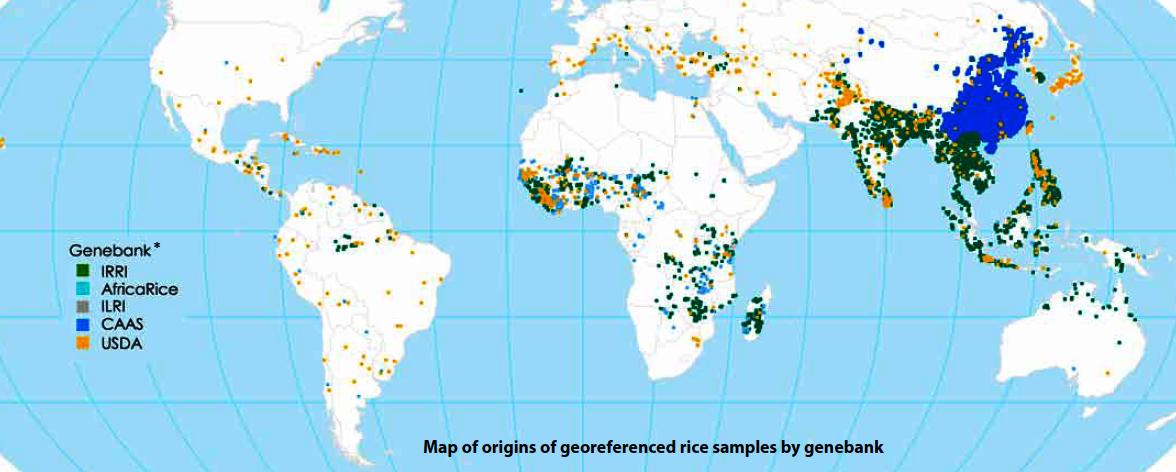
Problem is, not all of those other genebanks which nicely complement the IRRI collection make their material quite so obviously, freely and officially available to others. Plus, of course, we need the data from CIAT, EURISCO and all those other national genebanks. Genesys will help with that, hopefully, eventually. In the meantime, for comparison, this is what it now sees 1:
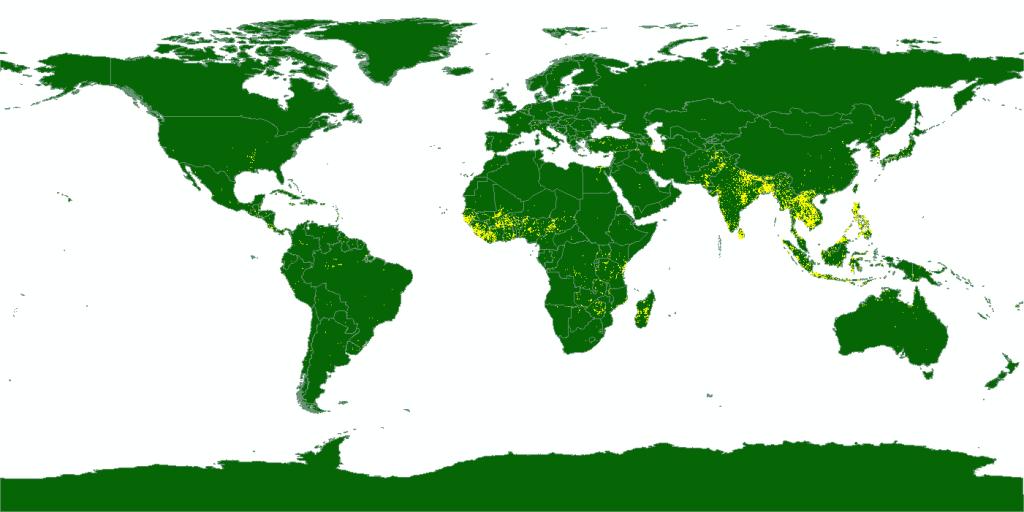
My eye was inevitably drawn to the outliers on that IRRI map. What is that northernmost collection, maybe in Kazakhstan? And alas the southernmost collection seems to have been cut off.
Anyway, now for the gap-filling!
TLB resistant varieties kicking their heels, twiddling their thumbs
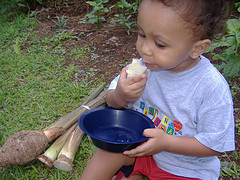 Readers with a long memory will remember that it was back in the summer that we first pointed to worrying signs that Taro Leaf Blight might be in West Africa. By October TLB was pretty much confirmed in Cameroon and the Pacific had offered its resistant varieties. The offer has not yet been taken up. Now there’s another flurry of activity at Pestnet, triggered by news of devastating losses in Nigeria. And John Cho from Hawaii informs us that there has been success in breeding for the disease in the Dominican Republic too. What will it take to get the TLB resistant varieties that we know exist in a few places around the world to where they are clearly urgently needed? This from the blurb on a new, and very timely, book on taro just out from Bioversity:
While new market opportunities and taro’s versatility are responsible for its growing popularity in markets, diseases and climate change also pose ever greater threats to its production and distribution. The current outbreak and spread of the devastating taro leaf blight in West Africa clearly highlights this vulnerability. By taking a global approach to the crop, the authors highlight ways to address new outbreaks of pathogens such as taro leaf blight.
Nibbles: Old fruit, Same fruit, Fruit juice, Dog breeding, Plant Cuttings, Seed storage, Romanian cattle breeds
- REALLY old fruit found in Chinese cellar.
- Marufo the same as Brujidera? Say it ain’t so!
- Rachel Laudan deconstructs a French depiction of cider-making. Well, someone had to.
- Genetic modification dates back to ancient Mexico.
- Rejoice, Plant Cuttings is out!
- Seeds of alpine plants don’t live as long as those of lower altitudes. So how many crop wild relatives are high-altitude species I wonder?
- Get your teeth into the work of the Transylvanian Rare Breeds Association.
The truth about camel wool
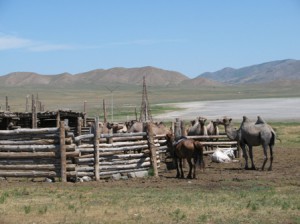
Now, you may think … [that] … camel wool is quite famous for making rather nice garments. However, normally such wool is sourced from two-humped camels who live in the cold and high-altitude deserts of Mongolia and China. Our wool is from one-humped dromedary camels 2 whose hair is quite short and rough and was until now believed to be much too scratchy to process into any thing else than a rope or a rug.
Actually I did think that. You live and learn. But really, would it kill the Rolex Award people to enable an RSS feed from the blogs of their laureates?