- Detailed look at food prices and crises.
- “[A] higher intake of fruits and vegetables is associated with a reduced risk of IHD [ischaemic heart disease] mortality. Whether this association is causal and, if so, the biological mechanism(s) by which fruits and vegetables operate to lower IHD risks remains unclear.” Who cares how it works.
- Higher rice productivity just “a phone call away,” it says here.
Is lack of sex really the problem for grapes?
There’s a very interesting article in the New York times reporting on a major investigation of the molecular diversity among grape cultivars.
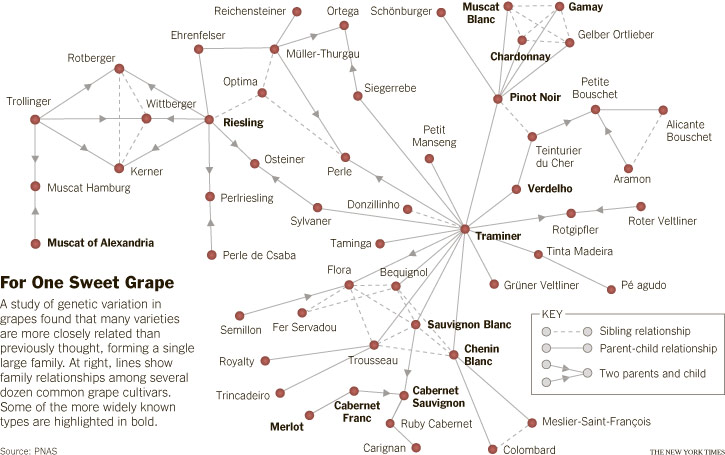
The report is based on a big paper in PNAS, which I confess I have not had time to read carefully. That said, a few things about the NYT’s coverage confuse me. One is the whole depiction of “relatedness”.
Thus merlot is intimately related to cabernet franc, which is a parent of cabernet sauvignon, whose other parent is sauvignon blanc, the daughter of traminer, which is also a progenitor of pinot noir, a parent of chardonnay.
This web of interrelatedness is evidence that the grape has undergone very little breeding since it was first domesticated, Dr. Myles and his co-authors report in the Proceedings of the National Academy of Sciences.
So how did those varieties arise? Maybe breeding means only “deliberate crosses made by a breeder”. Are they saying that the molecular data support the breeding records? Or are actual breeding records, especially for the older and better-known varieties, too sketchy to know? There’s more too, but I’m going to have to find time to read the PNAS paper properly. Or maybe you already have, in which case, feel free to comment.
Selection of pulses for better nutrition
Hot on the heels of the UK’s call for “advances in nutrition and related sciences” to be put to work to improve the efficiency of animal production, comes a paper surveying the protein content and composition of “107 cultivars of important grain legume species”. The primary motivation seems to have been to improve feed quality for pigs, especially for the organic sector which is not supposed to feed supplementary amino acids to make up the shortfall. From the abstract, it seems that feed quality could indeed be enhanced by selecting specific varieties. And a more diverse diet, to supply the amino acids in which most pulses are low?
Nibbles: Wheat pests, Coconut
- Oh no. Hessian flies are becoming resistant to hessian fly-resistant wheats.
- Coconuts! An Indian perspective.
The UK government’s report on the future of food and farming
There’s been widespread interest in the UK Government Office for Science’s final report on The Future of Food and Farming: Challenges and choices for global sustainability. Most of the excitement has centred on the claim that GM foods are essential to feed future populations. I’m not going to go there; that way lies madness. Nor have I had time to read the whole thing, although I did take a pretty close look at the papers on which the final report was based. So I’m grateful to colleagues at the Global Crop Diversity Trust who pointed to a nugget from the Executive Summary. Among its “general priorites” for new science, are:
- Development of new varieties or breeds of crops, livestock and aquatic organisms, capitalising on recent advances in the biosciences.
- The preservation of multiple varieties, land races, rare breeds and closely related wild relatives of domesticated species. This is very important in maintaining a genetic bank of variation that can be used in the selection of novel traits.
- Advances in nutrition and related sciences. These offer substantial prospects for improving the efficiency and sustainability of animal production (both livestock and aquaculture).
The Trust, naturally, lighted on that middle one, but as I read it I found myself humming “Is that all there is?” It isn’t. There’s also “Undernutrition needs to be tackled by direct and by indirect intervention,” promising approaches for which “include biofortification of staple food crops with micronutrients, and the health conditionalities embedded in cash transfers”.
It will be fascinating to see how this extremely comprehensive report influences future policy on agricultural research and development, widely construed, not just in the UK but around the world.