Featured: Tipping point

Jacob tackles tipping points:

I think that an explosion of local varieties, for instance, could count as variance amplification. An increase in variety names could be due to a fragmented knowledge system with lots of redundancies (the same variety having different names in different places) as farmers fail to trace each variety. At a given moment, the names become meaningless. This can then lead to genetic erosion, as farmers fail to find certain varieties due to the name confusion. Less common varieties that survive by going from hand to hand will be the first to go extinct. Has anyone observed this?

Well, has anyone observed this? Read the full comment, there’s also stuff in there about why a locally-based “genetic erosion monitoring portal” wouldn’t be much use.
Nibbles: Chickens, Peppers, Treaty, Breadfruit, Preservation, Food systems, Adaptation, Yam multiplication

Ghanaian buffet

Ghana has forty-seven different kinds of edible green leaves, each with a distinctive flavor.

I bet. And the diversity doesn’t stop there.

I think of Ghanaian cuisine as a kind of culinary jazz. The pepper, tomatoes, and onions, and possibly the oil, form the rhythm section. The stew is one musical form, like blues, the soup and one-pot dishes are others. Like a successful improvisation, the additional ingredients—vegetables, seeds and nuts, meat and fish—harmonize and combine into vibrant, mellow creations.

Dip into the sampler CD at Global Voices Online.

(New) things to do with pears

A little something silly for the weekend.

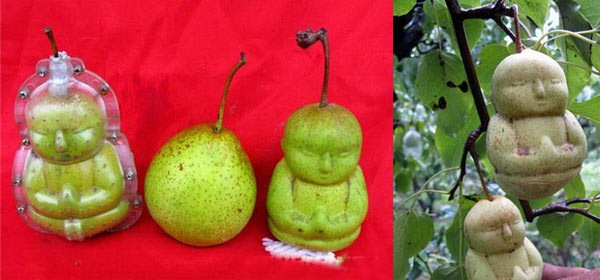
peras_budas.jpg

This bizarre story made it to Boing Boing and the Daily Mail, but the earliest I can find for it, and indeed where I first saw it (Thanks, Matt), was a website in Portuguese. Now, through the miracle of Google Translate, we bring you, How to make pear shaped Buddha!

I think this is the “How to” Strange as I posted here, after all, who is going to try this at home? Well, then, for purposes of curiosity, if you ever heard of pear-shaped Buddha or even the famous square watermelons in Japan knows that the process is simple, just put a cast on fruit when they are starting to rise because the fruit tends to take the shape of the mold as it unfolds.

I’m afraid of what marketers can do with it …

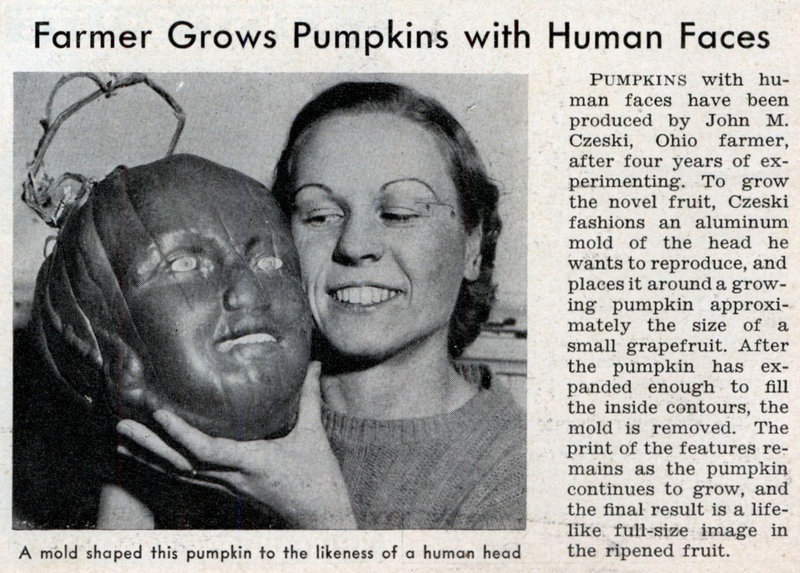
I’m more afraid of what the Mail did to it, but no matter. More to the point, even the square watermelon is not as new as all that. From Popular Science, January 1938:

lrg_pumpkin_face.jpg

Farmer Grows Pumpkins with Human Faces

Pumpkins with human faces have been produced by John M. Czeski, Ohio farmer, after four years of experimenting. To grow the novel fruit, Czeski fashions an aluminum mold of the head he wants to reproduce, and places it around a growing pumpkin approximately the size of a small grapefruit. After the pumpkin has expanded enough to fill the inside contours, the mold is removed. The print of the features remains as the pumpkin continues to grow, and the final result is a lifelike full-size image in the ripened fruit.

Nothing new etc.