How do you improve child nutrition and livelihoods of rural families?

Sometimes it is hard to tell whether what seems like good news is indeed either good or news. So it is with a recent press release from Compatible Technology International, a non-profit based in St. Paul, Minnesota, USA. CTI is sharing a grant of US$673,000 from the McKnight Foundation with ICRISAT (The International Crops Research Institute for the Semi-arid Tropics) and Sokoine University of Agriculture in Tanzania. But what is the grant for?

A release from CTI points out that malnutrition is widespread in Malawi and Tanzania, the target countries, and that “the need is urgent to develop and harvest improved, nutritious foods using locally available crops such as groundnuts (commonly called peanuts)”.

Sounds like they may be planning to use “locally available crops” to deliver more diverse diets and thus better nutrition and health, music to my ears.

But how? And what kind of crops? There really isn’t much more in the release. Some guff about reducing post-harvest losses, a non-specific objective to “improve the nutrition of rural households, particularly children”, selling “groundnut-based food products” in local markets to raise incomes, and other good stuff, but, as the children of Malawi and Tanzania might say, no real meat.

CTI’s expertise seems to be “designing food and water technologies that are sustainable and appropriate to local cultures” and that too is surely a good thing, especially as one of the other objectives of the project is to “reduce the intense daily labor typically endured by women”. Maybe they’re just flogging peanut-butter machines., though I doubt it.

I realize I’m being overly negative here. But the headline on the release is Compatible Technology International Project to Enhance Child Nutrition and Livelihoods of Rural Families in Malawi and Tanzania. Ignore the first four words; most other readers will. I think I’m still entitled to ask just how they plan to do that, even of a simple press release. Please CTI, ICRISAT, Sokoine — anyone — enlighten us.

Featured: More on “Conservation for a New Era”

Eve Emshwiller agrees with Nigel:

Thank you, Nigel, for highlighting the critical need to integrate biodiversity and agro-biodiversity conservation and the question of how to do that. It does indeed seem that the McNeely and Mainka publication provides little more than continued lip service (although admittedly that is better than ignoring the issue altogether).

Peter Matthews makes a plea for ‘biocultural diversity’:

Wild species that are related to cultivated crops (and wild plant varieties that are taxonomically placed within cultivated species) do fall into a hole between disciplines, exactly as Nigel states. But not only are they and their habitats and ecological associations neglected, so are the past and present relationships between people and those wild species and varieties.

Matthew Cawood talks integration:

Agreed, focusing on “agrobiodiversity” without considering “biodiversity” is to make the modern mistake of putting these two topics into separate intellectual silos. They are ultimately the same thing.

Read all the comments on IUCN’s “Conservation for a New Era” book and how it dealt with agrobiodiversity.

Nibbles: Gary Nabhan, Poppies, Gates and Worldwatch, Vavilov update, Aquaponics

  • “His piped cowboy shirt and vest made my westy heart ache with thoughts of home, and the intensity of his commitment to bringing variety back to our land and our table was inspiring…” I bet it was.
  • “The briefing note apparently anticipates a public-relations battle over planting poppies on the Prairies.” I bet it does.
  • “You ask if the money might have been better spent supporting the dissemination of this proven knowledge within Africa.” I bet they did.
  • Cassava processing in Africa. Lots of people betting on this.
  • Vavilov finds enormous onions in Algeria. Who wants to bet they’re still there?
  • Aquaponics catching on in Hawaii? You bet.

Mapping livelihoods diversity in East Africa

ResearchBlogging.orgAs the world discusses desertification and worries about the drought in East Africa, it’s as well to remember that it is livestock keepers that bear the brunt of these problems. A recent paper in Agriculture, Ecosystems and Environment helps to quantify the size of the challenge. 1

It uses environmental and livelihoods data to map the geographic distribution of different livestock-keeping strategies in East Africa. The authors — a team lead by FAO — conclude that:

…nearly 40% of all livestock in the IGAD region are kept in mixed farming areas, where they contribute to rural livelihoods in diverse ways, not least by enhancing crop production through manure and draught power and by providing additional indirect inputs to livelihoods that are seldom properly accounted for. Moreover, an estimated 50 million rural people in Eastern Africa — over a third of the rural population — live in areas where livestock predominate over crops as a source of income. Investment statistics would suggest that this fact often fails to be appreciated fully by governments, donors and policy makers.

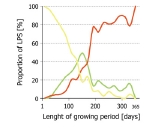
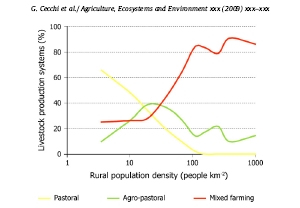
The map itself will hopefully prove useful in guiding policy in the future, 2 but I want to concentrate here on some of the analysis that having all these data in a GIS allowed. In particular, look at graphs of the prevalence of different livelihoods strategies plotted against human population density, and then length of growing period. 3A pastoral production system is where total household income from livestock (L) is 4 or more times greater than total household income from crops (C). An agro-pastoral system has a L/C ratio of 1-4. And in a mixed farming production system the income from crops exceeds that from livestock (L/C<1).[/efn_note] fig1

fig2

It looks like areas with a human population density of 20-30 people per square kilometer and a growing season of about 150 days are the most diverse in terms of production systems. It would be interesting to know whether they are also most diverse at the species and genetic levels, for either crops or livestock. I suspect the necessary data weren’t collected in the livelihoods surveys that formed the basis of this study. Will no enterprising student go in and test the hypothesis?

Revisiting domestication

One of the crucial pieces of evidence in studies of cereal crop domestication is the DNA mutation that keeps seeds attached to their stalk. 4 Staying attached — not shattering — is important because it allows people to harvest the seeds much more easily. You can gather bundles out in the field, carry them back to the village and do the processing there. If the seeds shatter, you have to harvest early, before they are fully ripe, and thus risk not getting their full food value or do all the processing out in the field or else risk losing much of the harvest on the way back to the village.

The loss of shattering is thus a crucial step in the process from cultivation to domestication.

The shattering mutation itself is extremely rare. In rice, for example, all types of rice share essentially the exact same mutation, crucial evidence that in rice it occurred only once, and then spread from Japonica types back into the wild and from them into the Indica types, domesticated a little later.

Now, we (and others) occasionally play the game of why aren’t any new species being domesticated. Sometimes the answer is that too many people are too satisfied with the few crop species that support humanity. Other times, it is that it is just too hard or too time-consuming, especially if one is hanging around waiting for a non-shattering mutation to arise. Mostly, both.

But hey! We know the gene that is mutated in domesticated rice, and wheat, and sorghum, and maize, and other species too, probably. And we know the nature of the mutation. And we know that the more we know, the easier it is to find out about new species. So, what if some smartypants isolated the gene from an as-yet-undomesticated species, say Coix , mutated it so it no longer functioned to shatter the seeds, and stuck it back in? 5 Then just give loads of samples to loads of farmers and let them get on with the business of selection.

Could we engineer a post-cambrian explosion of crop diversity?