- ILRI images are online.
- Rice farmers in Lao get an airing on Public Radio International.
- Tonto: expanding head banana beer.
- Rhizowen’s ongoing oca saga.
- “Intellectual property vital for agricultural innovation.” Er .. riiiiiiight.
- Instead of whinging, as we would, Laurent subverts the Blogger Bioblitz by including potatoes.
- The British National Hop Collection comes in useful. Hey, you had me at hops.
- Make better kimchi and the world will beat a path to your door.
- How many species of aquatic animals do you think farmers use in SE Asia?
- Labeling caviar.
- China’s food culture on the move.
- California’s oranges in big trouble.
Featured: Landraces and climate change
Peter Matthews asks some penetrating questions:
Farmers can feed people, but expecting farmers to feed rising populations indefinitely is like asking property companies to keep subdividing land for a rising world population. In both industries, limits exist. What can society do to reduce the demands made on farmers and farm land? And how can GM crops, land-races, and traditional seed varieties help us?
Is anyone willing to actually think about the answers?
Nibbles: Great Migration, Taro in Hawaii, Chestnut blight, Coopering, Urban beekeeping photos, Plant breeding online forum
- Ex-ILRI staff member Robin Reid on “60 Minutes” explaining the Masai Mara migration.
- GM taro banned.
- All about Cryphonectria parasitica, cause of chestnut blight.
- The ins and outs of cooperage.
- I’m the urban beekeeper and I’m ok…
- Did I already announce this new plant breeding forum?
Chewing up Kenyan gums
This strikes close to home. The Ministry of the Environment in Kenya has instructed farmers in Central Province to cut down eucalyptus trees growing near water courses. Apparently, this constitutes “an attempt to lessen the impact of the drought that is ravaging the country,” because eucalypts are “thirsty.”
The mother-in-law has been managing (by coppicing) a small eucalyptus stand for years. The firewood is what keeps her — and us, when we visit — warm during the cold season. And she sells a few poles every now and then for extra cash. You can see how important gums and other exotic trees are around her place in the Limuru highlands in this picture:
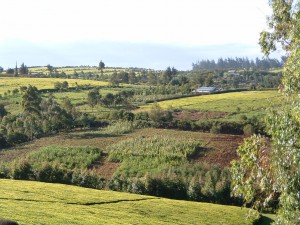
Now, I’m all in favour of indigenous trees, but the seeds haven’t been available in sufficient quantities until recently (to say nothing of awareness and policies). And the hydrological case against eucalypts is subtle: they certainly use a lot of water, but they are efficient in its use, and a very valuable resource in many places.
It seems unfair to blame and penalize farmers for choosing eucalyptuses and Australian acacias when they needed to plant some trees many years back and those were the species that were available, and were being pushed. I hope the mother-in-law gets to keep her eucalypts, at least until she can get some grevilleas growing. We’ll need them when the cold comes.
Berry Go Round #20
Welcome to all who landed here from Berry Go Round #20, over at the excellent Further Thoughts. And if you’re one of our regular customers, head on over to Ian Ramjohn’s blog for a great botanical roundup, including a couple of examples of agricultural biodiversity.