- Buffalo on California’s Santa Catalina island being sterilized. In other news, there are buffaloes on Santa Catalina island.
- GMO hotspots deconstructed. Zzzzz.
- Maize genome mapped. Zzzzz.
- Nigerian nutritionist pushes slimy micro-livestock. France surrenders.
- How to shop for fruit bats.
- New newsletter from Nepalese NGO. Li-Bird, where is it on your site?
Mobiles against hunger
Over at his other place, Jeremy expounds on an unusual idea for “solving” hunger. What do you think? Does he have too much time on his hands?
Nibbles: Old goat, Ethiopian sorghum
- Reptile-like Balearic goat.
- Sorghum diversity hotspots identified in Ethiopia.
Cavies in Congo
What next? Cane rats in Colombia?
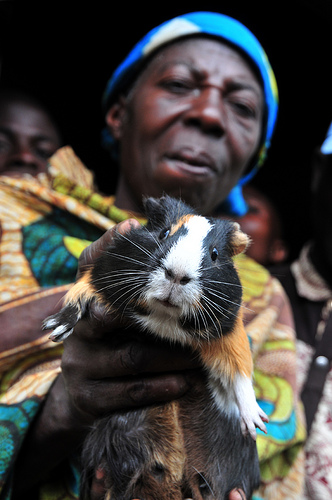
This picture really made me sit up and take notice when I saw it at CIAT’s Flickr photostream. I had absolutely no idea that people in Kivu, DR Congo, kept guinea pigs as mini-livestock, and a simple Google search turned up almost nothing of relevance. I went a bit deeper, and unearthed an article — Think big with minilivestock — in Spore from February 2008. That told me that in Kivu women often breed guinea pigs to provide their children with animal protein, which is otherwise not available to these most vulnerable members of the household. The article also says:
Throughout Central and West Africa and as far east as DRC and Tanzania, as well as in Haiti (Caribbean), small-scale guinea pig farming based on a few animals contributes to food security. It is a relatively easy activity, aside from problems caused by inbreeding which can eventually affect the health and weight of animals.
But it doesn’t tell me how this started, or what CIAT’s involvement might be. Can someone from CIAT or FAO please enlighten me?
And while we’re on the subject of introduced mini-livestock, has anything moved the other way? Luigi assures me that grasscutters (aka cane rats, Threonomys spp.) are delicious, but I’m pretty sure he didn’t taste them in Colombia.
So what’s with them bees?
Overall, we must conclude that claims of a global crisis in agricultural pollination are untrue.
That’s from a New Scientist digest of a Current Biology paper by the authors themselves. 1 Roughly, the argument is that (1) bees are responsible for the production of a lot of our food, yes, but not that much; (2) pollinators are declining, yes, but not worldwide, and probably not irreversibly; and (3) pollinator decline can threaten agricultural yield, yes, but it hasn’t actually done so yet. The data come from a huge FAO dataset of “yield, and total production and cultivated area of pollinator-dependent and nondependent crops.”
But not so fast. The relatively small proportion of agricultural production that depends on pollinators has quadrupled during the past 50 years. So if there’s no pollinator crisis now, there may well soon be one.