- It’s always good to be able nibble a paper with “wild asses” in the title. Especially since there’s nothing else on the internet today.
A plate of exotic agrobiodiversity
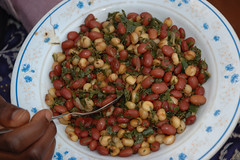
It’s a nice illustration of our interdependence for agricultural biodiversity that an East African staple dish can be made up of New World crops. Now, if only that green stuff in there were one of those interesting traditional African vegetables rather than the more likely sukuma wiki (kale), that would really make a great story.
Of cattle and people. And barley
Dienekes, a blogger who specializes in molecular anthropology, has a quick note today on a paper on the molecular genetics of cattle in Europe. The main story is one of distinction between North and South.
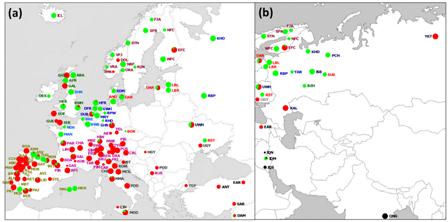
Apparently, the expansion of the dairy breeds have created, or largely maintained, a sharp genetic contrast of northern and southern Europe, which divides both France and Germany. It may be hypothesised that the northern landscapes, with large flat meadows, are suitable for large-scale farming with specialised dairy cattle (Niederungsvieh, lowland cattle), whilst the mixed-purpose or beef cattle (Höhenvieh, highland cattle) are better suited to the smaller farms and hilly regions of the south. However, it is also remarkable that in both France and Germany the bovine genetic boundary coincides with historic linguistic and cultural boundaries. In France, the Frankish invasion in the north created the difference between the northern langue d’oïl and the southern langue d’oc. The German language is still divided into the southern Hochdeutsch and northern Niederdeutsch dialects, which also correlates with the distribution of the Catholic and Protestant religions. On a larger scale, it is tempting to speculate that the difference between two types of European cattle reflects, and has even reinforced, the traditional and still visible contrast of Roman and Germanic Europe.
It doesn’t seem that the strong latitudinal genetic differentiation in cattle is matched by one in human populations. Here the pattern is much more gradual and clinal. 1 However, there may be a similar “sharp genetic contrast of northern and southern Europe” (or at least between the Mediterranean and the rest of Europe) for barley. 2
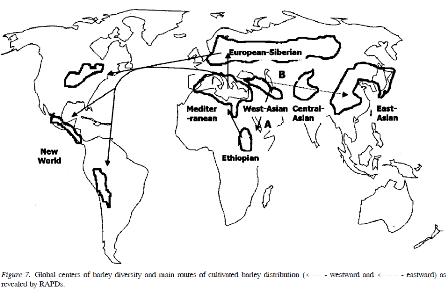
I’d dearly love to have the time to find out whether other livestock and crops show a similar pattern.
Blue maize and its proteins
I’ve only just subscribed to the INFOODS Electronic Discussion Group, so I’m not sure how active it is, but two interesting queries came in yesterday, so I’m hopeful. One was about how much bioavailable iron there may be in the juice you get when cooking beans. The other is about infraspecific differences in nutritional quality, which is a topic close to our agrobiodiversity-fueled heart. I’ll take the liberty of quoting the query in full, in case any of our readers has an answer:
Does anyone have the amino acid profile (PHE specifically) for blue corn 3? Looking at the USDA info for corn flour, whole-grain, *white* and corn flour, whole-grain, *yellow* they both have the same amount of protein (6.93 gm) and PHE (340 mg) per 100 gm. The *blue* corn whole-grain flour, however, has 8.75 gm pro/100 gm and the amino acid values are not listed.
I found a journal article that states blue corn is a more complete source of protein than either yellow or white and has elevated levels of lysine and tryptophan as compared to the other 2 (~0.8 mg/gm more LYS; doesn’t say amount for TRP). Could the additional protein be coming from the higher LYS and TRP and the PHE be the same as white/yellow or might the % PHE be significantly different based on percentages/amounts of the other amino acids?
Regards,
Belkys Prado RD CSP LD
Metabolic Nutritionist
St Joseph’s Children’s Hospital of Tampa
Tampa, FL
Nibbles: Heiser & Chambers, Quinoa, Books, Grafting eggplants, Vitamin D, Pitaya, Cassava, Beetroot, Worldwatch, BBSRC
- Celebrating Charles Heiser and Bob Chambers.
- Quinoa coming into its own in Bolivia.
- Earthscan and Bioversity International team up for new Issues in Agricultural Biodiversity book series.
- Crop wild relatives not just useful to breeders, eggplant edition.
- Vitamin D 101 in pictures.
- Improving pitaya.
- Cassava production trends in Africa in 28 slides. Twenty slides too many, but it’s always good to have the data.
- Beetroot’s colour deconstructed.
- Worldwatch’s 2011 State of the World was released yesterday. Gives a “compelling look at the global food crisis, with particular emphasis on global innovations that can help solve a worldwide problem.” At $19.95 a pop. But supporting material available. Here comes the commentary.
- The genebank at the UK’s Biotechnology and Biological Sciences Research Council gets its 15 minutes of fame.