Shades of blue, Tokyo style

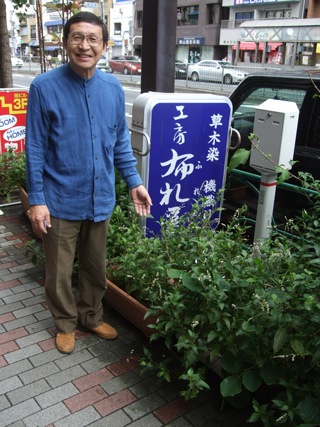
The Human Flower Project reports on a DIY indigo-dyeing shop in the heart of Tokyo. A fine idea, for all sorts of reasons. It puts people in touch with a natural, plant-based dye and offers us a chance to talk about agricultural biodiversity and even plant biochemistry.

The Human Flower Project’s page shows a photograph of the source of indigo labelled Polygonum tinctorium, also known as Chinese indigo. I fondly remember visiting an indigo demonstration dyer near Toulouse, in France, that sourced the dye from woad, Isatis tinctoria. And then there’s the Asian (or true, sic) indigo, Indigofera tinctoria. Native American tribes apparently used other legumes closely related to true indigo for their blue dyes.

What they all have in common is the process to get the colour. Young leaves are mashed with water and then encouraged to ferment. That results in a greenish sludge. The fabric is immersed in the sludge and then hung up to dry. As the pigments oxidize, they turn blue, and expert dyers can control the shade of blue by adjusting the duration of the oxidizing step, and other factors. (Loads more information here.)
6AF35A52-7908-4B09-A855-35D347CB8CA8.jpg

It struck me that indigo would make a marvellous central topic for one of those the-entire-history-of-the-universe-as-seen-through-a-single-neglected-thing books. There’s revolt and revolution, trade wars, the origins of modern organic chemistry, mercantile colonialism, slavery and rice, and pretty colours. Kew contibuted its model of an indigo factory to the BBC’s history of the world in 100 objects, but the model does not seem to have been the subject of one of those wonderful broadcasts. A pal of mine did a book on madder, another brilliant dye; I couldn’t find anything similar for indigo (although there is plenty of woo). Publishers! I am available.

Evaluating the Millennium Villages

We’ve shown our skepticism about the Millennium Villages here before, in particular their apparent disregard for the importance of agrobiodiversity. If I am honest, I would say that that on balance they are probably a good thing. They are certainly well-intentioned. And little else seems to have worked. But no matter how many evaluation reports I read, I suspect it is this snippet that will stay with me, quoted in a New Republic review of Peter Gill’s recent book Famine and Foreigners: Ethiopia Since Live Aid. Gill visits a…

…village called Koraro, chosen to be one of Sachs’s so-called Millennium Villages, which were meant as demonstration projects to prove that foreign aid can really work. He asks a local man whether he has ever met Sachs, to which the man replies, “I have met the owner twice”…

Following crop development in real time

The Global Agriculture Monitoring Project (GLAM), a joint NASA, USDA, UMD and SDSU initiative, has built a global agricultural monitoring system that provides the USDA Foreign Agricultural Service (FAS) with timely, easily accessible, scientifically-validated remotely-sensed data and derived products as well as data analysis tools, for crop-condition monitoring and production assessment.

Great for deciding on the timing of germplasm collecting expeditions too, I would imagine.

The agrobiodiversity of Wayanad District in Kerala

An extremely long explanation of the wonderful “‘home garden’ system” 1 of Wayanad District in the south Indian state of Kerala, from the Satoyama savants at UN University. There’s a video, natch, which is very pretty and very informative. One scene of four women pounding what looks like millet looks lovely, dangerous, and unnecessary. Couldn’t they get a mini-mill?

What I don’t get is why the headline says “South Indian agricultural model mimics fragile ecosystem”. Looks to me like the agricultural model is a lot more robust and resilient than the ecosystem. But what do I know?

Nibbles: Bean gap analysis, Protected areas 2.0, NZ livestock, French boar, Taro in Hawaii, UNEP, Moringa, False flax, Hordeum