Nibbles: Chilli diversity, Frankincense, Rice genomes, Rice domestication, Agro-ecology
- Why do chillies differ in their heat? Ed Yong explains all, and links to the peer-reviewed paper.
- Frankincense “doomed”. Yeah, yeah, yeah. Take a number. And a merry Christmas to you too, publicity hounds.
- IRRI to sequence 8.3% of its rice diversity. I’ll alert the media. No, wait …
- Speaking of which … Diversification of rice and diversification of languages; great long blog post explains how they illuminate one another.
- Agro-ecology is the answer, says UN Special Rapporteur on the Right to Food. What was the question?
Mexican dog brainfood
What’s that they say about a little knowledge? I knew the Aztecs ate dogs. I knew they kept a hairless breed of dog. So I naturally assumed they bred the hairless breed for food. So much more convenient not having to deal with all that hair in the kitchen.
 Wrong. I’m sure there’s a name for this kind of logical fallacy. Be that as it may, a recent visit to the Dolores Olmedo Patiño Museum, in Xochimilco, Mexico City, where they keep a pack of that hairless breed, which is called Xoloitzcuintle by the way, quickly disabused me. A notice there points out that the name Xoloitzcuintle makes reference to Xolotl, a god associated with death (among other things). Dogs were supposed to accompany the dead on their way to the next world. Not the done thing to eat them, then, surely. It must have been other breeds that were eaten.
 Well, maybe. The Wikipedia article on Xolotl says that “the meat of the Xoloitzcuintle was very much part of the diet of some of the ancient peoples of the region.” There’s no reference for that, though. What seems clear is that there were, indeed, other dog breeds. Many of the representations of dogs don’t really look like the Xoloitzcuintle at all. Squatter and fatter. Dare I say it? Jucier. There are many of them, mainly in pottery, at the museum, though I was not allowed to photograph the ones indoors.
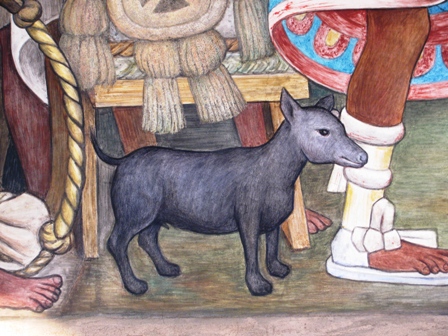
Diego Rivera seems to have had a thing about Aztec dogs, by the way. He painted them a number of times. Here’s an example from the Palacio Nacional mural. Interestingly, though, they look a lot more like the pottery pieces than the actual Xoloitzcuintle specimens roaming around the gardens of his friend Dolores’ house.
Nibbles: Animal traffic, EU agricultural policy
- Pre-columbian movement of animals around the Caribbean. But were any of them actually domesticated?
- European agriculture ministers want nothing to do with biodiversity. And it isn’t even agrobiodiversity.
Nibbles: Wild rice, Food forests, Domestication
- It isn’t rice, but it is wild. And threatened, by disease, dams and climate change. h/t Sustainable Nutrition.
- Food forests. All you can eat blog post, with video goodness.
- Archaeology International goes more-or-less open access. Read all about The Early Rice Project, among other treats.