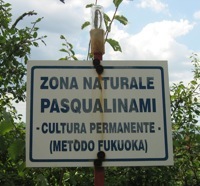
 File this one under spooky. Yesterday, walking in the Italian countryside, I spotted an unusual sign. It says, in effect, Permaculture, Fukuoka Method. How many people passing that sign would have the faintest idea what it meant? My companion had no idea who had put it up, or why. I told him briefly about Fukuoka, and he said he’d ask around among his neighbours and see what he could discover. And I took a close look at the hedge in which the sign was planted, and I couldn’t really see anything too unusual about it. A couple of apples, possibly not wildlings, brambles, rose-hips.

The spooky part? Exactly one year ago today, we noted the death of Masanobu Fukuoka, who died a year before I snapped that sign.
Was it really a permaculture hedge? And is this something general in Italy, posting signs of this nature? Maybe someone could enlighten me.
