Oneida corn story goes home

Last night we received a very nice message from Eve Emshwiller, who teaches an ethnobotany course. She had some welcome things to say about the blog, and then told us this story.

I looked at the site you nibbled yesterday on Oneida corn, and then sent it on to a Menominee graduate student who began working with me this semester, Diana Peterson. She had done her master’s thesis on Oneida three sisters agriculture, including that same maize. She then sent the link on to Jeff Metoxen, the Oneida man pictured and quoted in that article. He hadn’t seen the article previously, and was excited to see it in print! So, thanks to your blog and a sequence of forwarding of links, the news finally got back to the Oneida farmer himself. I’m glad to have been part of that path, and extra glad to have learned of it from your blog.

Which kind of summarizes in a few sentences why we do this. Thanks, Eve and Diana.

Prize for GIS study of malnutrition and agrobiodiversity

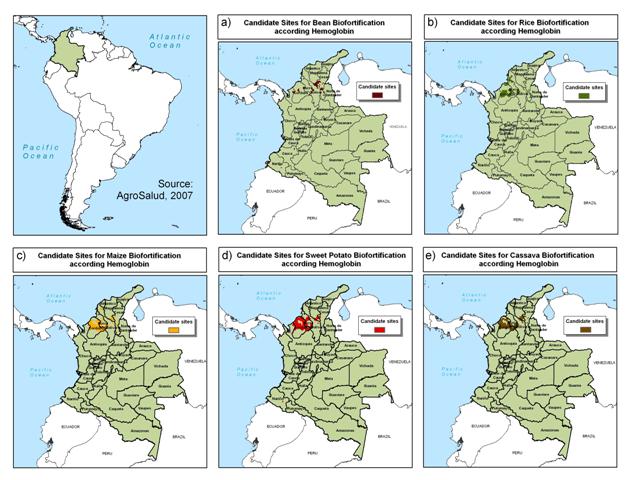
Emmanuel Zapata Caldas, a geography student at the Universidad del Valle in Colombia, has won second prize at the XVIII National Geography Event for his work, carried out in collaboration with CIAT, on the spatial analysis of malnutrition in Latin America. Reproduced below are some of his results for Colombia, which he kindly made available to us (click to enlarge).

emmanuel

For this particular analysis, Emmanuel looked at the prevalence of anemia and used secondary data on poverty and agricultural production to identify sites in Colombia where the biofortification of different crops could have a significant impact on this aspect of malnutrition. Congratulations to Emmanuel for his prize, and his interesting work.

Barley mutants take over world

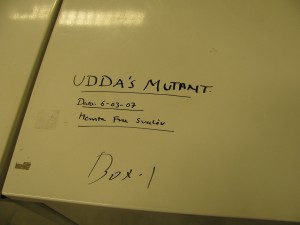
Sometimes nature needs a little help. That was brought home to me in emphatic fashion last week as I listened to the formidable Udda Lundqvist summarize her more than half a century making and studying barley mutants. Some 10,000 barley mutants are conserved at NordGen. In this freezer, in fact:
nordic09 071

And Udda described some of the main ones during her talk. You can see some of them, and read all about this work, in her 1992 thesis.

Useful mutations in barley include a wide range of economically important characters: disease resistance, low- and high-temperature tolerance, photo- and thermo-period adaptation, earliness, grain weight and -size, protein content, improved amino acid composition, good brewing properties, and improved straw morphology and anatomy in relation to superior lodging resistance.

Some of these have found their way into commercial varieties.

Through the joint work with several Swedish barley breeders (A. Hagberg, G. Persson, K. Wiklund) and other scientists at Svalöf, a rather large number of mutant varieties of two-row barley were registered as originals and commercially released (Gustafsson, 1969; Gustafsson et al., 1971). Some of them have been of distinct importance to Swedish barley cultivation. Two of these varieties, ‘Pallas’, a strawstiff, lodging resistant and high-yielding erectoides mutant, and ‘Mari’, an extremely early, photoperiod insensitive mutant barley, were produced directly by X-irradiation.

Udda is in her 80s but shows little sign of slowing down.