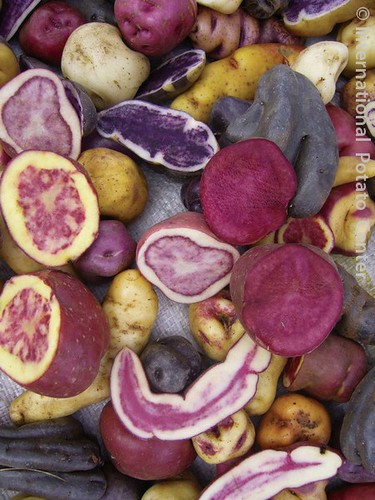
Potatoes’ flesh colors / El color de las pulpas en papas, a photo by CIP – International Potato Center on Flickr.
Great shot from CIP.
Agricultural Biodiversity Weblog
Agrobiodiversity is crops, livestock, foodways, microbes, pollinators, wild relatives …
Great shot from CIP.
SciDev.net reports on a new study reinforcing the view that after a disaster that wipes out seed stocks the local, informal seed system “in the form of loans or gifts of seed from friends and relatives” is more likely to restore agrobiodiversity to the farming systems than seed relief and markets. The study looked specifically at cowpea (Vigna unguiculata) after disastrous floods in Gaza Province, Mozambique, and strengthens the more general conclusion that seeds already in the local system offer the best chance of restoration.
I can’t help wondering, however, whether disasters of this kind might not also offer an opportunity to inject extra diversity into farming systems. Not just any old diversity, as might be provided by seed relief or generous private sector suppliers, but diversity selected to perform well under predicted climatic conditions in the disaster area. A savvy genebank system, working with relief agencies, might be able to supply small amounts of pre-selected diversity that farmers would be willing to try under the circumstances. And some of that diversity might even be better than what they had before the disaster.
Just a thought.
The main rubber tree, which the British took to Malaysia, was the basis of all plantations. There are nine other plants in that same group from which the Indians once got rubber. But the plantations had started to supply the world with better and cheaper rubber than the Indians had been producing under terrible — almost slave — conditions. So the Indians had three or four generations when they hadn’t tapped wild rubber, and we were sent into the various countries to try to stimulate this for the war effort. I had been in the Amazon of Colombia, so I went right back among my Indians, and I worked on that during the war.
That’s the Father of Modern Ethnobotany, Richard Schultes, in part of a long interview he gave in 1990 for something called the Academy of Achievement. You can read it, listen to it, or watch videos of it. Fascinating.