- And if you can’t get to Kew, how about an ethnobotany talk in Denver, Colorado? Or maybe one on GPS and plants, same venue? Can’t make either? Watch a lecture on Schultes in the Amazon. He’s the Father of Ethnobotany, after all.
- Misclassification of Hemp Holds Back Industrial Applications. Duuuuuuuuuude.
- Write a blog on youth and agriculture, win big money. Yeah, right, I’ve heard that one before… I’m still here, Sergey.
- Hawaii’s Breadfruit Festival is coming! So get in the mood.
- Sotheby’s auctions heirloom. No, really. Alas, probably no breadfruits.
- Now, what can I say about Scotsmen and pubs that won’t be construed as a racist slur? Probably nothing.
- Old potatoes helping Andean farmers cope with climate change. And, no doubt, obesity too.
- Conference on pesticide use on minor crops. Oh, to live-tweet that one.
- Micro-livestock makes it into the New Yorker. Can the backlash be far behind?
Not potatoes
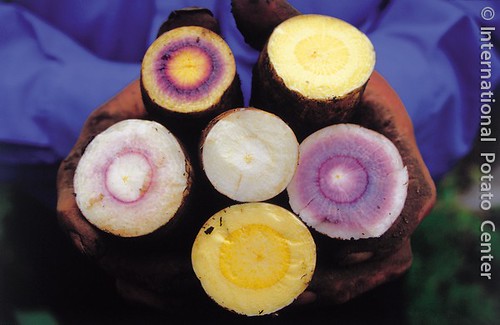
But colourful nevertheless. giving the lie to their binomial, Arracaccia xanthorrhiza.
Protected areas in China: more and better needed
A big article in BioScience looks at the state of nature reserves in China, and finds them lacking. According to the press release:
Protected area managers in many cases currently lack basic data about which plant species are present on their reserves and even the exact area and extent of the reserves. Consequently, the effects of China’s rapid economic development, the related spread of invasive species, and the growth of tourism could drive to extinction species that could be sources of future crops and medicine.
Some things worth mentioning, from the article itself. 1 First, nice to see crop wild relatives getting a look in, although there is no mention of the agricultural biodiversity already being used by farmers either in the protected areas or outside them. Secondly, although the authors suggest preserving “very rare and threatened species” in some of China’s more than 140 botanic gardens, they don’t talk about conservation in genebanks, and they don’t talk about incentives for in-situ or on-farm conservation. In fact, the only incentives mentioned are those government should offer to persuade people to move out of the protected areas and into the cities.
So, once again, people are the problem. “Conflicts between the interests of rural communities and nature conservation need to be resolved,” and the way to do that is to move the people out of the way of conservation.
China has an opportunity to lead the world in developing a coherent conservation policy for plants important to agriculture, one that recognises the importance of diversity (as much Chinese agriculture has done), that integrates the various different forms of conservations, and that enlists the people who actually interact with plant diversity, manage it, even if only by default, and thus help to determine its future.
Some goings-on at Kew; advance notice
Happy to share some information about future events at the Royal Botanic Gardens, Kew, with the customary offer to host a report from anyone who is able to be there.
Saturday 17/Sunday 18 September 2011 — Behind the scenes in Museum No. 2
For one weekend only, as part of the annual Open House London celebrations, Kew is re-opening the world’s first museum of economic botany, closed to the public since 1960 and now used as Kew’s School of Horticulture. Decimus Burton converted George III’s fruit store into a museum in 1847, and little has changed since then. With help from students and staff at Royal Holloway, we will have plenty of interpretation and information, and are also displaying a wide range of artefacts from the Economic Botany Collection, illustrating themes such as basketry, explorers, timbers,and Kew’s history.
Tuesday 11 October 2011, 5pm — Annual Ethnobotany Lecture
Prof. Will McClatchey on “Ethnobotany of the Home and Hearth”. Will McClatchey, a renowned speaker, is a leading ethnobotanist with special expertise in methodology, the evolution of patterns of human interactions with plants and ecosystems, and the ethnobotany of Pacific islands. His talk is in the Jodrell Lecture Theatre at Kew. No need to book in advance; just go to the Jodrell Gate. The lecture will be followed by further discussions in the Botanist pub on Kew Green. (More details at Kew’s Economic Botany page.)
Friday 9 December 2011. Sir Joseph Dalton Hooker — a centenary celebration
The Economic Botany collection is participating in this conference with displays of Hooker artefacts from his Himalayan expedition. The day will be fun, with a varied programme and expert speakers. Early booking advised.
Nibbles: Food Fest, Orange sweet potatoes, Land grab, Tackling hunger, Tomato evolution, Perennial grains
- The Eden Project in Cornwall to host harvest festival in October, featuring BBC TV presenter of Grow Your Own Drugs.
- “Super spuds help beat hidden hunger in Uganda.” Where NatGeo leads, DFID follows.
- A land grab story with a difference! Russia to lease land to North Korea.
- UN Special Rapporteur on the Right to Food offers G20 (more) advice: act on 8 priorities.
- The Scientist Gardener tackles the evolution of tomato fruit shape.
- Al Jazeera gives The Land Institute a soapbox for perennial grains.