- “[D]iversity in domestic dogs derives from a small genetic tool kit.” Really, really small. Like, 50 genes.
- ILRI says we need to maintain indigenous farm animal diversity in Asia. They eat dogs, don’t they?
- You say pomato, I say totato: “Tomato-potato cross benefits farmers.” Fine, but it’s a graft. So why call it a cross?
- Non timber forest products important “in times of crisis” shock.
- Sumerian beer non-alcoholic? Not even beer, but “fermented cereal beverage“.
- Then again, ancient Peruvians discovered popcorn. But not movies.
- IRRI wants a student to re-examine optimal drying conditions for rice.
- The Svalbard Global Seed Vault– is it important for plant genetic resources? Answers here, next week.
Starving Striga of essential micronutrients
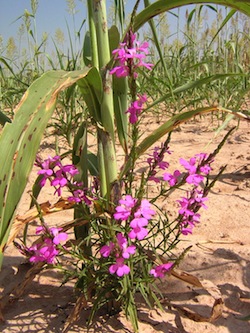 Interesting, and temporally confusing, news item from Wageningen University. Dated 12 January, it tells us that on 11 January Muhammad Jamil will be defending his doctoral research on the very pretty but also very devastating parasitic weed Striga. 1 And fascinating research it is too.
Striga seeds germinate in response to strigolactones, which are secreted by the host plant’s roots, and which effectively tell the parasite that there is a host nearby. Strigolactones are made from carotenes, which are the precursors of vitamin A, an essential micronutrient for people. Jamil’s research shows that the less carotene a plant produces, the less likely it is to be parasitised by Striga. Jamil also demonstrated considerable differences among rice varieties in the amount of strigalactones they produce under identical conditions.
Which raises lots of lovely questions. Will crops bred for higher levels of carotene — say to improve human nutrition — be more susceptible to Striga parasitism? Is the solution to breed those self-same crops to block the production of strigalactones? Could this be a job for life for high-tech plant breeders? And what’s wrong with the push-pull approach to controlling Striga? Does it, for example, not work on rice?
I do hope Muhammad is now Dr Jamil.
Nibbles: Ancient grains, Cassava beer, Yeast
- Wall Street Journal clambers aboard the ancient grains bandwagon.
- Cassava beer!
- Yeasts have a genebank too!
Featured: African rice archaeology
Dorian Fuller encourages the study of African rice.
Rice presents a fascinating opportunity to study parallel evolution in crop diversity, crop ecology and cultural traditions with the comparison of African O. glaberrima and Asian O. sativa. Sadly, at present the archaeobotany of most West African countries is a complete blank, and archaeobotany in Africa needs more researchers, but some exciting finds are coming out (see my blog for some recent examples). Asian rice has also attracted more historical linguistic research and discussion. Unravelling the cultural histories of African rice remains a good challenge to get to work on!
Well, what are you waiting for. Get to work!
Brainfood: Conservation policy, Grasspea breeding, Modeling rice diseases, Maize roots, Literature on new oil crops, Native vs non-native trees in Indonesian city parks, Cherimoya maps, Darwin Core, Seed dispersal and conservation, Oxalis variation, Polyploidy and variation, Pollinators, Microsymbionts, Plant migration, Culture and agriculture
As ever, we have added most of these references to our public group on Mendeley, for ease of finding. “Most?” we hear you say. “What gives?” Well, Mendeley and some academic publishers still don’t play nicely. There’s nothing to stop you adding the paper in question by hand, if you’re so inclined, but we don’t really have the time. And if you do, please do it right.
- Why are some biodiversity policies implemented and others ignored? Lessons from the uptake of the Global Strategy for Plant Conservation by botanic gardens. Because there are no feedback mechanisms?
- Genetic improvement of grass pea (Lathyrus sativus) in Ethiopia: an unfulfilled promise. Conventional breeding for low ODAP hasn’t worked, so forget about solving that problem through conventional breeding, and move on to other problems, or use genetic transformation.
- Modeling and mapping potential epidemics of rice diseases globally. It is not particularly well done, but one is surprised to see it done at all. NiM 2
- Morphological and physiological characteristics of corn (Zea mays L.) roots from cultivars with different yield potentials. More roots means more yield. Among some modern varieties anyway. Under some conditions. NiM
- Trends in literature on new oilseed crops and related species: Seeking evidence of increasing or waning interest. And finding it, alas. Sort of. NiM
- The green colonial heritage: Woody plants in parks of Bandung, Indonesia. Native species used to be used more, and should be used more again. NiM
- Mapping Genetic Diversity of Cherimoya (Annona cherimola Mill.): Application of Spatial Analysis for Conservation and Use of Plant Genetic Resources. Cool maps of microsat hotspots.
- Darwin Core: An Evolving Community-Developed Biodiversity Data Standard. The way out of Genebank Database Hell? Well, maybe the match that will light the torch that will show the way out.
- Seed dispersal in changing landscapes. Fragmentation, harvesting, invasions and climate change affect seed dispersal in ways that need to be understood by conservationists. NiM. And the BBC’s more verbose take on it.
- Distribution models and a dated phylogeny for Chilean Oxalis species reveal occupation of new habitats by different lineages, not rapid adaptive radiation. Title says it all, really. It’s not that a single lineage exploded as new habitats became available. Old lineages were pre-adapted to the new habitats. 3
- Extensive chromosomal variation in a recently formed natural allopolyploid species, Tragopogon miscellus (Asteraceae). Polyploidy leads to all hell breaking lose in the genome for generations.
- Overplaying the role of honey bees as pollinators: A comment on Aebi and Neumann (2011). It’s the wild bees, hoverflies and other native pollinators, stupid! But still.
- Arbuscular Mycorrhizas Reduce Nitrogen Loss via Leaching. 40 times less, no less.
- Distributional migrations, expansions, and contractions of tropical plant species as revealed in dated herbarium records. Eppur si muovono. And more on the paper. And more on herbarium digitization in general. what can I tell you, I’ve got apophenia.
- Ecological and socio-cultural factors influencing in situ conservation of crop diversity by traditional Andean households in Peru. There are influences; and why wouldn’t there be?