Autumnal Berry go Round

Apologies. I missed the publication of September’s Berry Go Round botanical blog carnival over at a DC Birding Blog. A birding blog? Well why not, they are as dependent on plants as the rest of us. Of agricultural interest is a post on sea buckthorn (Hippophae rhamnoides) in Berlin. Like baobab, sea buckthorn is everywhere. That’s superfruits for you. It even has fact sheets.

The next edition will be hosted at the slugyard. I do hope someone will have written something interesting about aspidistras. You can submit posts here, your own or someone else’s, botanical (sense latu) rather than gardening. And if you’re willing to be a host, drop me a line.

In the land of serendip

Luigi briefly drew attention to the latest offering from our friends at Climate Change, Agriculture and Food Security: the Adaptation and Mitigation Knowledge Network. And that — along with all the other maps that seem to have been springing up whenever one’s back is turned — reminded me of a map passage from a little-known Lewis Carroll book, Sylvie and Bruno. 1 Looking for the exact quote, I discovered that it had appeared yesterday in the daily blog of the august Paris Review. 2

Toward the end of Lewis Carroll’s endlessly unfurling saga Sylvie & Bruno, we find the duo sitting at the feet of Mein Herr, an impish fellow endowed with a giant cranium. The quirky little man regales the children with stories about life on his mysterious home planet.

“And then came the grandest idea of all! We actually made a map of the country, on the scale of a mile to the mile!”
“Have you used it much?” I enquired.
“It has never been spread out, yet,” said Mein Herr. “The farmers objected: they said it would cover the whole country, and shut out the sunlight! So we now use the country itself, as its own map, and I assure you it does nearly as well.”

Revisiting the passage in question, I discovered that it involves farmers, which entirely justifies me using it here. My real purpose, though, was to disagree gently with Luigi’s complaint that “You can’t really share the AMKN maps” Why would you want to? The map, after all, is little more than an index, like at the back of a book, that adds geography to content to help you find something you’re looking for.

If I wanted to draw your attention to a bit of a book, I wouldn’t point you to “line 36 on page 304” when that’s the entry in the index. I’d point you directly to page 211, where the bit in question resides. Same with the map. Why embed a bit of the map, when all it really does is point you to content elsewhere?

I had hoped there’d be something in the map around Baku, which I would then have taken a screenshot of 3 to illustrate my point and pique Luigi further. But apparently there is no knowledge of climate change adaptation and mitigation happening anywhere CCAFS doesn’t work, which I’m sure is just a coincidence.
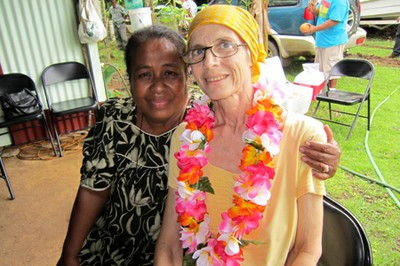
“Let’s go local” Lois Englberger interview

LoisEngleberger

I don’t know whether Lois Englberger actually saw the interview that has just been published in Farming Matters, the renamed LEISA magazine. In a way, it doesn’t matter. The result is both a very personal history of Lois’ involvement with the Island Food Community of Pohnpei and a useful and informative guide not only to what works and what doesn’t but also to the kind of thinking needed. Here’s a tiny extract:

What didn’t work?

Because the FSM is traditionally an oral society we found that written documents, like newsletters, worked for some groups – leaders especially – but not for the community. Furthermore, we found that people were reticent when simply advised to plant more local foods. Cooking classes and recipes thus proved to be a very effective means of motivating people, and inspiring them to want to grow local food. In general, however, perceptions are very difficult to change. Although community members were told on a number of occasions that their unhealthy lifestyles were to blame for their failing health it seemed like the message didn’t really sink in. People close their ears to messages, so we learnt that repetition is important.

You can read the whole thing here and download the entire special issue on Regional Food Systems. And a special tip of the hat to our friends Jess Fanzo and Danny Hunter, who helped compile the special issue, and Teresa Borelli, who wrote up the interview with Lois.

Nibbles: Graphic agriculture, Nutrition, Climate change, Giant pumpkins, Economic development, Roman millet, Fairtrade, Jojoba and guayule