Genetic erosion gets worse

We get hours of amusement from poking holes in the many ways in which statements about the loss of 75% of agricultural biodiversity are likely to be less than accurate any way you slice them. But here’s an entirely new wrinkle. A friend recently wrote asking for some moral support for a grant proposal, which included a forceful justificatory phrase to the effect that 75% of agricultural diversity has been lost since 1990. 1

I twitted him gently about this, something snitty to the effect of “interesting statistic, have you got a source for that?” And blow me down if he didn’t. Not just any old source either. A communication from the [European] Commission to the European Parliament, the Council, the Economic and Social Committee and the Committee of the Regions, no less, entitled Our life insurance, our natural capital: an EU biodiversity strategy to 2020, aka COM(2011) 244 final.

And there it is, on page 1 of the Introduction.

[A]ccording to the FAO … 75% of the genetic diversity of agricultural crops has been lost worldwide since 1990.

I wonder where they got that figure? Not from FAO. The same year is present in at least one other language, so if it is a typo it entered the proceedings early. But honestly, did nobody find it just the least little bit odd? Then again, my friend didn’t either. I suppose we’re the odd ones.
Heat vs Water: the death match

Although we write about the impact of climate change on agricultural biodiversity, and the need for biodiversity in plans to adapt agriculture to climate change, this is not a climate change blog. If it were, I’d be writing at length about some strange stuff going down.

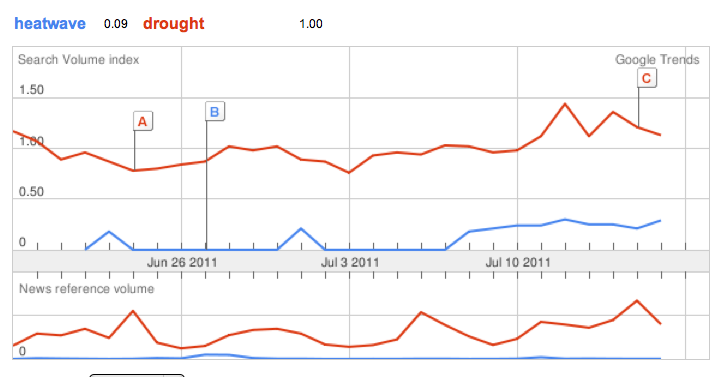
Drought versus heatwave past 30 days

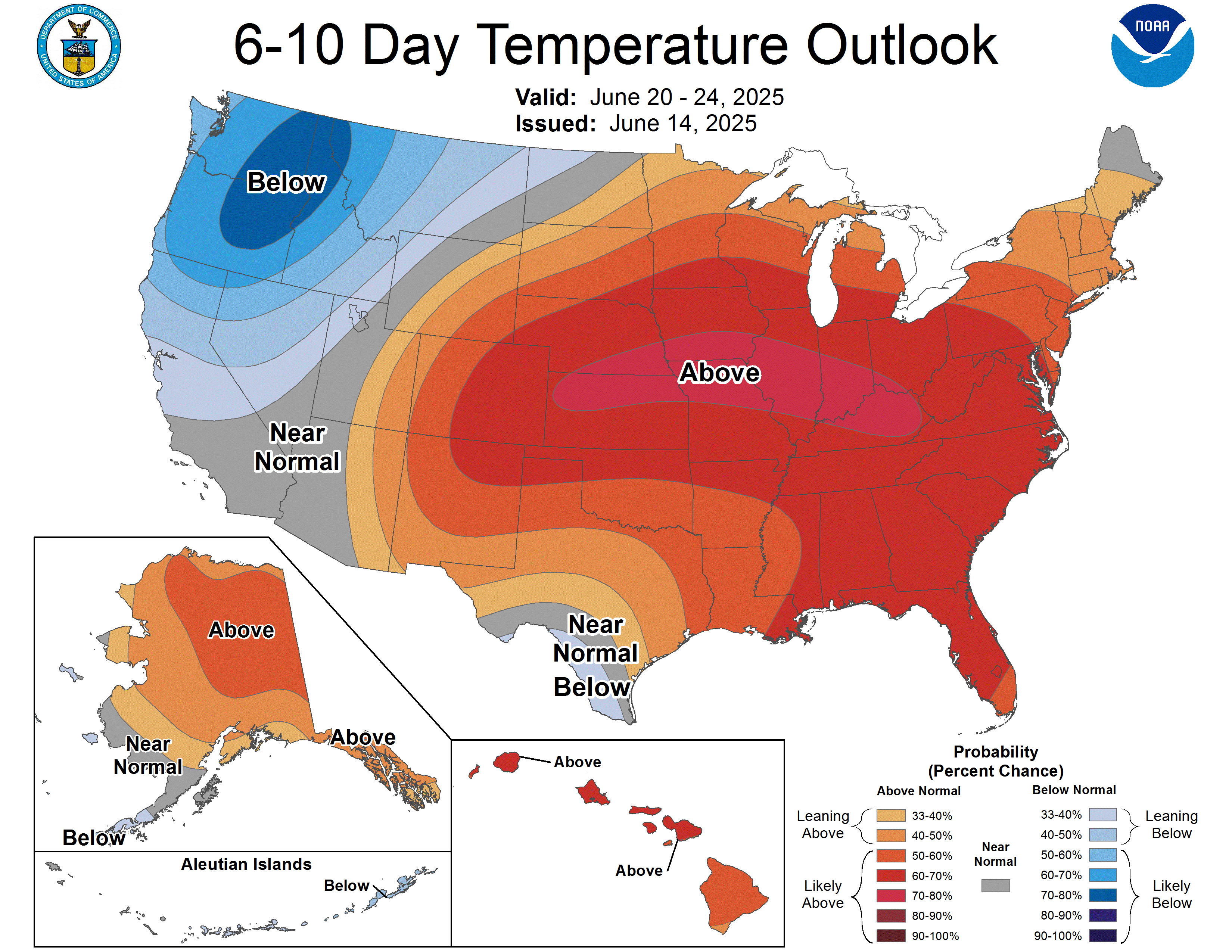
The US is facing both a drought and a heatwave. The drought is getting a lot of attention, the heatwave, not so much. The thing is, as Michael J. Roberts points out, the drought isn’t as bad as it looks, partly because there is irrigation where it seems worst, and partly because “standard drought indicators don’t predict crop outcomes especially well”.

The heat may be far more important for crop yields especially coming, as it is, at a sensitive time, as the corn (maize) begins to blossom.

Roberts, an economist, is thus “much more bullish” about corn prices. That is, he expects them to go up, not because of speculation but because the supply is likely to fall short.

All of which raises some questions.

Is there a reliable heat danger index or forecasting tool for any crop?
Is anyone in the US breeding maize to withstand higher extremes of temperature?
How about switching to something more heat tolerant, like sorghum or a millet?
Especially for biofuel, if they really think that’s a good use for maize?
If they did switch, would people eat it?

I don’t want to belabour the point, but all the things we say people in Africa ought to think about doing, people in the US might want to consider too.

Nibbles: Cuba, India, Kansas, Amazonia, Rice, Fonio, Rare breed

Food Vendor films

IRIN, “a service of the UN Office for the Coordination of Humanitarian Affairs,” has launched a new series of short films.

The Food Vendor tells the story of staple foods in different countries around the world and sheds light on the problems faced by the world’s poor in light of rising food prices.

I watched the first one, on lentils in Nepal, and found it rather tasty, so I thought I would share it here. Alas, unless I’m missing a trick, that does not seem possible. I can download it alright, and share the link on other sites, but I cannot seem to embed the movie here. Too bad, I suppose.

And if you’re into artisanal food processing, just look at the way the woman carefully wet-grinds the lentils at the start of the film.

Nibbles: Food Deserts, Garlics, Communication, Bee breeding, Millets, Sweet potatoes, Visualizing herbaria, Medieval beer