- The importance of multi-purpose crops in Africa.
- The importance of multi-purpose goats, everywhere.
- Target reader reviews The Complete Idiot’s Guide to Heirloom Vegetables.
- Tamarind charcoal loses out to tamarind drink, Malawian villagers rejoice.
- Has intellectual piracy been with us since humans first became engaged in agricultural production? AoB blog asks the tough ones.
- Land-use intensity and Ecological Engineering – Assessment Tools for risks and Opportunities in irrigated rice based production systems launched. Glad they have an acronym.
- Microbe diversity matters too.
- OK, so nobody nominated us, but the semi-finalists at the 3QD science writing competition have been announced.
Where will the protein come from?
As everyone and her dog ventures an opinion of how much more food will be needed to properly feed how many more mouths by when, it is worth bearing in mind an idea that was a little bit hidden in Oliver Morton’s wonderful introduction to The Anthropocene, in The Economist a couple of weeks ago.
Although nitrogen fixation is not just a gift of life — it has been estimated that 100m people were killed by explosives made with industrially fixed nitrogen in the 20th century’s wars — its net effect has been to allow a huge growth in population. About 40% of the nitrogen in the protein that humans eat today got into that food by way of artificial fertiliser. There would be nowhere near as many people doing all sorts of other things to the planet if humans had not sped the nitrogen cycle up.
There’s a chart, too.
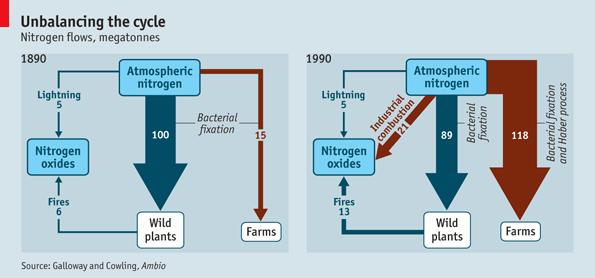
Industrial nitrogen fixation does not, of course, require oil, but it does require lots of cleaner, cheaper energy, and there’s still no sign of that just around the corner.
Nibbles: Wheat disease, Dried vegetables, Gates spending in Africa, Canadian spending in India, Ethiopian wheat
- Wheat disease understood; sequence of leaf blotch fungus.
- Wheat disease conquered? “Super varieties” resistant to UG99 and yield 15% more. What could go wrong?
- Zambian farmers urged to dry vegetables for fun and profit (and better nutrition).
- Gates Foundations has spent US$1.7 billion on agriculture in Africa, so far.
- Swaminathan Foundation scores Canadian support for research on agriculture, poverty and nutrition. h/t PAR.
- Bioversity Seeds for Needs distributes preselected genebank wheat varieties to Ethiopian women farmers to adapt to climate change.
Breathing life into research
We who are stuck at headquarters, trying to inject a little life into our organisation’s activities, envy the scientists whose activities they are. What adventures they must have! What people they must meet, whose lives they touch and whose lives touch them! What material they must be storing for their anecdotage! What stories they could tell!
Except that they can’t. Because they are researchers. Doing research.
 It’s not that they don’t have the skills. Some of them can tell great stories over a Tusker, baridi sana, and many take wonderful photos and even videos. It’s that they don’t have time when they’re in the field, precisely because they are doing the activities we are trying so hard to breathe life into. And when they get back here, there’s more work to be done. But what if there’s someone tagging along whose de facto job is not to do the stuff but to record the stuff others are doing? You get a rich set of impressions that can really help to bring a project to life, often unintentionally.
Bioversity’s recent field visit to some of its nutrition research in Kenya benefitted from just such a presence, resulting in a fascinating report from “the unofficial video guy”. What’s so nice about it is the immediacy of the impressions. The people were welcoming and gracious. There’s something called “African rice” that is “split and processed” maize. Muù, a “strange fruit that tasted like bittersweet marzipan”. The bus breaking down across both lanes of the road home, giving everyone a chance to learn a grain grinding song, all caught on video.
This is not a plea for jolly outings. It is a plea to recognize two things. That much of the time researchers have more important things to do than think about how to gussy up their work for wider consumption. And that someone whose job it is to do such gussying may stand a better chance of bringing a body of work to life.
Nibbles: Food security, Food carts, Cotton, Ritual, C4 C3 CC, American Indian diets, Community genebanks in India, Fowler, Dark earth soil, Domestication
- German donor examines food and security, notes “the fast loss of biodiversity”.
- Food carts are successful oases in at least one food “desert”.
- Yesterday’s Botany Photo of the Day was American cotton.
- Good news, everyone: “Hardcore farmers prefer lowkey rituals.” Obviously the memo didn’t reach the children of the corn.
- Photosynthesis and climate change: it’s complicated.
- Native Americans try to reclaim control of their foodways. And their waists.
- “…every district should have a community-controlled seed centre with a gene bank for traditional seeds.” Of course it should. “The local available seed diversity needs to be protected and conserved at any cost.” Of course it must.
- “Right now, all over the world, projects are underway to store seeds…“
- Dark earths not just in Amazon, Africa too.
- Presentation on IFAD project on cultivating wild aromatic etc. species for money in Morocco.