Aeroponic potato seeds in Kenya

A fascinating article on the Voice of America website tells us that Kenyan scientists, with colleagues at the International Potato Center (CIP), have developed a technique for growing potatoes plants in air (with water and nutrients) and then distributing the resulting plants to farmers, who report yield increases of 4 to 5 times. 1 The article dates back to June 2010, but CIP just shared it with its Facebook friends, and that gives me the chance to say I don’t fully understand:

Seeds are germinated in the laboratory. The seedlings are then fixed into holes cut out of Styrofoam sheets. And then after the seeds are developed further, they are harvested and distributed to farmers.

Talk about “seeds” and “germination” makes me think they’re talking about true potato seed, which has been the next big thing in potatoes for as long as I can remember. But if that were true, I would have expected the article to make more of it. And what will it do for potato diversity in Kenya? I have no idea what the market-leading cultivars are or the extent of concentration; how many varieties will the researchers make available?
Is lack of sex really the problem for grapes?

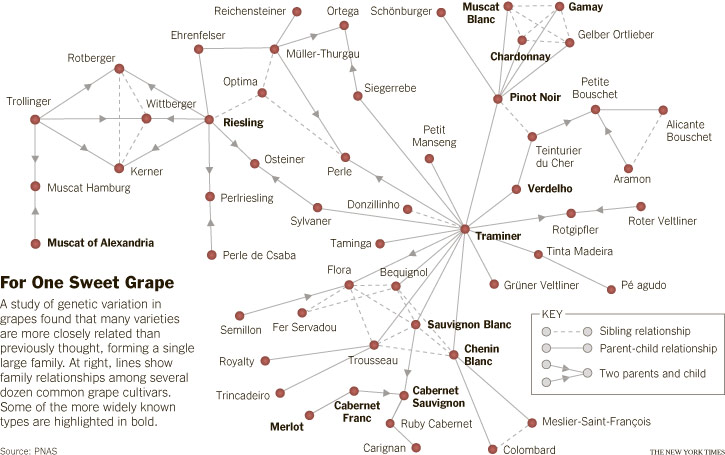
There’s a very interesting article in the New York times reporting on a major investigation of the molecular diversity among grape cultivars.

The report is based on a big paper in PNAS, which I confess I have not had time to read carefully. That said, a few things about the NYT’s coverage confuse me. One is the whole depiction of “relatedness”.

Thus merlot is intimately related to cabernet franc, which is a parent of cabernet sauvignon, whose other parent is sauvignon blanc, the daughter of traminer, which is also a progenitor of pinot noir, a parent of chardonnay.

This web of interrelatedness is evidence that the grape has undergone very little breeding since it was first domesticated, Dr. Myles and his co-authors report in the Proceedings of the National Academy of Sciences.

So how did those varieties arise? Maybe breeding means only “deliberate crosses made by a breeder”. Are they saying that the molecular data support the breeding records? Or are actual breeding records, especially for the older and better-known varieties, too sketchy to know? There’s more too, but I’m going to have to find time to read the PNAS paper properly. Or maybe you already have, in which case, feel free to comment.

Selection of pulses for better nutrition

Hot on the heels of the UK’s call for “advances in nutrition and related sciences” to be put to work to improve the efficiency of animal production, comes a paper surveying the protein content and composition of “107 cultivars of important grain legume species”. The primary motivation seems to have been to improve feed quality for pigs, especially for the organic sector which is not supposed to feed supplementary amino acids to make up the shortfall. From the abstract, it seems that feed quality could indeed be enhanced by selecting specific varieties. And a more diverse diet, to supply the amino acids in which most pulses are low?