- Sustainability and wildcrafting; not overharvesting frankincense, or anything else.
- Another take on cattle domestication.
- And the spread of ancient grains.
- Everyone wants to take credit for the peanut genome …
- Learn why that’s a good thing courtesy of the Generation Challenge Programme.
- A new website to ensure that seed aid after a disaster is not itself a disaster.
- Ah, the joys of walking the policy tightrope: Higher food prices are good for the poor … in the long run.
- Nice piece from the data nerds at 538: Can Evolution Outrace Climate Change?
- On a related note, can Bioversity outrace the IPCC?
- “The US Agency for International Development (USAID) today announced the launch of its US$100-million Global Development Lab in Washington DC — a move that will elevate the role of science at the agency.” WCPGW?
Agricultural biodiversity where you least expect it
Continuing our in-depth treatment of The Economist’s (unwitting?) coverage of agricultural biodiversity, two items in the most recent issue. First, consider this photo:
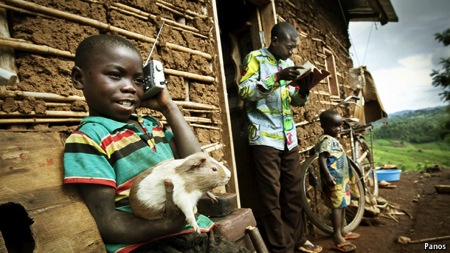
It’s from an article on the BBC World Service, and clearly shows the value of a radio in Africa. But what’s that the listener is holding? Could it be a cavy? I rather think it could, and of course one wouldn’t expect The Economist to mention its origins in the Andes. We, however, still want to know when they arrived, how they got there, and whether they are proving the “indispensable” option they were thought to be.
Then there’s this little table, from an article on price fixing and cartels.
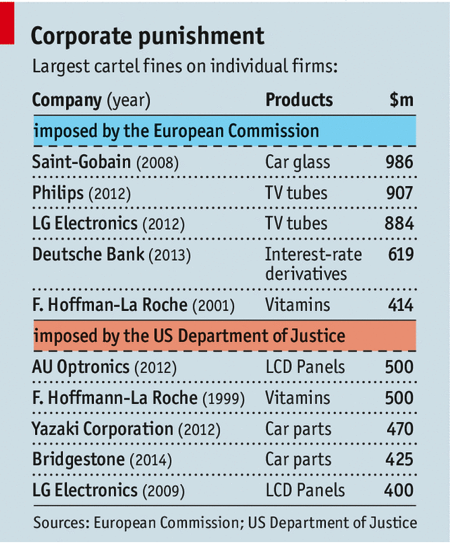
See those innocuous little entries for F. Hoffman-La Roche, labelled Vitamins? Those reflect decisions more than a decade ago by the US and the EU to fine not just Hoffman but a bunch of other pharmaceutical companies for fixing the price of vitamin A supplements, proof enough of the economic value of treating vitamin A deficiency as a simple medical problem requiring a simple (and expensive) medical fix. And most of the time, synthetic supplements aren’t even that useful to the children who get them. How else might you improve vitamin A levels? Well, you could try promoting a more diverse diet. But where’s the profit in that?
p.s. I was slightly saddened to see that while Hoffman remains joint number 1 in the EU, it has slipped to a poor 5th in the US. So I ran the numbers through an inflation indexer, which brings the $500 million up to $705 million in today’s dollars, which at least bumps them up a place.
Nibbles: Agavins, Women in Ag, Teacup shattered, Quinoa, Rice, PGR course, Seeds for Africa, Tomato, Global cookbook, Cover crops, Sheep
- Tequila plant is possible sweetener for diabetics. Talk about a waste of raw material.
- Would you Adam and Eve it? Women do not own 2% of the land. What next for the killer factcheck?
- In related news, teacup pigs are a fraud.
- Quinoa to feed the world, in Spanish.
- The rice warrior! Isn’t that overegging the pudding just a smidgen?
- Learn about plant genetic resources and seeds at Wageningen University.
- African Agriculture Technology Foundation “to avail adequate quality seeds at the right time and affordable price”. You might think some of the folks at the AATF should avail themselves of Wageningen’s course.
- Tough, flavoursome and bug resistant. Not Richard Markham, but a tomato bred specially for the Solomon Islands he’s talking about.
- Kew’s new global kitchen cookbook narrowly avoids being crushed by bandwagon trundling by.
- Cover crops are even more valuable than previously thought shock.
- Indigenous sheep breeds even more valuable than previously thought shock.
Who pays for banana research?
A little squib in The Economist a week ago caught my eye.
The banana world was split over the merits of a merger between Chiquita and Fyffes that will create the fruit’s biggest distributor. Antitrust regulators will look closely at the deal, especially in Europe, which imposed stiff tariffs on Latin American bananas until 2012. But some say a merger makes sense, given the current squeeze in profit margins as a result of the costs of tackling potentially disastrous diseases in banana crops.
There’s a graph too, of banana exports by country. But that’s besides the point. The point, as I see it, is in that final sentence. I’d love to know how much Fyffes and Chiquita (and Dole and Uncle Tom Cobley and all) are contributing to research to combat the spread of Tropical Race 4 of Fusarium wilt. Indeed, some would say that the industry is the problem.
Nibbles: Clone this, Colombian practices, Nepal biodiversity management, Maasai film-makers
- Hey, let’s clone a plant!
- Agricultural biodiversity in Colombia. Settle down in the back, this is about sustainable intensification.
- They’re at it in Nepal too, using community biodiversity management to, er, manage community biodiversity. Here’s how they restored the Rupa lake watershed.
- Now all the Nepalese need is for some award-winning Masaai film-makers to share their expertise.