A disappointing International Year of Biodiversity, so far

The Pimm Group uses Google Trends to track interest in biodiversity in this, the International Year of Biodiversity, and finds itself less than impressed. No change in overall interest since September 2009.

Of course, this evaluation depends on our measure of success. Perhaps it’s too soon to say the IYOB has “failed.” There are many ways to measure success and I have just chosen one that is readily available. Certainly the additional publicity for biodiversity is better than none at all.

Caution duly noted.

I confess, I don’t have the courage to do the same for agricultural biodiversity, in part because there is no one simple term that might capture interest. Myself, I have another metric. It is captured in this paragraph from a Press Release issued yesterday by the Convention on Biological Diversity, which some people seem to think is somehow responsible for the conservation of biodiversity.

Ahmed Djoghlaf, Executive Secretary of the Convention on Biological Diversity, said the General Assembly meeting [of the United Nations] would provide an important boost for the Convention’s upcoming 10th meeting of the Conference of the Parties (COP-10) in Nagoya, Japan, next month. COP-10, he said, is expected to adopt a new strategic plan for 2011-2020, including a 2020 biodiversity target and a 2050 biodiversity vision.

Missed your target? Find a new one! Miss that? Show vision! Handbaskets, this way please, your pitchforks await.
Nibbles: Ireland, Plumpy’nut, Saola, Food heritage protection, Millet, Wild veggies, Brassica, UNMDGs, Ukraine

  • Celebrating the Irish Seed Savers Association celebrations. We had wanted to be there…
  • CAS-IP on how to “break” the Plumpy’nut patent.
  • Cattle wild relative seen for first time in 10 years. Well, by scientists anyway.
  • “Initiatives that merely codify cultural products without taking the social-organizational context into account risk becoming little more than ‘museums of production.'” Ouch.
  • Millet domestication pushed back in time.
  • Antioxidant properties of traditional wild Iberian leafy greens. Yes, I know, this medicalizes nutrition, but I thought it was interesting that these wild species are still used.
  • “…a trait of the diploid species, which apparently looks undesirable, might in fact be highly valuable for the improvement of amphidiploids…”
  • “Food? We don’t need no stinkin’ food,” say UN negotiators.
  • UK ambassador’s observations on agriculture in Ukraine. Love the contrast between 100 ha fields of sunflowers and the table groaning under home-grown fruit and vegetables.
  • In other news, the UK’s ambassador to Ukraine has a blog. And so do a number of others. Sorely tempted to subscribe to their RSS.

More on the great buckwheat panic of 2010

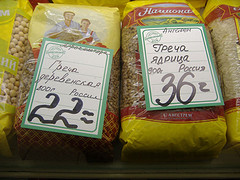
Buckwheat packets
Stop press: Luigi remembered a photo he had taken 18 months ago.
A month or so after The Guardian first told us about the buckwheat crisis in Russia, Radio Free Europe does a big number on the subject. There’s lots of good stuff in there about buckwheat and the part it plays in national diets and psyches. On the nutrition front, one of the things I remember reading is that although buckwheat is low in protein that protein contains a near-perfect balance of amino acids essential to humans. Unlike most true cereals, it is particularly high in lysine. That balance means that our bodies can make good use of all the nutrition buckwheat supplies in one meal, unlike needing, say, a pulse to make up for cereals’ lack of lysine. And that, as I recall, is why buckwheat is so satisfying and keeps hunger at bay for so long.

What really caught my eye in the article was this:

“It is believed that it was brought to Russia and further to Eastern Europe by Mongol Tatar invaders who first invaded China and knew what buckwheat was. In the Czech Republic for instance, it is called ‘pohanka’ — which means pagan or pagan’s food.”

The English name is supposedly derived from beech, whose seeds buckwheat’s resemble in miniature. But in Italian? Grano Saraceno. How about other languages?

Nibbles: Tokyo, Biofuels, Genebank conference, Forestry, Pinus, Hunger, Moringa