- Enough already with the popped sorghum.
- “In short, “heirloom” fruit is life. And life is beautiful.” In long, here.
- Get to know a breadfruit. Ma’afala is special.
- Slow Food anticipates October’s food fest.
- “Agricultural production systems need to be assessed on much more than just crops and crop yields.” Can I get a ramen?
Swedes get a load of Pavlovsk
Dagens Nyheter, A Swedish newspaper, ran a big spread on the Pavlovsk Experiment Station on 5 September. We asked our own favourite Swede to do us a precis. Thanks Britta.
The article is quite basic — after all the audience is the general Swedish public. It is nevertheless well written and presents several arguments for why Pavlovsk should be saved for the future, as well as an overview of the station’s history and past, and why it is now under threat of destruction.
Dagens Nyheter (DN, “Today’s News”) obviously finds the topic interesting as it has sent two people to the Vavilov Institute and Pavlovsk to do their own research and also to join The Committee from Moscow, which visited Pavlovsk on direct Presidential request to investigate if it would be possible to move the the material elsewhere.
Karin Bojs, the author, who is a science journalist, says that there are two big reasons why biologists, agronomists and other individuals are objecting to the plans to turn the area into luxury housing complexes, and now speak out to save Pavlovsk. One reason is the biodiversity that the station houses, the other is the science history that surrounds Russion genebank, including Pavlovsk.
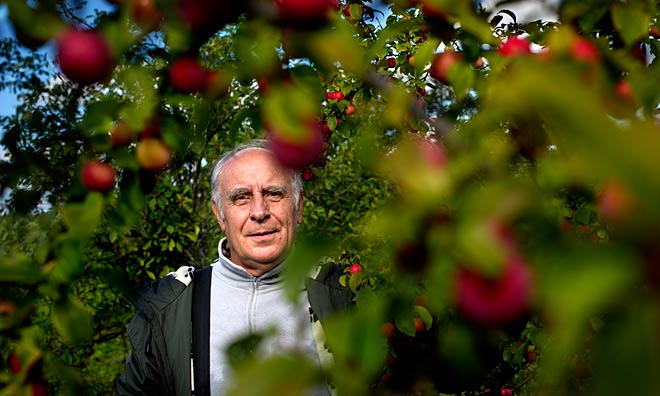
The reporters met with Sergej Alexanian at Vavilov headquarters and with Leonid Burmistrov, who is the head of research at Pavlovsk. Burmistrov says that some of the current project aims are to find genes to solve the biggest problems: resistance to fungal diseases and cold tolerance. Moreover, of course the berries and the fruit need to taste good.
The background and history of Nikolay Vavilov and the Institute that bears his name are described; Vavilov’s travels around the world, his work on genetics and centres of origin, including the story of how scientists starved to death during the siege of Leningrad while sitting in front of bags filled with oats, peas and beans, saving this material and treasuring it beyond their own lives.
Karin Bojs says that everyone seems to agree that the Pavlovsk station houses extremely valuable genetic diversity. The question is whether the material can safely be moved, or not. Staff of the Vavilov institute claim it would be impossible, and they are supported in their claims by international organisations like Bioversity International and the Global Crop Diversity Trust. Sergej Alexanian believes that now that the members of Medvedev’s committee have seen with their own eyes, they too would agree on the difficulties and understand that moving all those trees is not an option.
The bottom line is that there is hope that the Vavilov institute, which has survived the Stalin terror and the siege of Leningrad, has a fair chance of making it through also this chapter of Russian history.
Background:
- Dec 2009 – Russian authorities decide to transfer 90 hectares of farmland managed by the Vavilov Institute to a trust for housing development.
- [April 2010 Agricultural Biodiversity Weblog draws attention to the problem. Ed.]
- June 2010 – Cary Fowler visits Pavlovsk and raises media interest. New Scientist article. Thousands of internet signatures for the cause.
- 11 August 2010 – A court in Moscow rules that the matter has been handled correctly and that the building trust has full rights to the land. Pavlovsk staff can no longer weed the grounds, replant or chase away fruit thieves.
- 12 August 2010 – The save Pavlovsk campaign intensifies and is also run on Twitter. More than 30,000 individuals have signed protest letters.
- 13 August – President Medvedev informs that he will look into the matter.
- 31 August – A committe with representatives from different stakeholders and institutes travels to Pavlovsk to investigate if it would be possible to move the plants.
- 9 September – Russian Accounts Chamber says it will visit Pavlovsk on 15 September. Ed.
Plant Genetic Resources Newsletter: an update
We took advantage of a recent meeting to ask Theo van Hintum, one of the people behind efforts to breathe new life into Plant Genetic Resources Newsletter about the patient’s prognosis. He said that, encouraged by the support from the community, Robert Koebner, the other guy behind the initiative, and he had tried several donors, asking for $25,000 a year for three years. Answers ranged from “no” to no answer yet, and perhaps unsurprisingly, Theo and Robert are beginning to be a bit fed up. The demand is there; what is missing is a little financial support.
We discussed three possible solutions, all of which could involve you, our readers.
Maybe $25,000 a year for three years is too little. Instead of going to the usual suspects, who put PGRN in intensive care in the first place, what if a proposal went to an individual or foundation interested in agriculture, capacity building, education and empowerment? Might they entertain a grant of $100,000 a year for three years, which would enable PGRN to hire a dedicated administrator? Of course, none of us know of such a foundation or individual. Do you?
Someone suggested Kickstarter as a source of investors. That remains a possibility; does anyone have any experience with it? Alternatively, what about kickstarting PGRN ourselves. Theo says they need $25000 a year for three years. That’s only $1000 each for 75 of us who might be able to afford it, and less if more. I will if you will.
In the end PGRN must be self-supporting and not reliant on grants and whims. Would something like Google Adwords offer a reasonable income stream? It could be worth a try, in conjunction with either of the two pump-priming investments outlined above. If all the back-issues could be made available on one effective website, I reckon there’s a good chance that there would be enough traffic … but what do I know?
Theo said that he and Robert want to go ahead only if they can secure three years of funding, “to see whether it can be a success, and then maybe the proper organizations to handle the newsletter will want it back”.
“How do you define success?”
“Visitors, submissions, feedback; the donors will judge.”
I disagree. Donors have been known to reverse their judgments. The best measure of success will be if PGRN is sustainably and independently supported. Can we do that?
Considering crop wild relatives anew
Our friend Andy Jarvis is suffering the pains of the Villa Bellagio on scuzzy Lake Como as his contribution to a rethinking of the role of crop wild relatives in adapting to climate change. You can read his impressions (and see the presentation he unleashed on an unsuspecting audience) at his team’s blog.
Bottom lines:
- Crop wild relatives are increasingly important.
- Crop wild relatives are increasingly usable, and hence increasingly in demand.
- Crop wild relatives are increasingly threatened.
Nibbles: Heirloom Auction, Flatulence, Trade, Swaziland, Turkey genome, Sorghum
- The Art of Farming: How to fund heirloom veggies, NYC black-tie style.
- Oregano to save the planet from bovine emissions.
- Kew blogs “strange articles of trade“, all examples of agricultural biodiversity. How about them worms?
- Swazi farmer breaks with grazing tradition to adapt to climate change.
- Another day, another DNA “sequence”. The turkey.
- Overselling popped sorghum? On YouTube.