- This is not a Trojan Horse. Madcap agrobiodiversity antics in Abruzzo, Italy. No, I don’t get it either.
- Farmers are willing to forego some extra income or yield to obtain a more stable and environmentally adaptable crop variety. They are? Someone tell the Nabobs.
- Yucca moths and yuccas; an astonishing evolutionary story.
- Bee research gets USD1.5 million for a big database. Hope it helps.
- “GM bananas could cut blindness, anaemia in East Africa.” Because nothing else will?
- Coffee, a history.
I’m just wild about saffron
We’ve Nibbled the crocusbank — a global collection of Crocus sativus funded by the EU and hosted in Cuenca, Spain — before. So it is good to be able to bring you an update from José Antonio Fernández, Crocusbank Coordinator. 1
There’s a lot of fascinating information in the article. The genebank itself currently contains 454 accessions, 197 of them saffron crocus from 15 different countries and the rest wild relatives from more than 50 crocus species. And I had no idea that there were quite so many Protected Denominations of Origin for saffron; 7 granted and at least 5 more on the way. Which is a puzzle …
C. sativus is a sterile triploid. That is going to make using the assembled diversity to breed a little more difficult, and raises definite questions about how much diversity is represented in the collection, because the plant reproduces asexually and is generally propagated by replanting the little offsets that form at the base of the corm. Asexual reproduction of this sort does not usually give rise to much genetic diversity, and so it has proved. Back in March we briefly Nibbled “Many saffron clones identical shock,” a preliminary report on the work of Professor Pat Heslop-Harrison at Leicester University in England.
Saffron is all hand-harvested, hand processed and dried in different ways, which is why saffron from the major growing areas of Spain, Italy, Greece, Iran or Kashmir all have different qualities and characteristics.
What we’ve been looking at is the genetic diversity within the different types of saffron that are grown and we have found that many of the clones grown worldwide are genetically identical. It’s only the processing that makes the product different.
That and, perhaps, terroir. So, does the genebank need to keep all those genetically identical accessions of saffron crocus, or might it be sufficient to preserve only the knowledge of how to harvest, process and dry the saffron in all those different ways? How would you do that anyway?
There are, of course, some genetically diverse accessions, which are coming under closer scrutiny to discover “their special characteristics, and why they’ve dropped out of production in many of the world’s saffron producing areas”.
There are other mysteries, too, such as the parents of the saffron crocus. One is believed to be C. cartwrightianus, which has similar large stigmas, but the other remains unknown. If it can be identified, it might be possible to recreate the saffron crocus from its wild ancestors, as has been done for bread wheat, which could offer a whole new range of diversity to saffron growers.
Nibbles: Vancouver Island, Organic breeding, Evolution, Roots, Coffee, ABS, Donkey domestication, Domestication, Yam
- Nancy Turner, great food anthropologist, deconstructs dinner on air.
- Breeding for resilience: a strategy for organic and low-input farming systems? Eucarpia conference in Paris in December. Love the ?
- Ford Denison on evolution in reverse: crops that become weeds.
- Nature on evolution in forward: crop breeders look at roots.
- “Shade-coffee farms support native bees that maintain genetic diversity in tropical forests.” Good to know.
- Want to know about Access & Benefit Sharing negotiations? We thought so.
- Ancient people moved their asses.
- Selection during domestication differs from selection during diversification. For the ass too?
- Expect to see Dioscorea hispida appear in spam emails very soon.
- And today’s answer to malnutrition is a blue-grin alga from Lake Chad. Kidding apart, it’s an interesting story.
Not the world’s first red apple
Of course it is tiresome for you, Dear Reader, to have to wade through me correcting the mainstream media, but when duty calls I am powerless to refuse.
The BBC was all breathless a couple of days ago with news of a new apple variety on sale in England that has red flesh. Oooh. Ah. It’s like a tomato! And a large chunk of the little report was taken up by the breeder explaining that no GM was involved, just 15 years of crosses and selection and 20,000 seedlings rejected in favour of three that made the grade as worthwhile varieties. 2
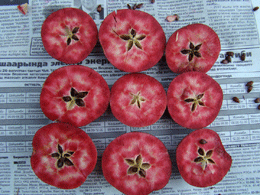 What really struck me, though, was not the utter imbecility of the reporter, or even what the bloody apple looked like. It was the fact that nobody had seemed to ask whether this was in fact the world’s first red-fleshed apple, as reported by FOXNews and The Daily Mail. 3 It isn’t that there are some wild red-fleshed apples out there, and this is the first one that’s good to eat. There have even been a fair number of commercial, good to eat, red-fleshed varieties. It’s just that reporters swallow rubbish so uncomplainingly. Google is your friend.
The photo (by Kayirkul Shalpykov, Bioresource, and lifted from the Living on Earth website) is of “Niedzwetzky apples (malus niedzwetzkyana), famous for their red flesh. There are 111 known trees left in the world”. Not sure I believe that either.
Untangling an agave story
Odd things happen when you’re utterly immersed (at least some of the time) in agricultural biodiversity, and so are your friends. You see a harmless enough story on a trade magazine’s website, which says that a century plant — which it specifies is Agave abrupta — at Royal Botanic Gardens Kew is flowering. Kew Director Stephen Hopper is quoted as saying that, being as how this is the International Year of Biodiversity, the “specimen is a great example of the beauty, joy and economic use that we get from the plants we share our planet with.”
Hort Week manages to garble Kew’s Press Release and blog post to tell us all about “the species”.
Native to tropical America, the century plant was introduced to Padua Botanical Garden in Italy – the world’s first botanical garden – in 1561 and is now widely cultivated throughout the world.
The species is now naturalised in the driest parts of southern Europe, and is often used for fencing in Mexico and Central America, as it is impermeable to both cattle and people once established due to its size and needle-sharp spines.
It was introduced to Spain in the 1940s for the production of sisal for rope, but subsided due to the arrival of nylon and synthetic ropes. In addition, the fermented juice of the agave plant is used to make the drink mescal.
So you send a link to a couple of chums who you know are interested in this sort of thing, reject the idea of writing about it on the blog, and think no more about it. Back comes one chum. “Agave abrupta doesn’t ring a bell for me.”
There are, it must be said, a large number of Agaves, maybe “293 recognized species.” Kew would know though, right?
Maybe not. I checked a couple of taxonomy databases, and A. abrupta didn’t ring any bells for them either. One site suggested that it was a synonym of Agave americana ssp. americana var. expansa (Jacobi) Gentry, which fits with the fact that Howard Scott Gentry wrote a famous monograph on Agaves, published in 1982; he presumably reclassified A. abrupta Trel. 1901, but Kew has chosen not to follow Gentry. I suppose that’s their prerogative. As chum 2 observed, “they’re a complex lot, and difficult to keep herbarium specimens”.
On to uses. Kew says it was used as fencing and grown for sisal. Not, then, “mescal”. Nor tequila, which was where my ignorant thoughts went. Ah, but … Chum 1 claims that the meteoric rise in tequila’s popularity has resulted in “some Agave-starved tequila companies … resorting to buying off old henequen plantations in the Yucatan peninsula to use the fiber-producing plants in their distilleries in order to keep the ‘100% Agave’ label (and the associated premium price) on their product.” Henequen is A. fourcroydes, grown for its fibre, which is almost identical to sisal. Presumably that breaks the law about “true” tequila, but as Chum 2 pointed out, the Geographical Indication that protects tequila is neither socioeconomically nor ecologically sustainable.
That said, aside from possibly adulterating tequila, henequen is also used to make its very own licor de henequen. Whether this is a traditional drink, as some claim, or a recent invention in response to henequen’s eclipse by nylon and other synthetic rope fibres, I’m unwilling to say.
All that information flowed from one rather silly article and press release, if you know the right people. Which we do.
Flickr photo of henequen fibre by Just Another Shot, used under a Creative Commons License.
And please note, the astounding Euro-centricity of the claim that Padua was “the world’s first botanic garden” has not passed unnoticed. Maybe another time.