- Mat Kinase discover best smut ever.
- World Bank embraces failure. Now there’s an idea. More here.
- I really don’t have time today for Food sovereignty in Africa: The people’s alternative. Anyone care to interpret?
- Kremlin now tweeting in English. No word yet on Pavlovsk.
- Kenya invests in new market facilities … to improve exports of food.
- Rachel Laudan considers hunger — and celebrates David Livingstone.
- Speaking of which, wanna understand food price spikes? Me too.
Nibbles: Trojan Horse? Farmer preferences, Yucca moths, Bees, GM bananas, Coffee
- This is not a Trojan Horse. Madcap agrobiodiversity antics in Abruzzo, Italy. No, I don’t get it either.
- Farmers are willing to forego some extra income or yield to obtain a more stable and environmentally adaptable crop variety. They are? Someone tell the Nabobs.
- Yucca moths and yuccas; an astonishing evolutionary story.
- Bee research gets USD1.5 million for a big database. Hope it helps.
- “GM bananas could cut blindness, anaemia in East Africa.” Because nothing else will?
- Coffee, a history.
I’m just wild about saffron
We’ve Nibbled the crocusbank — a global collection of Crocus sativus funded by the EU and hosted in Cuenca, Spain — before. So it is good to be able to bring you an update from José Antonio Fernández, Crocusbank Coordinator. 1
There’s a lot of fascinating information in the article. The genebank itself currently contains 454 accessions, 197 of them saffron crocus from 15 different countries and the rest wild relatives from more than 50 crocus species. And I had no idea that there were quite so many Protected Denominations of Origin for saffron; 7 granted and at least 5 more on the way. Which is a puzzle …
C. sativus is a sterile triploid. That is going to make using the assembled diversity to breed a little more difficult, and raises definite questions about how much diversity is represented in the collection, because the plant reproduces asexually and is generally propagated by replanting the little offsets that form at the base of the corm. Asexual reproduction of this sort does not usually give rise to much genetic diversity, and so it has proved. Back in March we briefly Nibbled “Many saffron clones identical shock,” a preliminary report on the work of Professor Pat Heslop-Harrison at Leicester University in England.
Saffron is all hand-harvested, hand processed and dried in different ways, which is why saffron from the major growing areas of Spain, Italy, Greece, Iran or Kashmir all have different qualities and characteristics.
What we’ve been looking at is the genetic diversity within the different types of saffron that are grown and we have found that many of the clones grown worldwide are genetically identical. It’s only the processing that makes the product different.
That and, perhaps, terroir. So, does the genebank need to keep all those genetically identical accessions of saffron crocus, or might it be sufficient to preserve only the knowledge of how to harvest, process and dry the saffron in all those different ways? How would you do that anyway?
There are, of course, some genetically diverse accessions, which are coming under closer scrutiny to discover “their special characteristics, and why they’ve dropped out of production in many of the world’s saffron producing areas”.
There are other mysteries, too, such as the parents of the saffron crocus. One is believed to be C. cartwrightianus, which has similar large stigmas, but the other remains unknown. If it can be identified, it might be possible to recreate the saffron crocus from its wild ancestors, as has been done for bread wheat, which could offer a whole new range of diversity to saffron growers.
Nibbles: Vancouver Island, Organic breeding, Evolution, Roots, Coffee, ABS, Donkey domestication, Domestication, Yam
- Nancy Turner, great food anthropologist, deconstructs dinner on air.
- Breeding for resilience: a strategy for organic and low-input farming systems? Eucarpia conference in Paris in December. Love the ?
- Ford Denison on evolution in reverse: crops that become weeds.
- Nature on evolution in forward: crop breeders look at roots.
- “Shade-coffee farms support native bees that maintain genetic diversity in tropical forests.” Good to know.
- Want to know about Access & Benefit Sharing negotiations? We thought so.
- Ancient people moved their asses.
- Selection during domestication differs from selection during diversification. For the ass too?
- Expect to see Dioscorea hispida appear in spam emails very soon.
- And today’s answer to malnutrition is a blue-grin alga from Lake Chad. Kidding apart, it’s an interesting story.
Not the world’s first red apple
Of course it is tiresome for you, Dear Reader, to have to wade through me correcting the mainstream media, but when duty calls I am powerless to refuse.
The BBC was all breathless a couple of days ago with news of a new apple variety on sale in England that has red flesh. Oooh. Ah. It’s like a tomato! And a large chunk of the little report was taken up by the breeder explaining that no GM was involved, just 15 years of crosses and selection and 20,000 seedlings rejected in favour of three that made the grade as worthwhile varieties. 2
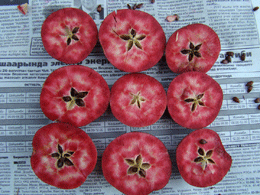 What really struck me, though, was not the utter imbecility of the reporter, or even what the bloody apple looked like. It was the fact that nobody had seemed to ask whether this was in fact the world’s first red-fleshed apple, as reported by FOXNews and The Daily Mail. 3 It isn’t that there are some wild red-fleshed apples out there, and this is the first one that’s good to eat. There have even been a fair number of commercial, good to eat, red-fleshed varieties. It’s just that reporters swallow rubbish so uncomplainingly. Google is your friend.
The photo (by Kayirkul Shalpykov, Bioresource, and lifted from the Living on Earth website) is of “Niedzwetzky apples (malus niedzwetzkyana), famous for their red flesh. There are 111 known trees left in the world”. Not sure I believe that either.