Livestock reverse desertification

There’s something delicious about received wisdom being overturned. For example, you’ll hear it said, categorically, that livestock turn fragile landscapes into desert; they eat the plants binding the soil, and their hooves cut up the surface and promote erosion. But it ain’t necessarily so.

Operation Hope, a Zimbabwean NGO and winners of $100,000 Grand Prize in the Buckminster Fuller Challenge, has

[T]ransformed 6,500 acres of of parched and degraded grasslands in Zimbabwe into lush pastures replete with ponds and flowing streams – even during periods of drought.

The quote is from a write-up in Seed magazine, which gives lots of details of the story. In essence, the key to livestock and grasslands is time, not numbers. If animals are on the land too long, their hooves do indeed powder the soil and they do overgraze. But if they are free to move on, or are moved by herders, moderate trampling allows rain to percolate into the soil, rather than run off and cause erosion. It also improves contact between seeds and soil, promoting germination. And dung and urine return plant matter to the soil to increase fertility and sequester more carbon, without becoming pollutants.

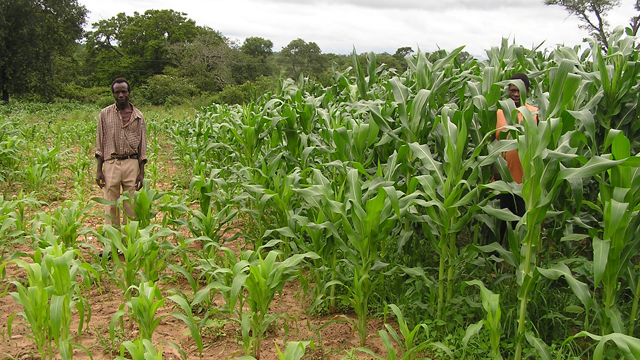
Operation Hope grazes animals in one spot for a maximum of three days, and they do not return for at least nine months, mimicking the natural movements of large herbivores on the savannah. At night they are protected from predators in portable kraals, which are also mobile to prevent a build-up of dung and urine. The effects are impressive. (“Animal-treated” field on the right, conventionally managed field on the left. Image courtesy Buckminster Fuller Institute”)
What’s interesting, and this is explored in much more detail in the Seed article, is that this kind of ecosystem thinking, which requires human knowledge and ingenuity to tackle complex problems, could have applications well beyond range management. Allan Savory, the scientist behind Operation Hope and the Africa Centre for Holistic Management, is hard on the Green Revolution.

“We posit the necessity of a new ‘Brown Revolution’, based on the regeneration of covered, organically rich, biologically thriving soil, and brought to fruition via millions of human beings returning to the land and the production of food.”

Of course, that’s hard work. But it is also surely much more interesting and fulfilling.

Agricultural biodiversity stamped on

Those limelight-hogging publicity mavens at the Convention on Biological Diversity have done it again. A massive press release celebrates the fact that Syria recently became the 12th country to issue a set of postage stamps to celebrate the International Year of Biodiversity. Ahmed Djoghlaf, Executive Secretary to the CBD had this to say:

I want to pay tribute to the countries that have made the effort to design and issue beautiful stamps as a way of reminding people of the importance and irreplaceable nature of the biodiversity of our world … Young people and adults alike can enjoy and take pleasure in these stamps, which will become permanent and memorable collector’s items.

And yes, you’re dead right, we’re about to get on our high horse again and moan about the (lack of) agricultural content of these stamps. I took a close look at the pictures the CBD sent out, and as usual there are almost no crops or livestock there. India’s features rice farmers — and an owl. Belarus has a couple of fish, which may or may not be edible, although I think Portugal’s are. Hong Kong’s and Singapore’s may feature edible tree fruits, but then again they may not; who can tell? The UK has a couple of whales (the dormouse is not the edible one) but given the UK’s stance on whales, it’s pretty safe to say they didn’t have food in mind.

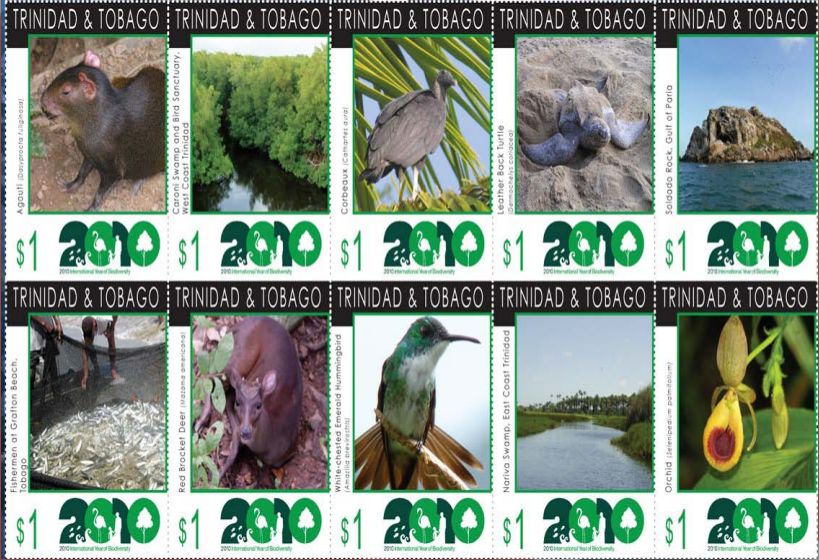
Biodiversity stamps from Trinidad and Tobago

Let’s hear it, then, for Trinidad and Tobago, which did Select Hybrid Cacao, hot pepper diversity, water buffalo, agouti, leatherback turtles and fishermen, plus a couple of productive ecosystems.

Biodiversity stamps from Trinidad and Tobago

Perennial grains gain credibility

ResearchBlogging.org It has been almost 10 days since the publication of Increased Food and Ecosystem Security via Perennial Grains in the Policy Forum of the journal Science. 1 Not long in the 10,000 year history of agriculture, agreed, but long enough to have had a bit more impact, which it deserves for two reasons. First, there’s the subject itself: perennial grains. Then, there’s where it appeared; Science is pretty mainstream on most things, and its willingness to publish 29 authors from 21 institutions must help to bring perennial grains in from the cold.

As ever, the article is behind a paywall, so a summary is in order. Jerry Glover, of the Land institute in Salinas, Kansas, and his co-authors make several points. Grain yields from major crops have doubled since the 1950s, but 1 in 7 people are malnourished. Populations continue to grow, and biofuels are competing with food production. The best croplands are not at risk of soil erosion or degradation, but those lands are only 12.6% of total land area. More than half the world’s population depends instead on marginal lands, which are capable of growing crops but which are at risk of degradation under annual crops. Global food security depends on annual production of cereals, legumes and oilseeds, but for a variety of reasons the production of these staples is unsustainable and fragile. Against this background, as the authors say:

Development of perennial versions of important grain crops could expand options.

They go on to list the benefits of perennial crops, which I won’t repeat here, and some of the past history of this exciting research area. One of the key arguments against perennial crops is that plants make a trade-off between storing resources to overwinter vegetatively and putting those resources into seeds that can survive adverse conditions. In other words, you can have deep roots etc. or big seeds, but not both. But even if true, perennial grains may still be a good idea, for two reasons.

First, high yield is not the only factor governing the use of specific crops. Wheat, for example, yields less than maize, but is grown on a larger area than maize because it will produce some yield under conditions where most maize will produce none.

[L]ower yield perennial crops could be options where higher yield annuals cannot reliably achieve full yields. In semiarid regions of sub-Saharan Africa, annual crops often use less than 30% of rainfall due to high rates of water draining below root zones, evaporation and runoff … Perennial crops can reduce … water losses and be grown on highly erodable sites. For example perennial types of pigeon peas, important food crops and sources of biologically fixed nitrogen, are grown on steep slopes in regions of Malawi, China, and India.

The second reason perennial crops may be a good idea even though yields remain lower at present is that by virtue of their deeper roots and longer-lived leaf canopy, they can convert more sunlight into biomass than even the most advanced, most pampered annual crops. Miscanthus (a grass heavily touted for biofuel production) for example, with no additional fertilizer, produces almost 60% more aboveground biomass than heavily-fertilized maize.

Glover and his co-authors point out that plant breeders need to combine many desirable traits in perennial grains, and that new technologies like genome screening and marker-assisted selection can speed the process. They also point out that this requires greater investment, calling for new and expanded breeding programmes, expanded research, better global coordination, agreed prioritiy-setting and capacity development and training. 2 They also identify the many ways in which perennial crops could contribute to what they call “domestic and international challenges,” pointing out that several US agencies ought to have an interest in promoting R&D into perennial grains.

And that, perhaps, is where the article’s real importance lies, and why I am a little surprised that it has not (yet?) generated more discussion. With governments increasingly talking about food security in a much broader context than mere calories and proteins, and given Science’s clout as an outlet for important ideas, one can but hope that somewhere serious-minded people are considering shifting just a tiny bit of the agricultural research budget into obviously attractive alternatives to seeds and feeds.

Inside Abu Ghraib

We’ve been keeping more than a brief eye on the blog of The Iraqi Seed Project but things have been a little quiet. Not surprising, really; they have better things to do than post their field notes to the internet. Today, though, a wonderful surprise. The filmmakers got to the Iraqi National Genebank at Abu Ghraib and, better yet, got to meet Mrs Sanaa Abdul Wahab. She’s the woman who saved some of the Iraqi accessions during the 2003 invasion. It was our report of her bravery that partly prompted The Iraqi Seed Project to seek her out, so we’re really glad they found her. And their report of progress at Abu Ghraib — complete with great pictures — is mostly reassuring. Sure, they need equipment and infrastructure, but the resources are there and in good hands.

Aren’t the interwebs wonderful?

11 blog posts about plants that you really must read

Berry Go Round 29 is upon us, a little delayed because of some unforeseen travel on my part. And getting right down to it, let’s honour the mindless fools who honestly think that a blog carnival dedicated to plants and botany is going to feature their absurd lists of great mortgages or places to become a veterinary assistant.

How about some pollination pr0n? Sally at Foothills Fancies has been Getting Down… and Busy among the wildflowers to observe bees feasting on “a seasonal smorgasbord” while doing their flying penis thing. Photos courtesy of a pal of hers, these are guaranteed safe for work and edumacational.

The Phytophactor focuses on a wildflower that would grace any low-lying and dampish corner of a garden for his Friday Fabulous Flower the Swamp Milkweed. Does it do that milkweed thing of donating its toxins to caterpillars, I wonder? He also gets political in a discussion of A real resurrection (fern), suggesting that research on out of the way organisms like ferns could be important for drought resistance in maize. Yeah right.

Sarcozona, over at Gravitys Rainbow, primed by a previous post of Phytophactor’s, notices another wildflower in bloom: Lilacs!?!. She also nominated World of Ecology‘s post introducing a new tool to help people Learn how to recognise Australian plant families. I’d love the opportunity.

Ted at Beetles in the Bush has a Friday Flower too, just as fabulous in my opinion. It’s pawpaw. Or, if you’re feeling particular, Asimina triloba. Because there are lots of plants that go by the name of pawpaw. How does this one relate to the others? Ted reveals all, and more.

Dave Ingram, at Dave Ingram’s Natural History Blog, has been sticking his nose into flowers in an experimental test of the old adage about A rose by any other name. I’ve a feeling Shakespeare wasn’t thinking of the entire family Rosaceae, but who knows.

Got Sisyrinchium? Over at Anybody seen my focus … JSK has two, which she explores in some detail. There’s Annual blue-eyed grass and Needle tip blue-eyed grass and, of course, they’re not grasses at all.

Exercising editor’s rights, I’m going to single out Watching the world wake up‘s post Strawberries are way cool from among the many sent in. You’ll learn why I’m wrong when I refer to wild strawberries and much else besides.

And now, both to boost numbers and to draw attention to an unfolding tragedy, I give you a post right here on the Agricultural Biodiversity Weblog. It is brief and to the point because we have covered the story previously. The Russians are planning to turn one of Vavilov’s field stations into a housing estate. The station is still doing important work, and there really is no need to get rid of it. Land for houses can’t be that scarce that it should take precedence over a long-standing and fruitful collection of plant diversity. What can you do? Save Pavlovsk!

That’s all for now. My thanks to all the smart people who suggested entertaining and informative posts. Next month’s carnival is being hosted at Brainripples, so submit.