Diverse points of view on feeding Africa

We like to embrace different points of view here ourselves, though we also like to think there’s a certain consistency to most of what we say and do. Maybe that’s why I find it strange that a single blog, on a single day 1 can feature two such divergent posts. One — Homegrown Solutions to Alleviating Hunger and Poverty — is a thorough look at the role of indigenous fruit and vegetable crops in delivering a healthy and nutritious diet. The other — Breeding for Climate Change — links, almost without comment, to a report on the Bill & Melinda Gates Foundation’s project to deliver just two (one conventionally bred, one genetically engineered) drought-resistant maize varieties to sub Saharan Africa.

I have no doubt that genetic engineering, precision farming and other high-tech tools of modern intensive farming can supply all the calories the world will need even when it hosts 9 billion people. I do doubt that the 9 billion will actually get those calories. And I know that calories alone are not enough. People need nourishment, not merely calories.
Costs, benefits, and the search for disease resistance

An epidemic of Fusarium head blight swept through the United states between 1998 and 2000, costing the wheat industry an estimated US$ 2.7 billion. That’s right: billion.

Salvation came from Chinese and Japanese landraces, especially a Chinese wheat called Sumai 3. To prepare for the inevitable mutation of the fungus, scientists at the USDA have broadened their search for resistance. They examined 87 Asian varieties of wheat, many of them old landraces, and found good levels of resistance in 26 of them. Better yet, some of the resistance genes seem to be different from the ones derived from Sumai 3, which means that they might offer protection against different varieties of the fungus.

Just knowing that various resistance genes exist, and having markers to select more resistant crosses from breeding efforts means that future outbreaks can probably be more effectively dealt with, which is reassuring. More to the point, for our purposes, this research raises again the question: how can anyone doubt the value of genebanks? Just one disease cost just one country US$2.7 billion over three years. Genebank accessions contain the solutions. Do you really need to know the cost of every accession to decide whether genebanks are worthwhile?

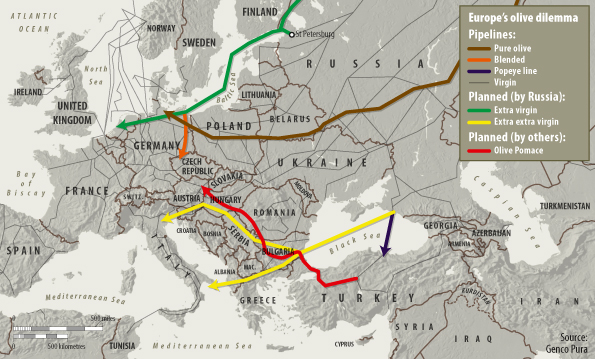
Shortage of olive oil threatened

201014NAM116_Olive.jpg

Disturbing news from The Economist:

It is becoming clear that reserves of olive oil will peak in the coming decade, as climate change wipes out most of the groves in the Mediterranean, the main production zone. The likes of Turkey will struggle to make up supply. Russia, however, expects to profit handsomely: its steppes, freed of permafrost, will soon host vast olive groves; a series of pipelines will send extra-virgin supplies westwards.

Somewhat disappointingly, The Economist seems to have taken no account of the benefits for the south of england. As we reported here earlier, home-grown olives are now on sale in the UK; can oil exports be far behind?

Not nibbles: on women, sweetness, reinventing the CGIAR, tomatoes and seed swaps

Notes from all over: In Vietnam, a woman working on the conservation of indigenous livestock breeds — Professor Le Thi Thuy — has won the 2009 Kovalepskaia Award from the Alexander von Humboldt Foundation in Germany. ILRI’s blog post on the award tells us more about Kovalepskaya (a pioneering Russian mathematician) than about Professor Thuy or the project she directs. But we’re here to tell you that pigs may be involved.

In Australia, a casual mention of sugarbag flies took me to a post about the Weipa mission in “North Queensland on the west side of Cape York, the pointy bit at the top”. There’s a lot more to this post than the heritage of honey and how to make good use of it; not as sustainably as you might imagine, in many cases. In any case, it is a great read.

In France, right now, and elsewhere at other times, the burning question on everyone’s lips: Are Gates and CGIAR a good mix for Africa? We’re not going to rehearse all the old arguments here — SciDev.net does that for us. But we might be even bolder and ask whether the new CGIAR will be a good idea not just for Africa but for the hungry everywhere. Maybe not

In academe, an odd paper in Nature Genetics focuses on a single gene that can boost tomato yields by 60% or some. Sure, that’s not going to feed the world, but it might make ketchup supplies more secure. The press release casts the discovery as an explanation of heterosis, which seems like overegging the pudding, but perhaps that’s just me.

In the informal seed sector, two posts that illuminate a different way of spreading agricultural biodiversity. The Guardian (no, not that one, the one that “covers Prince Edward Island like the dew”) reports on a local meeting of Seeds of Diversity Canada. I wonder how many potato varieties there are on PEI. And over at Our Earth/Ourselves, Madronna Holden ruminates on How to feed the world. A big part of her answer: A Propagation Fair.