A very warm welcome back to Rebsie Fairholm, the best singing backyard breeder of all time, I reckon. I’m looking forward once again to the vicarious thrill of following her adventures in pea breeding, among much else.
Sesame: not an open and shut case
Lack of time sometimes casts an interesting item as a Nibble, so it is good to have time to draw attention to a FARM-Africa project in Tanzania. A recent post on the Farm Africa blog updates a sesame project. The chair of the Sesame Marketing Group in one of the target villages explains:
[E]ven though the community has been harvesting sesame for years one of the big problems they face every year is the size of the sesame crop. The villagers tend to use a mixed bag of seeds, which means that the plants grow at different rates. As a consequence they are unable to harvest a large crop, or to sell in bulk.
He hopes that by using the seeds provided by FARM-Africa the villagers are able to produce a larger crop and generate a profit.
Looking back at the overview of the sesame marketing project, there are clearly some very good things in it. Farmer Production Groups will be helped to learn more about sesame production, will get equipment to measure oil and moisture content, will be connected with markets and market information, will be trained to clean and store seeds effectively, and much more besides. But the key seems to be the distribution of improved sesame varieties, “giving them the chance to grow a larger, higher quality sesame crop”.
All extremely worthwhile, and I for one hope that the project is an enormous success. But I would feel even better about it if the project included banking the local unimproved “mixed bag” of seeds. There are ex situ sesame collections, and efforts have been made to whittle them down to core collections. Before FARM-Africa’s successes cause Tanzanian growers to give up on their old varieties, I’d like to be assured that they are already being conserved somewhere.
Instead of all which, had I been pressed for time, I would simply have written “Open Sesame”.
Featured: Archives
Hearing about the Jack Hawkes Archive, Professor Adi Damania bemoans the fate of another giant’s papers:
Jack R. Harlan’s papers … are scattered between his students, sons, and admirers here at University of California, Davis. His papers have survived a boat sinking in New Orleans harbor and the Katrina floods. We are seeking funds to do a biography.
What will happen when someone’s papers are just bits? Will they be easier or harder to assemble?
Nibbles: Seeds, Organics, Absinthe, Potato, Cattle genome, Tree diseases, Rice, ABS, Avian flu
- Software will ease seed availability. No, really.
- Enforcement of organic regulations sometimes flawed. No really.
- Absinthism a myth. No, really.
- Potato film hits big time. No, really.
- “Influential” bulls sequenced. No, really.
- Tree diseases distribution will change under climate change. No, really?
- Boffins in drive to double rice production in Africa. No, really.
- Boffins and lawyers meet to sort out biodiversity access and benefit sharing thing. No, really. And, incidentally, what could possibly go wrong?
- H5N1 committee wonders whether they have sampled enough. No, really.
Photos wanted
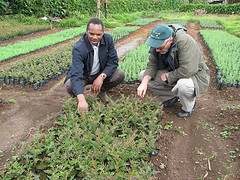 Got photos of Africa? I know we do. But that’s not the point. The point is that the Worldwatch Institute wants your pictures to illustrate its forthcoming report State of the World 2011: Innovations that Nourish the Planet. All details here.