Cavies in Congo

What next? Cane rats in Colombia?
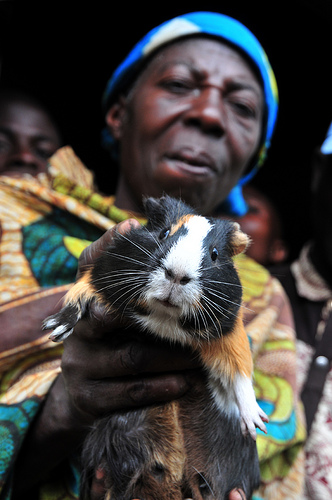
Guinea pig keepers in the North Kivu Province of Democratic Republic of Congo.

This picture really made me sit up and take notice when I saw it at CIAT’s Flickr photostream. I had absolutely no idea that people in Kivu, DR Congo, kept guinea pigs as mini-livestock, and a simple Google search turned up almost nothing of relevance. I went a bit deeper, and unearthed an article — Think big with minilivestock — in Spore from February 2008. That told me that in Kivu women often breed guinea pigs to provide their children with animal protein, which is otherwise not available to these most vulnerable members of the household. The article also says:

Throughout Central and West Africa and as far east as DRC and Tanzania, as well as in Haiti (Caribbean), small-scale guinea pig farming based on a few animals contributes to food security. It is a relatively easy activity, aside from problems caused by inbreeding which can eventually affect the health and weight of animals.

But it doesn’t tell me how this started, or what CIAT’s involvement might be. Can someone from CIAT or FAO please enlighten me?

And while we’re on the subject of introduced mini-livestock, has anything moved the other way? Luigi assures me that grasscutters (aka cane rats, Threonomys spp.) are delicious, but I’m pretty sure he didn’t taste them in Colombia.

When diversity is A Bad Thing

We generally adopt the view that diversity is a good thing. But there are cases where it definitely is not. One such is being discussed over at Small Things Considered, “the microbe blog”. In part one, Elio Schaechter answers Five Questions about Oomycetes. Number one: What makes oomycetes important to people? Answer, potato blight, and many other diseases.

Lots of good stuff, but we’re particularly taken with his colleague Merry Youle’s addition on Oomycete mating types and the potato blight. The point is, late blight is now capable of sex outside its home in Mexico, and has been since the late 1970s. Two consequences follow. First, the spores of sexual reproduction are capable of surviving over winter; currently, cold winters destroy the asexual spores giving potato growers a fighting chance of avoiding the blight. Over-wintering spores could be a disaster. Secondly, and perhaps more important in the long term, sexual recombination will allow late blight to do its own gene shuffling, and could come up with new combinations of genetic diversity that could make it even more virulent. Fungicide resistance in over-wintering spores would be quite a threat. Youle concludes:

K. V. Raman, a professor of plant breeding at Cornell University and an authority on potatoes in Mexico and Eastern Europe, observes: The conditions prevalent in today’s Russia are all too reminiscent of those of Ireland in the mid-19th century. That was the time of the Great Famine in Ireland (the subject of our next post). As was the case then in Ireland, Russia today has a population dependent on the potato and an aggressive blight out of control. In this, Russia is not alone. This time, the impacts are expected to be global.

Scary, or what? I’m looking forward to two more posts promised on the subject.

“It is silly to think of one solution”

Johan Schut pulled a folding knife from his hip pocket, inserted the tip into the base of a bright, crispy head of romaine lettuce and severed it in two.

“See there, the little brown specks with black legs?” He lifted one of the busy beasts onto the tip of his blade. “It’s a family of aphids. This is a non-resistant lettuce.”

Gotta love the New York Times ledes (as we ex-reptiles call them). This one certainly got me reading, and probably would have done even if I weren’t interested in “entrepreneurs and scientists [who] are trying to use all available techniques, including genetic modification, to improve agriculture around the world.”

It’s all there; cisgenesis, AFLP and MAS, arms races, private-public partnerships, options up the wazoo. Go Wageningen!

Nibbles: Climate, Money, Wine, Rice, Photosynthesis, Diversity

Featured: EU seed regulation

Robert asks Andre the questions on almost everyone’s lips:

Is there is a real & significant risk that allowing non-certified seed exchange would undermine the certification system? To the extent that it could imperil agricultural production (and hence our society)? A risk grave enough to infringe on the free exchange of seeds (an overlooked, but fundamental, (post-neolithic) human right)?