Reviving an old rice for sake’s sake

“Use it or lose it” is a frequent refrain among those who want to conserve genetic resources. We strive to point out that nothing is ever useless, we just haven’t discovered the uses yet. Sometimes, though, the use is well-known. Brewers, especially the more traditional types, often swear by specific varieties of their raw material. Golden Promise, a famous malting barley, is spoken of fondly by bearded men in sandals clutching a pint of warm cloudy brew. So I shouldn’t be surprised that the same is true of Nihonshu (日本酒). A long article at The Japan Times explains how sake makers are increasingly trying to use traditional old rice varieties.

Wataribune was used in 1939 to develop the now-dominant Yamada Nishiki strain. It had been widely used in sake making for centuries but fell into near-extinction around 50 years ago. Though it was rumored to yield brews of great depth and complexity, it was notoriously difficult to grow. The plant’s tall stalks made it vulnerable to typhoons, while its long growing season exacerbated the risks. [Takaaki] Yamauchi proposed an initiative to revive the strain, but few farmers were willing to gamble on such an uncertain enterprise.
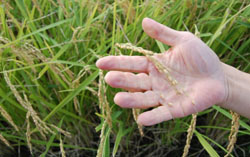
fg20091030d1c.jpg The article goes on to describe how the master brewer eventually found 14 grams of Wataribune rice in the genebank at the National Agricultural Institute in Tsukuba, and parlayed that into a range of award-winning sakes. The photo, by article author Melinda Joe, shows how easily Wataribune rice grains fall from the ears of the stalk, making it a challenging rice strain to work with. There’s a lot more in the article, about rice varieties in sake and about ordinary Japanese people who are spearheading a movement towards more regional diversity in rice, including groups that reclaim and regenerate abandoned rice paddies.

Featured: Breeding

Forget dropping seeds from planes to breed for the future. Jacob has a better idea:

In the future, I think much breeding should be crowdsourced to farmers.
Forget about Fisherian statistics, “stability” (without reference to the environmental conditions themselves!) and that kind of nonsense.

This is my recipe:

Step 1. Stick two little bags of crop seeds with unique codes on every bottle of Coke in Africa.

Want the details? Read on!

Eternal mystery: an ongoing search for the true meaning of Eeuwige Moes

Originally published on 20 October, updated 29 October (at the end).

I was very privileged to be invited to judge entries in the 6th annual audiovisual festival of biodiversity, organized by Crocevia, an Italian NGO. My own personal favourite was a Dutch film called Eeuwige moes. As I said in my comments, the film “was beautifully photographed and lit, and conveyed not only the beauty of agricultural biodiversity, but also the passion with which some people approach its conservation. At its heart, the film was a mystery that remained unsolved, and that made it very thought-provoking”.

Don’t just take my word for it, though. Take a look at this clip.

The bigger mystery, however, is the film’s title. The director translates it as “Eternal Mash”. But that doesn’t really mean anything in English. After the judging I spoke to Daniel, a young Dutch film-maker who helped organize the festival as a volunteer. I explained my difficulties, and he explained that moes had something of the connotation of the huge diversity and range of plants that grew. I didn’t really get it. But I did wonder about possible connections between a moes and a mess (of pottage).

The problem surfaced again today, and I did a little asking around, although no answers have arrived yet. I also did some additional Googling, and came up with this:

Eeuwige Moes, ook wel splijtkool, splijtmoes of stekkool genoemd, is een type kool (Brassica oleracea var ramosa) dat sinds lange tijd in Limburg wordt geteeld.

My Dutch isn’t brilliant, but my vegetal Latin is just dandy, and it seems to me that this is talking about a perpetual kale. In fact, “eeuwige moes, also known as split cabbage (?), split mash (?) or cutting cabbage, is a type of cabbage (Brassica oleracea var ramosa) has long been grown in Limburg”. Reading on, I gather that it is ready for eating very early in the year, and that the leaves are made often into a purée (moes sometimes translates (mechanically) as purée.)

Now, I feel, we’re getting somewhere. Not very far, but somewhere. If eeuwige moes really is the name of an old traditional crop plant, rather like, say, Hungry Gap kale then perhaps using it as the title of the film conveys layers of meaning that cannot begin to be captured by Endless Mash. If so, what the film-makers — and the rest of us — desperately need is someone who both understands Dutch and, perhaps more importantly, the nature of the passion for saving seeds and diversity that is the core of the film. They should watch the film and then we might be able to have a discussion about what it ought to be called in English. A simple translation clearly won’t do.

Later … After lots of useful input, not all of it in the comments, I’m convinced that Moes does indeed carry a significant freight baggage. And I believe that the kinds of ideas the Dutch title conveys might be better conveyed by something like “Eternal Leaf”. Let English-speaking viewers make the connection between Leaf and Life themselves. Anyway, it’s just a thought.

Canadians inventory biodiversity

Mary at Open Helix points to Dorothy at The Book of Trogool who says we should all take a look at Canadensys (hohoho). Dorothy says that Canadensys “is trying to collect biodiversity information from various researcher networks”. Canadensys says:

The mission of Canadensys is to unlock the specimen information held by Canadian university-based biological collections and share this via a network of distributed databases, compatible with other biodiversity information networks like CBIF and GBIF. In its initial phase, the network focuses on data of three of the most diverse, ecologically and economically important groups of organisms: plants, insects and fungi, the latter two representing some of the most poorly understood and inventoried organisms world-wide.

As Dorothy further points out, “their technical infrastructure is very much “use what you have; build only what you must”. Gosh, that sounds like a plan.

Big questions await intrepid database explorers. How are they dealing with agriculture? Might this become another gateway out of GBDBHell? Go ahead and rush in where I fear to tread.