Development and entrepreneurship in Africa

The company is just one part of Wade’s “comprehensive plan for Africa,” an anti-aid alternative to the Jeffrey Sachs vision.

A fascinating quote from a fascinating article on the Freakonomics blog, about three entrepreneurs in Africa. The woman whose quote I extracted above is Magatte Wade, and she’s the reason the story deserves a mention here. Her company — Adina for Life — came into being when she returned home to Senegal “and was disappointed to find that the traditional hibiscus drink of her childhood had been usurped by Western soft drinks”.

Hibiscus drinks are indeed a constant in many parts of sub-Saharan Africa, and hibiscus has been the focus of efforts to improve livelihoods by capitalizing on its popularity. Adina seems to be in a state of turmoil at the moment — with its US outlets suffering a crisis of identity and Wade apparently no longer associated with the company, at least in the US. But the larger point, that it is possible for Africans to make better use of their own natural resources remains valuable, and the other two stories in the Freakonomics story amplify that.

I wonder, though. Adina plunged into the cut-throat soft drinks market of the US. Why, when the stated goal was to replace sticky soft drinks in the home market? Wouldn’t that be enough?
Nibbles: Banana disease, Prickly pears, Pea breeding, Aquaculture, Bees, Soil microbes

Nibbles: Chickens, Peppers, Treaty, Breadfruit, Preservation, Food systems, Adaptation, Yam multiplication

(New) things to do with pears

A little something silly for the weekend.

peras_budas.jpg

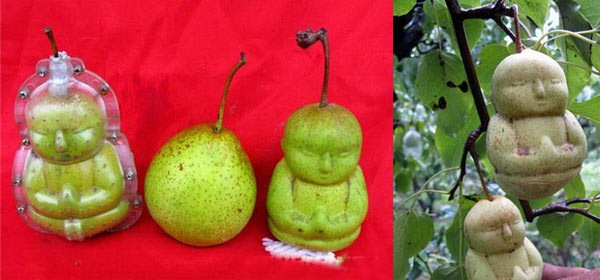
This bizarre story made it to Boing Boing and the Daily Mail, but the earliest I can find for it, and indeed where I first saw it (Thanks, Matt), was a website in Portuguese. Now, through the miracle of Google Translate, we bring you, How to make pear shaped Buddha!

I think this is the “How to” Strange as I posted here, after all, who is going to try this at home? Well, then, for purposes of curiosity, if you ever heard of pear-shaped Buddha or even the famous square watermelons in Japan knows that the process is simple, just put a cast on fruit when they are starting to rise because the fruit tends to take the shape of the mold as it unfolds.

I’m afraid of what marketers can do with it …

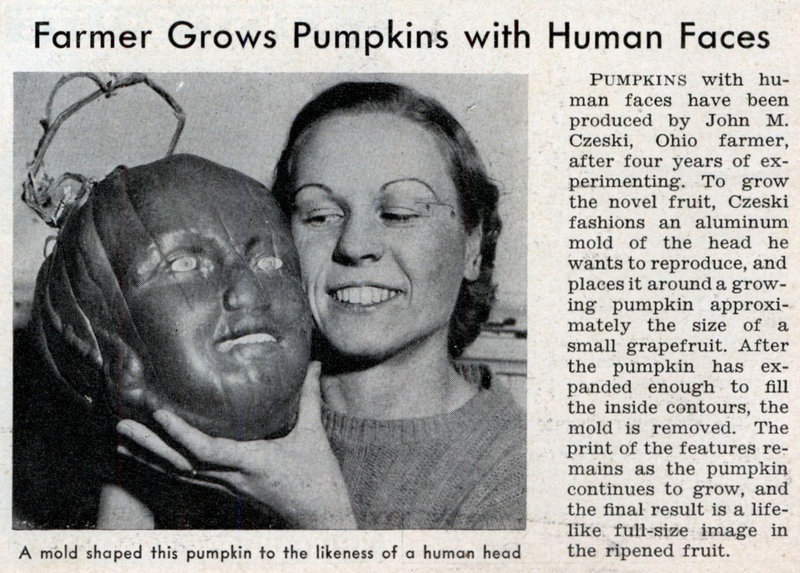
I’m more afraid of what the Mail did to it, but no matter. More to the point, even the square watermelon is not as new as all that. From Popular Science, January 1938:

lrg_pumpkin_face.jpg

Farmer Grows Pumpkins with Human Faces

Pumpkins with human faces have been produced by John M. Czeski, Ohio farmer, after four years of experimenting. To grow the novel fruit, Czeski fashions an aluminum mold of the head he wants to reproduce, and places it around a growing pumpkin approximately the size of a small grapefruit. After the pumpkin has expanded enough to fill the inside contours, the mold is removed. The print of the features remains as the pumpkin continues to grow, and the final result is a lifelike full-size image in the ripened fruit.

Nothing new etc.