Asparagus lust

Harold McGee talks about asparagus in his latest column at the New York Times. The money quote, for agrobiodiversity enthusiasts:

According to the food scholar Alan Davidson, some 1930s French varieties produced bland spears 2 inches in diameter and more than a pound in weight. Bland or not, those sound like heirlooms worth unearthing.

Amen to that.

Climate change to devastate crops, promote livestock

[B]y 2050, hotter conditions, coupled with shifting rainfall patterns, could make anywhere from 500,000 to one million square kilometers of marginal African farmland no longer able to support even a subsistence level of food crops. However, the land, on which some 20 to 35 million people currently live, may still support livestock.

Boosting livestock production could be an attractive alternative for millions of poor farmers across Africa who, in the coming decades, could find that climate change has rendered their lands unsuitable for crop cultivation yet still viable for raising animals, according to the study that appears this week in a special edition of the journal Environmental Science and Policy.

That’s from a press release put out by ILRI, the International Livestock Research Institute. The paper is from a special issue of Environmental Science and Policy on Food Security and Environmental Change, Food Security and Environmental Change: Linking Science, Development and Policy for Adaptation. Just skimming the contents gives me the willies.

By the way, Wikipedia says sub-Saharan Africa covers an area of 24.3 million square kilometers. It doesn’t say how much of that supports a subsistence level of food crops. So it is hard to know how much difference this prediction will really make.

Food strategies for the future

Coming from a state, Wisconsin, that has more cattle than people, I say thank your lucky stars that Hindus worship cows, because it could be a lot worse. As globalization triggers the successful emergence of a world-spanning middle class largely centered on India and China, what Mr. and Mrs. Middle-Class Chindia choose to eat in coming decades will reshape this planet’s ecosystem to a profound degree.

Tom Barnett has a clear-eyed view of the future, and his take on The Economist’s take on rich countries rushing to buy up farmland makes fascinating reading. Here are his two conclusions:

So those Chinese and Saudi Arabian agents running around the planet, buying up all the arable land deeds they can find, are simply trying to hedge against this inexorable future. Will such pieces of paper matter when a serious food shortage hits? I doubt it. Last year China was one of the first nations to slap restrictions on rice exports, so how can it expect states where it may own farmland to act any differently?

But here’s where the new rules really kick in: A 21st century dominated by advances in biotechnologies is sure to feature commensurate bioweaponization, including among the weapons wielded by transnational terrorists. As energy production becomes increasingly localized thanks to technology breakthroughs, expect global food transportation systems to become the preeminently vulnerable — and thus preeminently guarded — commodity network on the planet.

You think so?

Carnival time

The latest (5th) Scientia pro Publica blog carnival is up at Pro-Science, offering a selection of blog posts that celebrate the “best science, nature and medical writing targeted to the public”. As ever, we scour the lists looking for things of an agricultural bent (no matter how vague). Overfishing Simplified… Then Complexified comes closest. Mauka to Makai follows some of the tangled webs that connect piscivores, and while definitely illuminating, it isn’t all that optimistic.

Later … Festival of the Trees is just out too, at Roundrock Journal. Lots of fruit stuff there. Seems to be a good day for nibbling fruit today.

Semi-naked chicks go wild on Crete

“Eeyew. What’s wrong with that chicken?”

We were sitting on the shaded verandah of Nico, a lovely man who, after training as an architect in the US, chucked it all in to live off the grid and as sustainably as possible in a converted hovel in the west of Crete. No electricity, no running water, a wild garden and wilder chickens foraging through it.

Naturally I peered at the chicken, and there it was: naked-necked as I live and breathe.
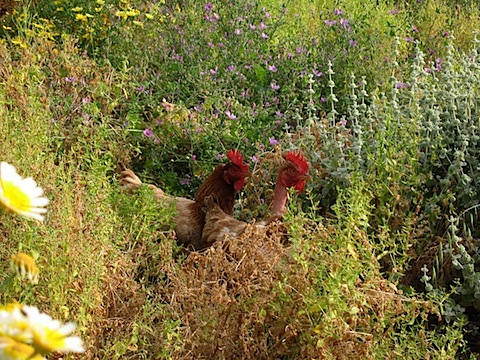
Cretan_chickens.JPG

“Golly, a naked-necked chicken, here on Crete.”

Nico, meanwhile, was answering my friend, and explaining that it was that way naturally and didn’t seem to be any different from the other chickens in his flock.

I waded in with information about the naked-necked chickens of Transylvania and elsewhere, citing the very latest thoughts on the subject, to-whit:

The use of single or combined dominant genes for feather restriction (Na) and feathering structure (F), as well as the sex-linked recessive gene for reduced body size (dw), has been found to be particularly relevant for the tropics (Horst, 1989; Haaren-Kiso et al., 1995). Research into the effects of these genes on economic factors has been undertaken in Malaysia (Khadijah, 1988; Mathur and Horst, 1989). For example, the feather restriction (Na) or Naked Neck gene results in 40 percent less feather coverage overall, with the lower neck appearing almost “naked”. This considerably reduces the need for dietary nutrition to supply protein input for feather production, and protein is a limiting factor in many scavenger feed resource bases. Barua et al., (1998) has reviewed the available information on the performance of indigenous Naked Neck fowl in the hope that it will draw the attention of scientists worldwide to its interesting characteristics and facilitate future research.

I asked Nico whether the naked-necked birds were more efficient egg layers, or suffered less in the heat, but he didn’t know. I said I’d be happy to return to conduct a thorough investigation, but I haven’t had a reply yet.

The photo took some doing too, the birds treating me as an overlarge predator definitely up to no good. Which they should.