A new use for tubers

A sharp knife is an essential element in the preparation of many vegetables, a fact as true 2 million years ago as it is today. Results from the recent meeting of the Paleoanthropology Society, reported in Science, indicate that the people who occupied the site of Kanjera South in Kenya carried stones that held an edge better from at least 13 kilometres away. Thomas Plummer of Queens College in New York and David Braun of the University of Cape Town found that a third of the stone tools at Kanjera came from elsewhere, and that these stones made longer-lasting knives than local material.

What were they using the knives for? To butcher animals, obviously, but also to cut grass and to process wild tubers. Cristina Lemorini of La Sapienza university here in Rome showed that the pattern of wear on the ancient tools matched the wear on modern stone tools used by the Hadza people of Tanzania to process plant material. In particular, using the stone knives to cut the underground storage tubers of wild plants left a pattern of grooves and scratches that was identical on modern and two-million year old stones.

Why tubers? There have been lots of theories about the role of plant tubers in the evolution of humanity, most of which hinge on the energy to be obtained from tubers, especially when times are hard. Margaret Schoeninger, of the University of California, San Diego, floated an intriguing new idea at the meeting. She noted that most of the tubers provide scant energy, and that modern Hadza chew on slices of tuber but don’t swallow the fibrous quid. Measurements show that panjuko (Ipomoea transvaalensis) and makaritako 1 can be up to 80% water. Schoeninger thinks that early humans used the tubers as portable canteens.

That might raise the question: why weren’t they domesticated? That’s an unanswerable hypothetical, but the simple answer might be that there was just no need to.
Nix that fruit. It really is a vegetable

I’ve always adopted a somewhat disdainful approach to those “fruit or vegetable” arguments that occasionally beset the tomato (and other things). Different realms of discourse, obviously. But no! It made a difference, back in 1893, when differential tariffs were bunged on fruits and vegetables. In the US, imported vegetables were taxed. Fruits were not. The Nix family sued Edward L. Hedden, Collector of the Port of New York, for taxes paid under protest — and lost.

In Nix v. Hedden the Supreme Court, after hearing readings from several dictionaries, opined that:

“The passages cited from the dictionaries define the word ‘fruit’ as the seed of plants, or that part of plants which contains the seed, and especially the juicy, pulpy products of certain plants, covering and containing the seed. These definitions have no tendency to show that tomatoes are ‘fruit,’ as distinguished from ‘vegetables,’ in common speech, or within the meaning of the tariff act.”

Useful ammo.

Happy Mayday

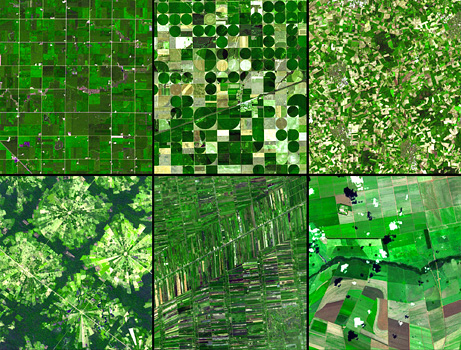
090428-08-agriculture-farms_big

Like patchwork quilts, satellite views of farming patterns around the world form the above montage of images taken by the Terra satellite.

At top-left, a regular grid pattern suggests that agriculture was shaped by 19th-century surveying in Minnesota. Meanwhile, center-pivot irrigation in Kansas is responsible for the circles visible in the second image. A well in the middle of each field serves as a pivot point for wheeled, spraying watering machines.

In the top-right image of northwest Germany, small and disorganized fields can be traced back to the less-planned farming of the Middle Ages.

Curious pie-shaped fields in the lower-left image are the result of a planned settlement near Santa Cruz, Bolivia. At the center of each field is a village, while a buffer of rain forest separates each community.

In Thailand, at bottom-center, rice paddies just outside Bangkok form skinny slices. The purple fields are flooded, a normal part of rice’s life cycle.

At bottom-right, Brazil’s woodland-savanna cerrado contains massive farms, a by-product of the flat land’s inexpensive price.

Many thanks, NASA and National Geographic.

Featured: Climate change

Meike sets out a research agenda:

[D]efinitely both climate change and land use changes will affect crop production areas and the distribution ranges of crop wild relatives. Most likely they will also influence gene flow and introgression rates, e.g. by affecting the niches of pollinators, flowering times etc.

She was talking about mapping studies, but we say there’s more than enough there for everybody.