- Colony collapse disorder. It’s still complicated.
- The Botanist in the Kitchen is at it again, with an in-depth treatment of okra, slime and chocolate.
- But seriously, why don’t Anglo-Saxons eat equids? It’s all down to religion.
- Nigeria embraces UNCTAD report that warns against monoculture.
- An interactive map of crop wild relatives. If it showed barley too, I know someone who would be in heaven.
- As so often in these matter, Kew comes to the rescue.
- A history of the peanut-butter-and-jelly sandwich. My kind of dietary diversity.
Botanic gardens conserve crop diversity too, two.
Speaking of social media, Royal Botanic Gardens Edinburgh just published an interesting post entitled Botanic gardens conserve crop diversity too. 1 The crux of the matter is that RBGE tweeted about having collected some wild relatives of cabbages and other veg. A picture of one cabbage caught Luigi’s eye, as pictures of wild relatives often will, and he in turn discovered that the population from which it came is not represented in the UK’s leading collection at the Genetic Resources Unit in Warwick. Horrors! As he said at the time:
[T]he material mentioned in the Edinburgh tweet, which comes from Fife in Scotland, is likely to add significant diversity to the “national” collection at Warwick. Scope for some closer collaboration between these two institutes? Well, maybe it’s already there and I haven’t caught it. Do let me know if I’m being unfair.
@RBGE_Science shot back a tweet.
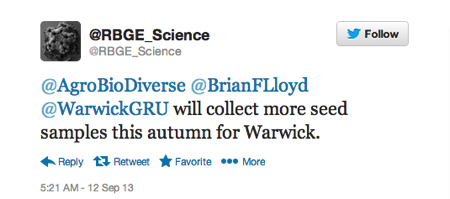
Fast forward less than a week, and RBGE now has this to say:
Seed samples from wild collections … will be passed to the Genetic Resources Unit at Warwick to enhance their CWR collection. An example of the value of this collaboration is provided by the fact that Warwick currently has no Scottish origin wild cabbage. … [T]his in turn will provide further ex-situ conservation for what is quite a rare plant in Scotland.
Was Luigi being unfair? Or should he take full credit for furthering cross-border collaboration in the important matter of cabbage wild relatives?
Nibbles: Rice terrace photos, Street food, Book
- Flickr shows off its best photos of the rice terraces of China. No idea how to embed these on our site. You’ll just have to go see for yourself.
- UK diplomats embrace street food giveaways.
- A book: Cultivate Diversity! That’s an order, obviously. Order it from here.
Genebank managers manage to have a good time
Luigi has been tweeting up a storm from the genebank managers meeting in Ames Iowa. If that’s the kind of thing that interests you, look for his hashtag, #ames13. Even if it isn’t, you might take a look for an object lesson in how to use social media.

This morning they’re off on a field trip. Will that slow him down? I doubt it.
Nibbles: Chickens, Markets x 2, Bananas, Cover crops, Pyramid foods, Beans, Maize, Austrian diversity, Tuberous legume, Natural wine, Figs and mulberries, Meetings x 3, Purple sweet potatoes, Bambusetum
- Backyard chickens too much hassle? We have the solution for you.
- Supplies go up, prices go down. Those pesky speculators had nothing to do with it.
- Prices go up … The story for India’s agrciultural labourers.
- Colombia’s loss will Ecuador’s gain. Predictions for bananas in the 2060s.
- Conventional farmer loves cover crops. Shurely shome mishtake.
- Building the pyramids. It’s a tough job, but at least you eat well.
- Beans with benefits. On the road with a breeder in Rwanda.
- Chinese maize diversity explored, a bit.
- Massive diversity of all sorts of thing, in German.
- Rhizowen has another favourite underutilised legume crop: Amphicarpaea bracteata subsp edgeworthii.
- It’s vino, but is it natural?
- How is a fig like a mulberry? The Botanist in the Kitchen explains.
- Capturing wild relative and landrace diversity for crop improvement. A conference, in June 2014.
- Agricultural Biodiversity Community @ Work. A conference, in June 2013. PENHA was there.
- Preparations are underway for Kew’s Great Seed Swap. Call me dumb, but I cannot see a date anywhere there.
- Purple sweet potatoes to dye for.
- Oh boy! A regional genebank for bamboo. A bambusetum, no less.