- A well-briefed Olivier De Schutter, UN Special Rapporteur on the Right to Food, reflects on biodiversity for food and agriculture as a public good. Video. Comments closed!
- UK genebanks are wonderful, says chair of British Society of Plant Breeders.
- Getting ready for a possible ban on pig castration, the Nordic Food Lab tells us how to deal with Boar Taint.
- The things you can learn from strawberries (if you can hold off eating them).
- More money for research on organic agriculture shock plea.
- HRH Prince Charles didn’t use the R-word, but you know he might just possibly agree.
- I wonder whether he realises that the evolution of resistance by insect pests is predictable.
- If cassava is such a Rambo root, how come it quivers before a fly? Even a super-fly?
- And if that isn’t enough to keep you busy over the weekend, how about celebrating World Gin Day tomorrow, with a good book (and a glass) in hand, natch.
The state of chickens
Luigi pointed me to a nice graphic poster of the officially approved bird for all 50 of the United States. Among them, I noticed two chickens, for Delaware and Rhode Island. Rhode Island might seem obvious enough, the Rhode Island Red being almost the canonical farmyard bird.
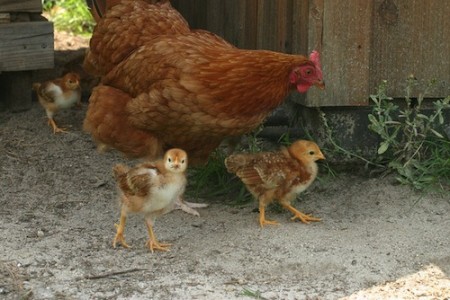
But Delaware, not so much.
In fact Delaware was one of the biggest poultry and egg producing states in the Union. Sussex County DE, where the modern broiler industry began, still holds the record for egg and poultry sales, “with $707 million, or 1.9 percent of the total U.S. value” in 2007. That’s almost 2% of the value from 0.024% of the land. But Delaware’s state bird – the Blue Hen Chicken – is not one of the squillions (many of them carrying Rhode Island Red genes, I’ll warrant) that contribute to Sussex County’s top cock status. It isn’t even a real breed. 1
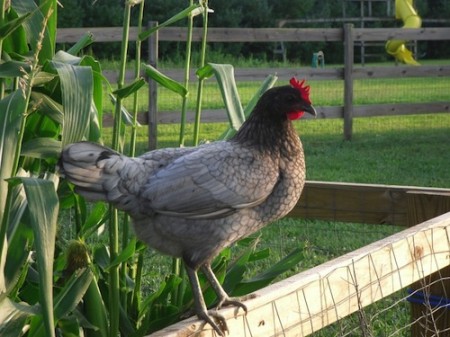
Nope; apparently Delaware’s blue hen chicken is a reminder of the Revolutionary War. Exactly how remains uncertain. Cock-fighting was common there at the time, and the Delaware Regiment may or may not have carried feisty blue gamecocks into battle, may or may not have been as feisty as a blue gamecock, and may or may not have looked like a flock of feisty blue gamecocks in their natty uniforms. There is a flock of blue hen chickens at the University of Delaware, whose mascot is the blue hen chicken, but it was created in the 1960s by H.S. Hallock du Pont, and has not been recognized as a proper breed, perhaps because it does not, in fact, breed true. Yet.
Nibbles: Hot peppers, Job, Hippy scientist, Seed law considered, Old seed, Rice and recovery
- Will the world ever tire of hot pepper stories?
- Would you like to work at the Millennium Seed Bank?
- The Guardian hymns Howard-Yana Shapiro, the “vegan hippy scientist” who wants to open orphan crop genomes.
- Patrick links to Arche Noah’s response to the new EU seed laws.
- Laws that don’t bother Gene Logsdon, planter of old seed.
- IRRI claims that rice seed aids Bangladesh’s cyclone recovery, but frankly, I can barely read it.

Featured: “GMO” tomato
This is too perfect for words. You’ll remember that I was a little confused by a strange report on a GM purple tomato that somehow wasn’t GM because it was bred from GM parents. Or something. Matthew now reveals that it is even more confusing than I first thought:
You’ll notice that the photo of the “GMO” purple tomato is from Oregon State University. It’s actually a photo of one experimental line from Jim Myers classical breeding program that last year released a new purple commercial variety. Here’s the press release they took it from: http://horticulture.oregonstate.edu/purple_tomato_faq.
We’ve written about those GM purple tomatoes before, and about Oregon State’s breeding programme. Nothing since then has changed my mind on the topic.
Featured: Seed Law
Patrick gets it: beyond fitness for purpose, freedom of choice is all people want from seed laws.
Everything else can more effectively be dealt with through the free market. If farm-saved seed, local adaptation and the value of diversity don’t translate into farm profits and productivity, then they will cease to exist. If people want to buy DUS and VCU, and these are more productive, so be it. If one seed company produces seeds deamed in some way to be better than their competitors, then farmers can choose those seeds.
So I guess he’d agree with Dave’s point:
As to Holly point: “There’s nothing wrong with growing whatever you want.” I agree – but tell that to the people who are blocking Mexican farmers growing GM maize. The activist-imposed `regulation’ tries to stop farmers in ill-defined Centres of Crop Origins growing GM crops (brinjal in India, maize in Mexico).