- Higher maize yields? Plant cover crops between the rows.
- Barley tempeh! My kind of food exploration.
- Danny Hunter impresses Irish Times with need to conserve biodiversity.
- UK devotes millions to research for “bigger yields of better quality fruits and vegetables”.
- Germans embrace high-tech urban agriculture — cautiously.
- Put farmers’ markets near medical centres for added benefits. What happens when everyone’s so healthy they don’t need the doctor?
How to solve global hunger and malnutrition
There’s been a whole lot of noise lately about how to feed 9 billion people well, much of it adopting ammunition of silver. Organics can do it. GMOs are essential. Women farmers. Microdoses of fertiliser. Sequence everything. Drip irrigation. Et cetera, et cetera. Mostly special interest groups looking after their special interests. And like Dr Johnson’s apocryphal epigram, they’ll never agree because they are arguing from different premises. In the meantime, though, is it any wonder that some people take umbrage at pronouncements like these:
The United States of America is the world leader in agriculture. We have invested in domestic agricultural education, infrastructure and distribution, and reaped the rewards. Other countries look to us for new technologies and new systems. It is time to teach them more efficient farming methods.
That, from one Christopher Barden, is the prelude to a call to increase the number of agricultural exchanges, which “allow young or mid-career agriculturalists to come to the U.S. and live and work alongside American farmers and learn the work ethics, technologies, organization and honesty practiced in that community. Participants can earn money to invest in their agri-businesses at home while taking back a bank of knowledge and respect.” Mr Barden, as it happens, “is the vice president of Worldwide Farmers Exchange, a 501(c)(3) nonprofit independent of government funding”.
I wonder whether any of the young or mid-career agriculturalists have any solutions to, say, the problems of the Gulf of Mexico dead zone, or the externalities imposed by concentrated pig operations?
Dan Glickman, former US Secretary of Agriculture, tells a very familiar story in an article for Diplomatic Courier magazine. Feeding a Growing World Sustainably and Nutritiously goes through the usual reasons and rounds up the usual suspects, to whit: invest in “basic and adaptive agricultural research,” in “the production of fruits and vegetables and other nutrient-dense specialty crops,” and especially in women.
Investing in women has positive repercussions not just for productivity, but also for nutritional improvement. Women make the majority of household nutritional decisions, and giving women nutrition information is proven to improve maternal and children’s health.
But here’s a thing: Despite Rhetoric, Women Still Sidelined in Development Funding.
Of course, one can’t blame ex-Secretary Glickman for that. Personally, however, if the problems are as pressing as everyone seems to think they are, wouldn’t it be better to try lots of different approaches, and see which ones work best where, and in what combinations. But no, lets just slag off everyone who doesn’t agree with us. 1 One rather wishes a well-meaning psychologist type would come along and figure out why no one group can even begin to appreciate another’s point of view. The world is diverse, and so are the ways in which people secure their food and nutrition. A first step might be to recognise that.
Nibbles: Marker assisted selection, Ecoagriculture, Tomato grafting, Food sovereignty, Rice genomes, Other genomes, Molecular toolkit, Yaks, Evotourism, Sandalwood
- Yale University magazine drinks the fast-track breeding KoolAid panacea.
- Compare and contrast. Repeat. Endlessly.
- Grafting tomatoes is hot for lots of reasons; but how does it protect against leaf-borne diseases? And not just tomatoes, actually.
- Getting the lowdown on that “food sovereignty” farrago.
- And today’s DNA sequencing will solve world hunger and cure bunions story.
- Genomics also good for “health, agriculture, livestock, fisheries and biodiversity” in Philippines. Have we forgotten anything?
- Well yeah, you forgot your handy molecular toolkit.
- Meanwhile, back in the real world, the choice is between forests and yaks.
- More hard choices: evotourism destinations. But check it out, there be agricultural biodiversity too!
- And another one: to go to the International Sandalwood Symposium, or not to go?
Consolidation in the seed industry
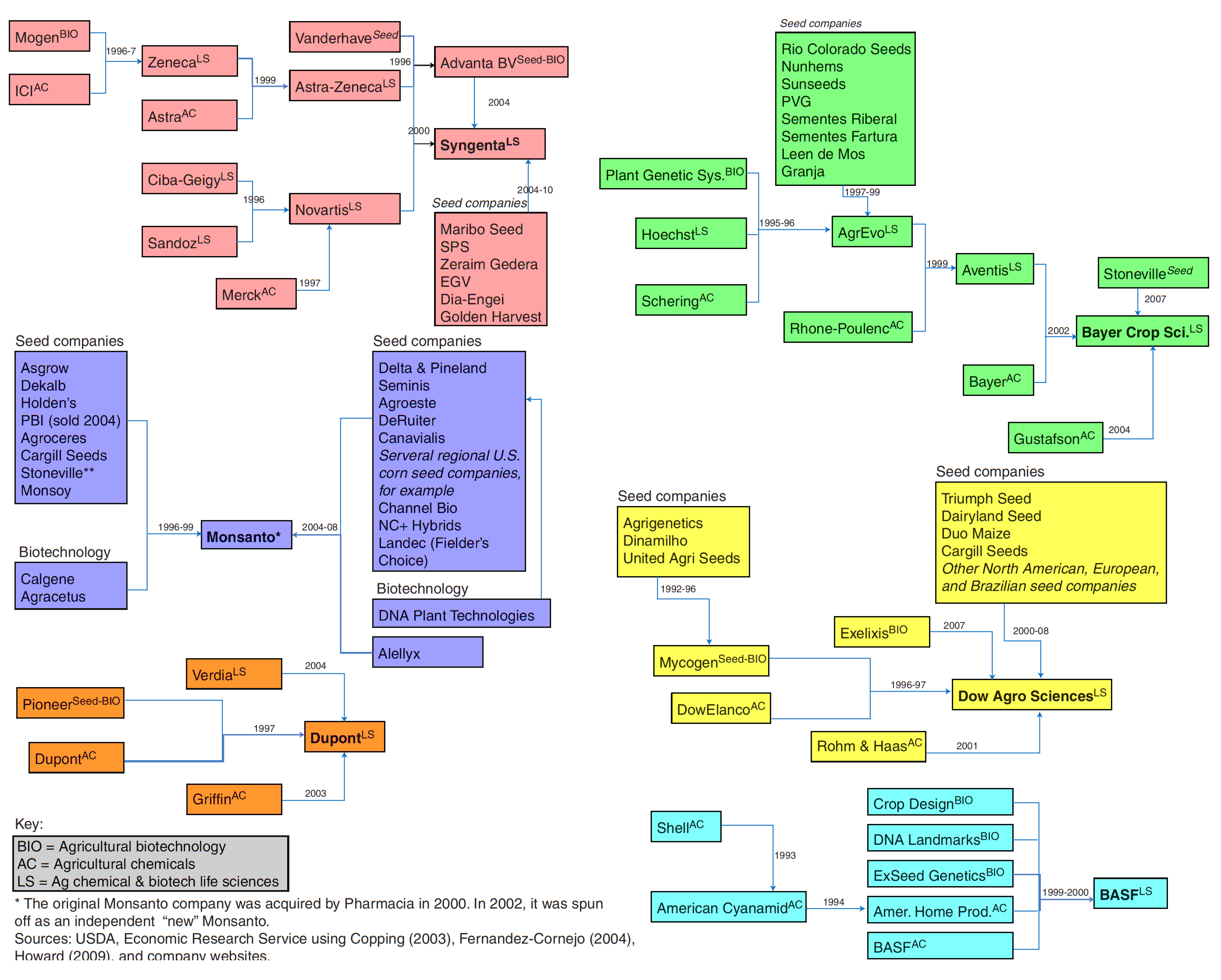
We’ve written before about consolidation in the seed industry making the same tired joke that I want to make again now, that a picture is worth 1000 words. It doesn’t hurt to stay up to date though, which is why I am grateful to Resources Research for finding, and colouring in, the diagram from the USDA report on Research Investments and Market Structure in the Food Processing, Agricultural Input, and Biofuel Industries Worldwide.
The USDA report is not, as far as I can tell, anything to do with the US Department of Justice’s investigation of antitrust practices in the seed industry, announced a couple of years ago. So what has become of that? Anyone know?
Brainfood: Falcons, Wild soybean squared, Horse domestication
- Effects of Introducing Threatened Falcons into Vineyards on Abundance of Passeriformes and Bird Damage to Grapes. Potential savings of US$234/ha for Sauvignon Blanc, more for Pinot Noir.
- Genetic characterization and gene flow in different geographical-distance neighbouring natural populations of wild soybean (Glycine soja Sieb. & Zucc.) and implications for protection from GM soybeans. There is a small amount of outcrossing, which decreases with distance. GM crops should be grown far from wild populations, certainly more than 1.5km. And we can work out better ways to collect for ex situ conservation.
- Phylogenetic relationships, interspecific hybridization and origin of some rare characters of wild soybean in the subgenus Glycine soja in China. Intermediate forms are closer to the wild than the cultivated species.
- Mitochondrial genomes from modern horses reveal the major haplogroups that underwent domestication. A diversity of maternal lines were domesticated about 150,000 years ago, leading to about 18 modern haplogroups. One of them is only found in the only remaining wild horse, E. przewalskii.