- Are species’ range limits simply niche limits writ large? A review of transplant experiments beyond the range. Meta-analysis shows dispersal constrains geographic distribution but extends altitudinal. Biotic interactions important at low elevations and latitudes.
- Herbivores and nutrients control grassland plant diversity via light limitation. Nutrients bad, herbivores good for grassland diversity.
- Economic and ecological implications of geographic bias in pollinator ecology in the light of pollinator declines. Half the data come from 5 countries. Nuff said.
- Integrated crop and livestock systems in Western Europe and South America: A review. Market logic has driven crops and livestock apart, but it should drive them back together again.
- ARABIDOPSIS THALIANA HOMEOBOX25 Uncovers a Role for Gibberellins in Seed Longevity. Seed longevity gene found. No word on whether giberellin treatment can prolong seed life in genebanks. Yet.
- Molecular-level and trait-level differentiation between the cultivated apple (Malus×domestica Borkh.) and its main progenitor Malus sieversii. Status of M. sieversii as main progenitor confirmed. Always good to have more data.
- Adaptation of Cultivated Amaranth (Amaranthus spp.) and Their Wild Relatives in Mexico. One of the wild species could be a source of adaptation for the cultivated under climate change.
- Eat your orchid and have it too: a potentially new conservation formula for Chinese epiphytic medicinal orchids. Nature reserves and cultivation on farms not enough. What you need is “restoration-friendly cultivation.”
- A continental-scale study of seed lifespan in experimental storage examining seed, plant, and environmental traits associated with longevity. Australian seeds are somewhat longer-lived than those from other regions. But there’s plenty of variation, some of which can be explained by different features of the seeds, plants and the specific environment where they grow.
- Inclusive fitness in agriculture. Plants and their root symbionts can get along even better together, with a little help from human selection.
- Genetic diversity analysis for quantitative traits in lentil (Lens culinaris medik.) germplasm. NBPGR seem to be on an evaluation blitz. More power to them. Hope to see the data online soon.
The latest thinking on domestication illustrated
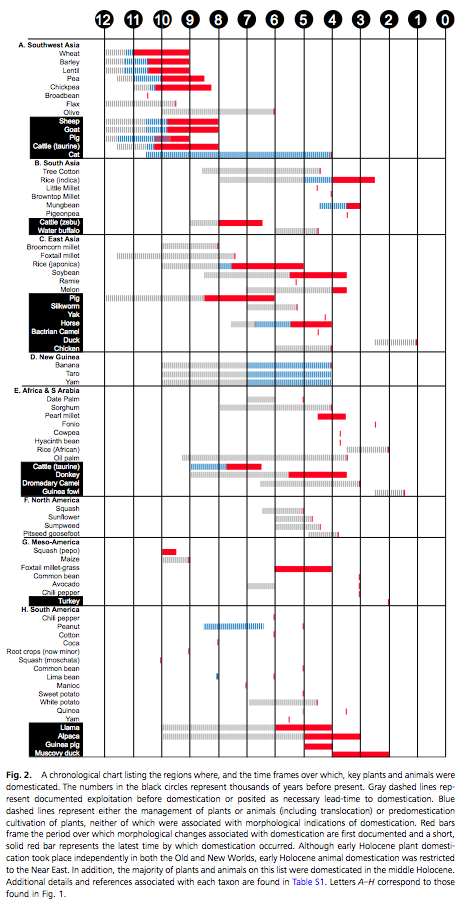
I’m still ploughing through the PNAS special feature on domestication, 1 but I just thought I’d share what are in many ways the money figures. They come from the overview article, and they show the about 20 or so accepted and probable centres of domestication:
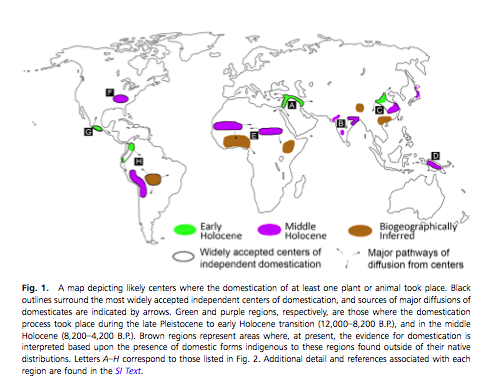
And a timeline for selected domesticates:
A one-step approach to clarify the origin of crop species
We asked Dr Dan Brock to break down his paper on the domestication of Jerusalem Artichoke. Thanks, Dan. Sandy Knapp has also had her say on this. Who needs the full text of papers these days.
 Identifying the wild progenitors of crops is one of the key steps we have to take if we are to effectively harness the diversity maintained in the world’s genebanks. This information can and should be used to fuel efforts to increase the productivity and sustainability of modern agriculture. In the case of allopolyploid crop species, which are formed by a combination of interspecific hybridization and genome duplication, this information is also of technical significance. In these systems, a major obstacle in the way of genome-scale surveys of genetic diversity is the fact that variation occurring between the progenitor-derived sets of chromosomes cannot be discerned from variation occurring within each chromosome set. In a recent publication in the journal New Phytologist 2 we highlight a one-step approach that can be used to clarify the origins of previously intractable polyploid complexes, using Jerusalem Artichoke as an example.
The Jerusalem Artichoke (Helianthus tuberosus) is a culturally and economically important tuber-producing hexaploid whose origin has long fascinated botanists. Despite prolonged interest, the evolutionary history of this species has, until recently, remained a mystery. Different hypotheses have so far proposed the annual sunflower H. annuus as well as numerous other congeners as its likely progenitors. We tested these competing scenarios using the genome skimming approach. 3 One lane of Illumina sequencing generated sufficient data to reconstruct complete plastid genomes, partial mitochondrial genomes, as well as partial 35S and 5S nuclear-encoded ribosomal DNA for the Jerusalem Artichoke and its candidate progenitors. Analyses performed using these data provided unprecedented resolution for this group, which is notoriously difficult to resolve using phylogenetic inference. Our results showed that the Jerusalem Artichoke originated repeatedly via hybridization between the Hairy Sunflower (H. hirsutus), which likely served as the maternal parent, and the Sawtooth Sunflower (H. grosseserratus), which likely served as the paternal parent.
The advent of new sequencing technologies has made ever-increasing portions of the genome available for investigation, with ever-decreasing investment in researcher time and effort. We are therefore in an ideal position: we can use these breakthroughs to resolve the origins of crops like the Jerusalem Artichoke whose unclear ancestry has, until now, hampered evolutionarily-informed germplasm preservation and genome-enabled progress.
PNAS special feature on domestication surfaces
Those of you looking for the Proceedings of the National Academy of Sciences big special feature on “The Modern View of Domestication” won’t find it at the URL we previously cited. Twice. You will, however, find it here. I smell another Brainfood coming…
LATER: And here’s the latest press release.
More domestication papers breaking free?
Hang on, has another paper from the PNAS special issue on “The Modern View of Domestication” broken embargo? An article from the Washington University comms machine 4 lays out the difference between animal and plant domestication. Apparently, plant domesticators targeted genes that were insensitive to epistasis (i.e., the effect of other genes) and the environment, whereas animal domesticators did not. Maybe PNAS should just give up? Oh yeah, it has.