- Genetic Diversity of Cultivated Lentil (Lens culinaris Medik.) and Its Relation to the World’s Agro-ecological Zones. 352 accessions, 54 countries, 3 agro-ecological groups (South Asia, Mediterranean, N temperate) in USDA collection.
- Association mapping of seed and disease resistance traits in Theobroma cacao L. 6 and 1 markers, respectively, based on 483 unique trees in the International Cocoa Genebank, Trinidad (ICGT).
- Historic translocations of European larch (Larix decidua Mill.) genetic resources across Europe – A review from the 17th until the mid-20th century. Humans have moved material to areas outside its native distribution, and have mixed up genetically distinct populations in some places.
- Insights into the Genetic Relationships and Breeding Patterns of the African Tea Germplasm (Camellia sinensis (L.) O. Kuntze) Based on nSSR Markers and cpDNA Sequences. African material groups according to where it was bred.
- First the seed, next the smolt? Will salmon farmers learn the right lessons from plant biotechnology? I bet not.
- Geographic patterns of phenotypic diversity in sorghum (Sorghum bicolor (L.) Moench) landraces from North Eastern Ethiopia. There aren’t any. Patterns, that is.
- Subgenome parallel selection is associated with morphotype diversification and convergent crop domestication in Brassica rapa and Brassica oleracea. Similar heading and tuberous morphotypes in the two species are due to parallel selection on genes that diverged after duplication event.
- Assessing the Cost of Global Biodiversity and Conservation Knowledge. Golly, it’s expensive!
- Sixteen years of change in the global terrestrial human footprint and implications for biodiversity conservation. Human footprint hasn’t increased by as much as might be feared, but still extends over 75% of world’s land surface. Let the mashing up with crop wild relatives hotspots begin!
Nibbles: Cotton pollination, Wild peacock, Chicken migration, Canadian seeds, Amaranth, Aztec gardens
Nibbles: Artisanal bread, Phenotyping, Maris Piper, Algae, Superfood debunk, Banana 101, Indian millets, Wheat seed photosynthesis, Chili evolution
- Nice tweeting about bread and other Central Asian food over past few days.
- Rothamsted’s “Scanalyzer“.
- The genebank origin of the UK’s premier potato, Maris Piper.
- Seaweed in South America.
- Repeat after me: superfoods are a scam.
- Third and final instalment in The Plate’s history of the banana.
- India going on a millet kick.
- The wheat seed is C4? Totally crazy.
- The evolution of Capsicum in half a page. Which is both too much and not enough.
Bananas everywhere
National Geographic have just published the first of a three-part series on the history of the banana. It’s been done before, several times, but you can usually count on NatGeo to get it right, and it looks like it’s off to a good start. Coincidentally, I blogged about the crop just a couple of weeks ago over at the work place. And I’m sure Colin would like me to remind everyone that the banana is eaten in 192 countries.
Brainfood: China cereal yield, US soybean breeding, Breadfruit genomics, Field app, Urban ag, Rose breeding, Strawberry cryo, Global biodiversity loss, Oceania bananas, Vegetable breeding, Badass Chinese sheep
- Patterns of Cereal Yield Growth across China from 1980 to 2010 and Their Implications for Food Production and Food Security. There has been yield stagnation over about 50% of total area of rice and maize, 15% of wheat.
- Genomic signatures of North American soybean improvement inform diversity enrichment strategies and clarify the impact of hybridization. 579 soybean varieties released 1940-2009 fall into 3 maturity groups, the overall diversity of which is not too different from the diversity of the ancestor landraces.
- Low-Coverage, Whole-Genome Sequencing of Artocarpus camansi (Moraceae) for Phylogenetic Marker Development and Gene Discovery. There’s been a whole genome duplication in Artocarpus.
- ColectoR, a Digital Field Notebook for Voucher Specimen Collection for Smartphones. So many of these things around.
- Potential ecosystem services of urban agriculture: a review. Important at local scale, not so much at global scale.
- Nineteenth century French rose (Rosa sp.) germplasm shows a shift over time from a European to an Asian genetic background. Ah, the lure of the exotic; 19 genetic groups, not corresponding to horticultural groups.
- Cryopreservation of in vitro shoot tips of strawberry by the vitrification method — establishment of a duplicate collection of Fragaria germplasm. The German national collection, including wild relatives, is a bit safer.
- Has land use pushed terrestrial biodiversity beyond the planetary boundary? A global assessment. Looks like it. Cross-reference with crop wild relatives?
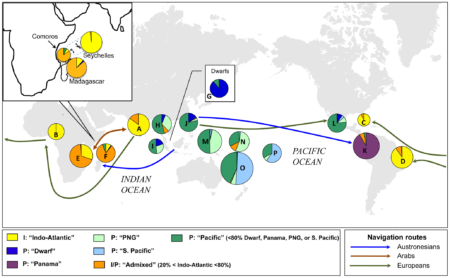
- Traditional Banana Diversity in Oceania: An Endangered Heritage. Out of New Guinea…
- The contribution of international vegetable breeding to private seed companies in India. Vegetable breeding by AVRDC still has a role as R&D shifts to the private sector, but it’s different to what it was.
- Whole-genome sequencing of native sheep provides insights into rapid adaptations to extreme environments. Genomes of 77 Chinese breeds from extreme environments reveal genes likely to be useful in extreme environments.