- The croissant explained.
- Belgian beer in trouble. That can’t be good.
- And not only beer.
- Some people held out against agriculture.
- NY Public Library shares ton of digital images, including of agriculture.
- Still got an hour to spare after that? Check out this podcast on tea in China.
The most valuable fruit introduction yet
The Sacramento Bee has a nice piece by David Boulé 1 about the history of the ‘Washington’ Navel Orange in California, the world’s second most common orange variety (after ‘Valencia’).
Navel oranges have been known in Spain and Portugal for centuries. They made their way from there to Brazil, where, in Bahia, a seedless and easy-to-peel variety of great taste and color was discovered. It was probably a sport (mutant) from the Portuguese variety ‘Umbigo’, which is said to be described in the Histoire naturelle des orangers by Risso and Poiteau (you can get your own copy). I could not find it in that book, but I did enjoy Poiteau’s botanical drawings, like this one 2:
From Bahia the tasty navel went to Australia in 1824 and to Florida 3 in 1835, and from Australia to California. But the introduction that led to adoption of the name ‘Washington’ and to its commercialization in California and around the world occurred in 1870, when William O. Saunders of the USDA received twelve trees from Bahia (twigs in an earlier shipment had been dead on arrival). They were planted in a greenhouse in Washington D.C. and propagated for distribution 4.
On 10 December 1873, Eliza Tibbets of Riverside, southern California, traveled by buckboard to Los Angeles to pick up two of these trees, delivered by stagecoach from San Francisco 5. Their fruits won first price at a citrus fair in 1879, and the ‘Washington’ navel spread rapidly after that — there was a citrus gold rush going on after the recent completion of the transcontinental railroad, which allowed selling to markets back east. Oranges were commonly propagated by seed in California, but the seedless ‘Washington’ had to be grafted. The Tibbets sold cuttings at a dollar each, earning as much as $20,000 a year.
In 1903, one of the original trees was transplanted to a location in front of the Glenwood Hotel in central Riverside, with president Roosevelt shovelling some of the dirt. 6
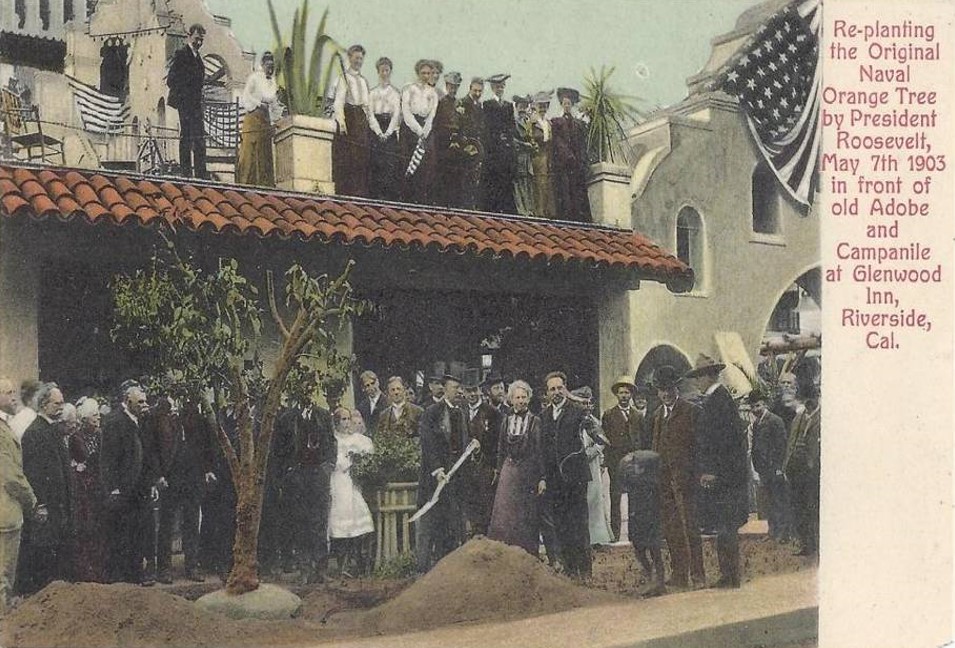
That must have been about here (the name of the hotel was changed to Mission Inn). Alas, the tree died after a couple of years. But it was there long enough to be used in marketing:
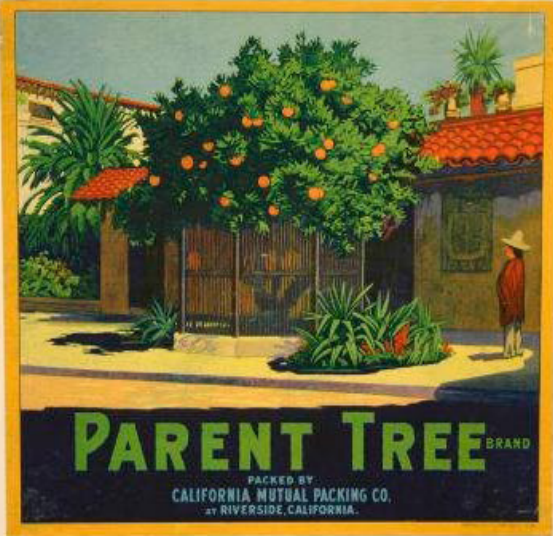
The other ‘parent tree’ was planted a couple of miles south of the Glennwood Inn, in Low Park. It is still there, see for yourself, about 145 years old, despite its dire state 50 years ago:
for some years past it has been declining in vigor, and in 1967 seemed unlikely to survive much longer.
The tree is a ‘California historical landmark’ and has this plaque in front of it:
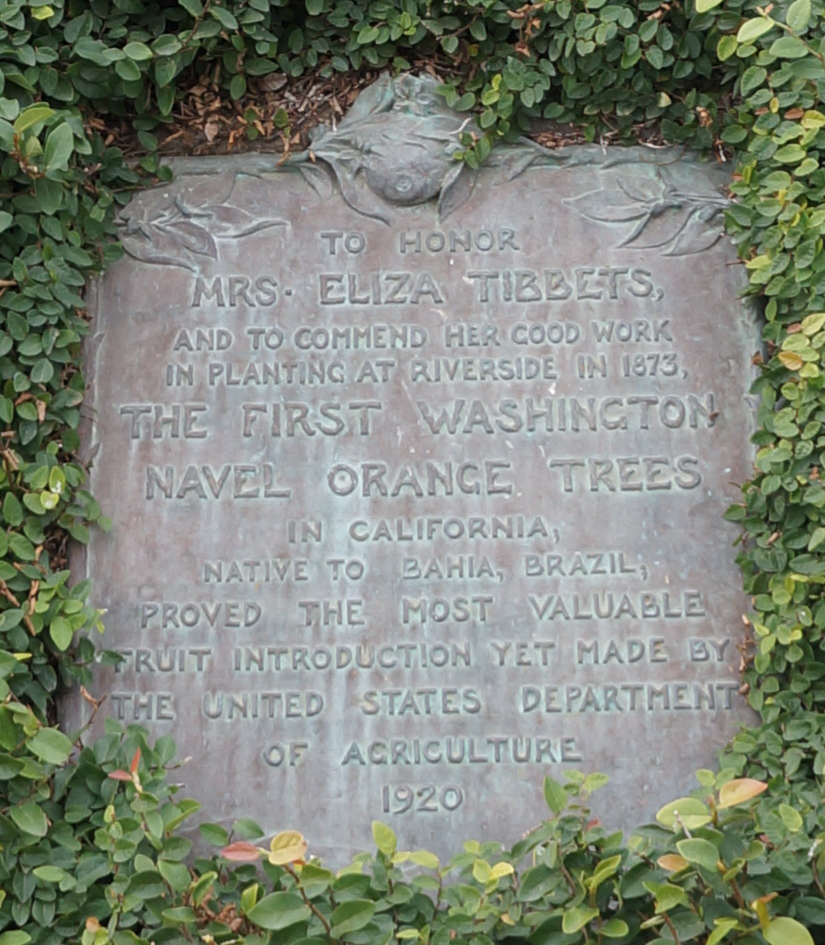
which states that, as of 1920, this was the
most valuable fruit introduction yet made by the USDA.
Was that a fair claim back then? And if so, is it still true? There is some economic analysis here and here.
Riverside does not boast only that tree, it also has the California Citrus State Historic Park. And after you visit that, drive east to the Coachella Valley to see the dates that were introduced a few decades later. 7
Nibbles: Ancient faba, Ampelography double, S. African cattle, CIMMYT in Ethiopia, Seed pix, Heirloom pix, Trifolium genome
- Faba beans came before cereals in Galilee.
- Wine is not quite so old in Georgia, but still pretty old. But will they be able to genotype it?
- South Africa is a cattle melting pot.
- Getting improved wheat out there in Ethiopia.
- These seeds are definitely ready for their close-ups.
- Speaking of close-ups: Amy Goldman has a new book out.
- First forage clover genome. More and more difficult to think of firsts.
Brainfood: Camel diversity, Livestock vs wildlife, Tunisian fig diversity, In vitro artichokes, Habanero diversity, Sorghum diversity double, Greek cherry diversity, Barley domestication, Omani bananas, IBPGR collecting, Buckwheat flow
- Molecular characterization of camel breeds of Gujarat using microsatellite markers. The two sympatric camel breeds Kachchhi and Kharai are genetically distinct.
- Beefing Up Species Richness? The Effect of Land-Use on Mammal Diversity in an Arid Biodiversity Hotspot. Livestock and wildlife can co-exist.
- Analysis of genetic diversity of Tunisian caprifig (Ficus carica L.) accessions using simple sequence repeat (SSR) markers. Diversity low and mixed up.
- A validated slow-growth in vitro conservation protocol for globe artichoke germplasm: A cost-effective tool to preserve from wild to elite genotypes. Sounds promising.
- Synthesis of a base population of Habanero pepper. That’s an equal mixture of F2 seeds from all crosses obtained among 31 accessions. Now go crazy, breeders!
- ISSR-based analysis of genetic diversity among sorghum landraces growing in some parts of Saudi Arabia and Yemen. Differentiates some white from dark-grained landraces, and among some geographic areas.
- Assessment of sorghum germplasm from Burkina Faso and South Africa to identify new sources of resistance to grain mold and anthracnose. Breeders book flight to Ouagadougou.
- Diversity of morpho-physiological traits in worldwide sweet cherry cultivars of GeneBank collection using multivariate analysis. The national and international material from the Greek genebank falls into 3 groups. Apparently that will be useful to breeders. Who are unavailable for comment.
- Barley domestication: the end of a central dogma? Non-centres, not centres.
- Distribution and diversity of banana (Musa spp.) in Wadi Tiwi, northern Oman. An unfavourable environment at a crossroads of trade routes makes for interesting diversity.
- Plant genetic resources collections and associated information as a baseline resource for genetic diversity studies: an assessment of the IBPGR-supported collections. IBPGR collecting missions in 136 countries between 1975 and 1995 collected over 200,000 samples: here comes the data.
- Social and environmental influences on tartary buckwheat (Fagopyrum tataricum Gaertn.) varietal diversity in Yunnan, China. Lots of exchange of material among farmers, which needs to continue.
How was this harpago used?
I finally got to see the Feeding the Empire exhibit at the Ara Pacis in Rome on Saturday, and learned a lot about how Rome managed to keep a million people fed most of the time. In one of the display cases, I saw this astonishing implement.
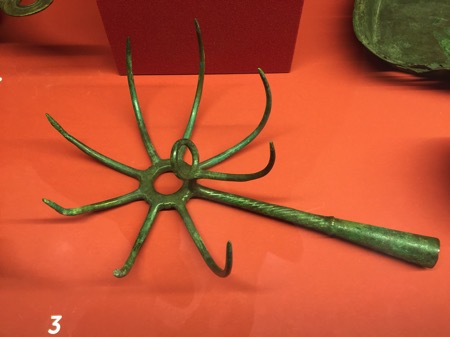
It was labelled simply Harpago. No explanation, nothing. The word seems to be linked to harpoon, and is translated as “grappling iron” in some places. It also shows up “in insect morphology for the distal end of a genital clasper” and lends its name to spiny sea snails and a plant commonly known as Devil’s claw, Harpagophytum spp.
All of which makes perfect sense. But what on earth does it have to do with the preparation of food?