- An investment in organic research. At last.
- Plant models go online. Not those kinds of models.
- Where the peppers for Tabasco sauce come from.
- Apparently, “[w]hite alpacas have been overbred.” But not that kind of breeding, I think.
- Pigs are weird.
- Learn how to make poles. Yes, those kinds of poles.
- Even ducks can be heritage.
- Higher carbon dioxide bad for nutrition.
Saluting Edmond Albius
By the late 18th century, a ton of Mexican vanilla was worth … “its weight in silver.”
That’s just one of the fun facts I learned from Robert Krulwich’s rendering of the bittersweet story of the slave boy on the Indian Ocean island of Réunion who discovered how to manually pollinate vanilla. Or did he? Well, that’s the point of the story. If you read the whole thing over at National Geographic’s blogs, you also get the benefit of some really charming drawings.
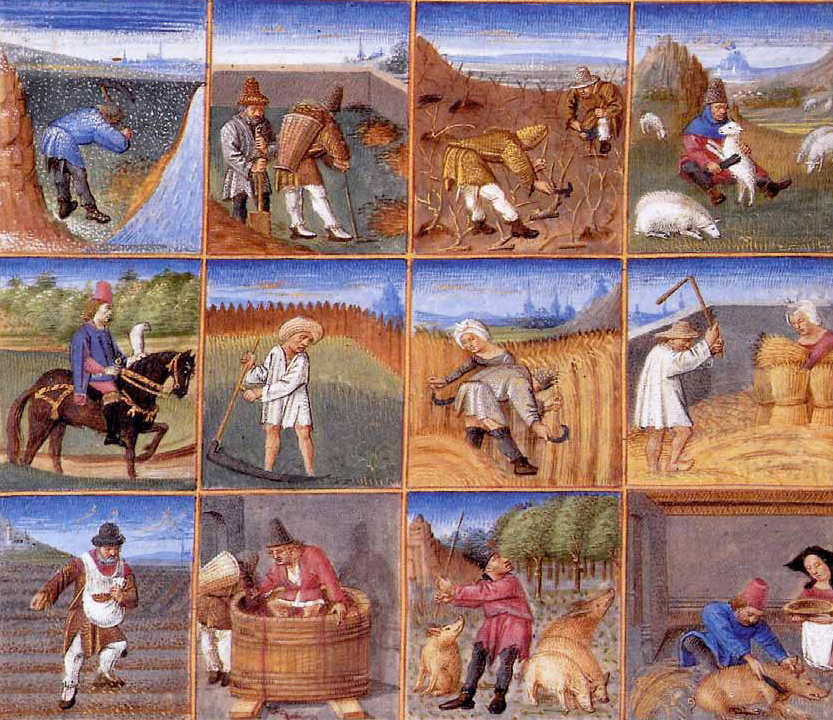
Ruralium commodorum
Medievalists.net has a great article today on the yearly cycle of farming activities, as illustrated in a 15th century manuscript. It reminded me that I really ought to link to FAO’s crop calendar database one of these days.
Nibbles: EU meet, Green cities, Gates strategy, Indigenous hunger, Niche coffee, Salinity, Botany rules, Pollinator evidence, Sacred cows, Coke bottles
- A couple of EU DGs discuss farming for diversity, maybe even diversity in farming?
- They recently heard about urban farming from FAO, which might help. Oh no, wait, that’s a different DG.
- Gates Foundation doubles down on nutrition, nice to see agriculture in the mix too.
- Meanwhile, efforts are underway to measure the food security of indigenous people in better ways, so that we can figure out whether things like the above are actually working.
- Sourcing high quality coffee. I think we can all get behind that goal.
- Deconstructing salt tolerance in chickpea.
- Botany has an image problem. No, really?
- Fact-checking pollinator decline.
- Only local cows for Haryana. Seems extreme? Well, Michigan not above doing the same.
- Coca-Cola has plant-based bottles. Now to embed some seeds in them.
- Maybe Swedish vegetable seeds. Do they have Coke in Sweden?
Nibbles: Savannah diversity, Omani banana, Truffle dogs, Taro & reef, Organic returns, Interspecific hybrids, Silk worm DNA, Indian diversity, American-Indian diversity, Aquaculture, Edge of Extinction, Inga key, Mexican forests, Mexican genebank, Beer, Spanish wheat, Commodities & SDGs
- Metabarcoding of poop reveals secret of large herbivore diversity in African savannahs.
- Unique Omani banana fights pests.
- Truffle dogs: “Il cane, le corna non te le mette mai…”
- Traditional taro cultivation protects Hawaiian reef.
- Organic farming pays.
- Climate change favouring offspring of interspecies hybridization. Also in crops? Like brassicas maybe?
- Domestication of silk worm probed molecularly. Is that even a word?
- Video explains Baranaja. Spoiler alert: it’s the diversity, stupid.
- And along the same lines: rare seeds go home.
- Brazil wants to be among the top 5 fish producers in the world. What could possibly go wrong.
- Extracts from Jules Pretty’s book on what we can all learn from more nature-loving societies.
- The key to Inga conservation. Is keys.
- Community-based forest management in the Yucatan: “Future generations have the right to know them.” And not just the trees, bees too.
- Since we’re in Mexico: a visit to the genebank.
- The women of beer. None of them using cassava, though, alas.
- “El mercado tiene sus normas y los científicos no las conocemos”.
- Agro-commodity traders can be good for you. Somebody mention the market?