- I say ale, you say beer.
- Ireland has a patron saint of beer. Well of course it does.
- The bread of the Gauls was made from beer foam.
- Reviving ancient beers. Wait, what’s with all this beer today?
- Genetic Resources in Plant Breeding: Conservation, Characterization and Utilization, 17-28 August 2015, Swedish University of Agricultural Sciences (SLU), Alnarp, Sweden: More detailed information on this course coming soon…
- Not that these guys in Florida need it.
- Pix of kids’ breakfasts from around the world.
- Development and biodiversity can coexist: here come the data.
- African leafy veggies have truly arrived, haven’t they, if they’re getting the Fairtrade treatment.
- But it might be too late for some medicinal plants.
- Phytoliths 101.
- What’s that you say? You want to integrate agrobiodiversity in your climate adaptation plans? Got just the thing for you.
Wheat roundup
Great to get an email update from Andy Forbes yesterday on the latest developments at Brockwell Bake. They’ve been busy with their Nordic colleagues of late, as you can read in the latest edition of True Loaf. 1 But the big news is they’ll be on the BBC’s Food Programme later today, along with lots of other heritage wheat enthusiasts.
And the wonderful Wheat Gateway has had a couple of tweaks over Christmas:
Wheat *hub *pages such as for Hen Gymro are intended to link up available historical references, morphological descriptions and modern imagery to germplasm data and in due course current cultivation and usage reports for landrace and other heritage lines of specific interest.
“*with image*” searches on the database has been added so the various image resources (USDA, INRA, BBA, NordGen) can be targeted by users – inspired to do so by the immaculate image collection of the Nordic Genebank.
Brockwell seem to be cornering the market in wheat genetic resources information systems.
Oh, and since we’re at it, here’s philosopher Julian Baggini on our duty of stewardship towards einkorn.
Wild potato diversity halved
 David Spooner and co-workers have written a comprehensive overview of the systematics and genetics of wild and cultivated potato species (Solanum section Petota) 2. This nicely illustrated and very accessible paper is essential reading for anyone interested in potato diversity — or indeed the study of plant diversity in general.
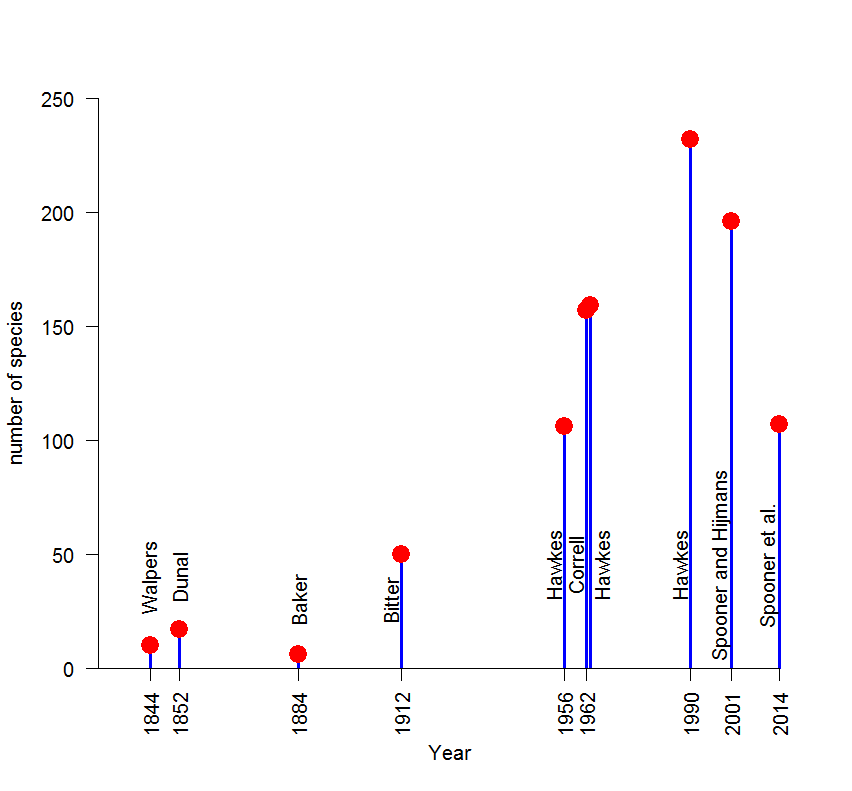
A remarkable aspect of wild potato systematics is the way the number of recognized species has fluctuated over time. In 1956, Hawkes recognized 106 species, but in his 1990 treatment of the group this had increased to 232. This will likely be the highest number we’ll see, because it has come down drastically since, and Spooner et al.’s paper puts it at 107 — almost exactly where it was back in 1956. This does not mean that we are back to the same set of taxa though. Many new species were described after 1956, notably by Carlos Ochoa, who named about 25% of the 107 species. 3
The graph below shows the number of species over time, based on published compilations, and the name of the authors 4 .
It is not easy to determine where a wild potato species begins and where it ends. Many species look very similar, and there is “lack of strong biological isolating mechanisms and the resulting interspecific hybridization and introgression, allopolyploidy, a mixture of sexual and asexual reproduction, and recent species divergence.” A smaller number of species is not necessarily better, but, in the case of wild potatoes, Spooner et al. think it will help us move away from “a taxonomy that is unnatural, unworkable, and perpetuates variant identification” to a system that hopefully enables better conservation and use of these plants.
It also creates a mess, though, because previous analyses based on species level diversity, for example to set collection and conservation priorities, may need to be revised. Spooner et al. update some of the analysis of geographic pattern in wild potato species richness described previously.
The reduction in the number of species is in large part due to new insights from David Spooner’s incessant work on this group, through molecular and morphological studies, and observations during collecting expeditions. His kind of naturalist is a species that is also declining in numbers, or so it seems. That is not a good thing, as there is a lot of work to do.
Nibbles: Tilapia pros & cons, Cotton history, Potato diversity, Mars sustainability, Forest conservation, Homegardens, Village forests, 14th century gardening, American chestnut, Soil barcoding, Non-cow milk, Conserving Spanish grapes, Biodiversity & poverty
- The truth about tilapia. Well, according to Fox News, anyway.
- “..the greatest industry that ever had or could by possibility have ever existed in any age or country.” Go on, guess. No, not tilapia aquaculture, though it has time.
- Modern Farmer gives us its hipster take on the potato. And bows out?
- Mars unleashes its sustainability policies.
- The Forest Stewardship Council gives examples of community-based conservation success stories.
- Homegardens for nutrition. (No, no pre-cooked bean products here).
- Ok, put the two previous together and you get this: Sumatran village forests.
- Bet those villagers don’t need a gardening manual, unlike Henry VIII of England.
- The American chestnut continues its comeback. Manual probably available.
- After barcoding: metabarcoding.
- Symposium on non-cow milk. Sounds like fun.
- “With more diversity, the more tools we have to fight against problems like climate change.” Yes, even with wine grapes.
- Biodiversity goods and bads: the role of biodiversity in poverty alleviation.
Sweet potato expert passes away
Very sad to hear of the passing a few days ago of Dr Daniel F. Austin. Among other things, he was one of the world’s top experts on the biodiversity of the sweet potato and its wild relatives.