- Daniel Zohary: Geneticist and Explorer of Plant Domestication. Nice profile of iconic explorer of agricultural biodiversity.
- The date palm with blue dates Phoenix senegalensis André (Arecaceae): A horticultural enigma is solved. A variety of P. canariensis, as it turns out.
- Crop diversification as a smallholder livelihood strategy within semi-arid agricultural systems near Mount Kenya. It will work better at higher elevations.
- Change of oases farming systems and their effects on vegetable species diversity: Case of oasian agro-systems of Nefzaoua (South of Tunisia). Not working at all in oases.
- Clonal diversity and genetic differentiation revealed by SSR markers in wild Vaccinium macrocarpon and Vaccinium oxycoccos. Cranberries have much more variation than previously thought.
- Two decades of InterDrought conferences: are we bridging the genotype-to-phenotype gap? Yes, slowly, but genomics will help. Eventually.
- Microsatellite Marker-based Genetic Diversity of Seed-use Watermelon (Citrullus lanatus ssp. vulgaris var. megalaspermus Lin et Chao) Collections. They’re all very similar.
- On the History of Cattle Genetic Resources. The loss of breeds adapted to local conditions and extensive management are the main threats to the genetic diversity amassed over the past 12,000 years.
- The vulnerability of US apple (Malus) genetic resources. Could be worse. Could be better.
A meaningful date
There is a wonderful piece by the Kitchen Sisters on US National Public Radio about the history of dates in California — and about plant exploration, politics, and people.
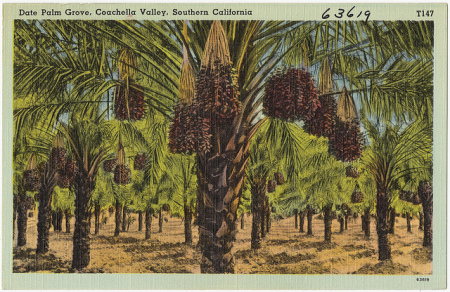
There are about 3400 ha of date palm in the Coachella Valley, a Southern California desert. Here is a road side view (note how you can you can estimate the growth rate by comparing with the 2007 street view photo) and here is another grove. Wikipedia says that that the Spanish introduced the date palm to lower California (Mexico) in 1765; but Walter Swingle gets the credit for bringing the plant to the USA (see this letter by David Fairchild). In 1903 he collected Deglet Noor in Biskra, Algeria, and in 1929 he collected the prized cultivar Medjool in Morocco.
Coachella date grower Patricia Laughlin has this to say about that:
When the Medjool dates came in, there were only nine offshoots that all of the present trees come from. These medjools came from the oasis of Bou Denib. It’s been wiped out by a disease in Algeria and Morocco. We have sent back good plant stock to return to those areas from which they originated. My husband and I visited. It’s over the Atlas Mountains from Marrakech — out really in the desert. When we got to Bou Denib, the mayor came out to greet us. It was a big occasion. And he said why would anyone from the United States want to come to Bou Denib? We had worked with the Medjool dates for so many years and to see where they originated was very meaningful for us.
Nibbles: R&D, Cheese double, Cali candied yams, Sustainable joe, Soy & deforestation, Cereals in Sudan, Big Ag, History of breeding
- ASTI says agricultural research investment in Africa is bearing fruit and needs to double.
- There’s a cheese revolution going on in America’s heartland.
- Meanwhile, the UK is worried about fake goat cheese.
- “Apparently, Californians like well-tanned sweetpotatoes.” Well of course they do.
- Good coffee AND conservation? I’ll take it.
- Soy AND conservation in Brazil? Well, not quite, but good news nonetheless.
- Cereal cultivation in Sudan pushed back several hundred years.
- What are the conditions for success in large-scale agricultural initiatives? You tell them.
- The history of crop improvement 101.
Nibbles: Farmers’ markets, Pacific news, Solanaceae news, Globally Important Agricultural Heritage Systems, Tibetan barley, Rice roundup, David Lobell interview, Native American crops, Mesopotamian recipe, Insectophagy, Cities, Land purchases, Dormancy in evolution, Bad news from some crops, Good news from others, Creative Commons at Gates
- Hell of a week in the office again, so catching up on accumulated Nibbles on a Sunday. Because we’re here to serve.
- Cynical, funny take on farmers’ markets: “No, I don’t save seeds. That’s time-consuming nonsense for backyard gardeners. Yes, I’ve heard of Monsanto. I’m a farmer. I know about goddamn Monsanto.”
- Uncynical double from the Pacific: Samoa’s agricultural show and more detail on the aroid breeding work.
- High tech breeding of solanaceous crops. Nothing like this for aroids yet, alas. Yeah, but first you have to collect the little blighters.
- On the other hand, you also need an awareness of the past. Ask the Tibetans.
- And here’s kind of an example of that involving rice in India. Compare with that first Nibble: seed saving not just for backyard gardeners after all? Convinced? Go do it, no, really. Or read Bob Zeigler; you can listen to him too. We could go back and forward on this forever. I know: let’s get some data.
- And another example involving wild not-rice in the US and Canada. Though there are some things that haven’t survived quite as well among Native Americans as those wild rice recipes.
- And speaking of ancient recipes, here’s one from another wetland, far far away from the above.
- Yeah but not all ancient recipes are so resilient, take beetles for example.
- Urban farming is big, needs to be bigger.
- Meanwhile, agricultural land is being bought up all over the place, for what it’s worth, so maybe cities will be all we have to grow stuff.
- International Cocoa Organization calls bullshit on all those chocolate-is-running-out stories.
- Maybe we should chill about wine too? I dunno, I think I’d prefer to play it safe with both. Or get help from above. Or from the Fascists.
- The banana was going extinct too, wasn’t it?
- British apples (and other trees, to be sure) are of course perennially in trouble, but help is on the way, courtesy of Kew. And not just British or apples that get help from that quarter.
- “The potato will not only survive climate change, it will help us to survive it as well.” Good news at last.
- Mapping cassava, all of a sudden an exciting new crop, if you can believe it. No stopping it now that Bill Gates has called it the world’s most interesting vegetable.
- Incidentally, he’s also decided to go totally CC-BY.
- And that’s all she wrote. For now.
Nibbles: Chocolate, MAS, Cash crops, Medicinal plants, Rice domestication, Cat genome, Banana research, Artichoke history, Root vegetables, Diabetes data, eMonocot, Paris herbarium, Appleseed, Seed saving, Potato safety duplication, Seed atlas, Botanical Jurassic Park, Mapping urban fruit, Midwest road trip, Iraqi marshes, World Digital Library, World Parks Congress, Plant demography
- Ok here goes, there’s a week’s work of Nibbles we’ve got to catch up on.
- World running out of chocolate! Tell that to Cologne.
- Yeah well I prefer tea to cocoa.
- Greenpeace: “Smart breeding” will save us, not GMOs. Breeders: All breeding is smart.
- Guess the world’s biggest cash crop. Yeah, that one.
- Alas, it’s not included in the recent strategy for conserving medicinal plants. Not that it would need conserving.
- The domestication of the world’s biggest crop, period. Deconstructed. And if you want to drill down.
- And of the world’s biggest fruit.
- And of the world’s biggest pet.
- And of the world’s most difficult to eat vegetable.
- Root “vegetables” made simple. Because winter.
- And why you must eat your veggies, including the difficult ones.
- Videos on Kew’s monocot database and on the renovation of another famous herbarium.
- The real Johnny Appleseed.
- But you too can save seeds, just like Johnny.
- But don’t forget to safety duplicate, like CIP has done, at Embrapa.
- And this shows you what those seeds can look like.
- You don’t necessarily need seeds to save plants, though.
- Mapping fallen fruit. Because we can.
- Road trip!
- Boat trip!
- Selected Techniques in the Art of Agriculture. From French to Turkish to Arabic. One of many nifty agriculture-related resources in the World Digital Library.
- Oh yeah, the IUCN World Parks Congress has been on and its all over the intertubes. Including with neat visualizations, natch.
- How many of the species in the COMPADRE database of plant demography information are in protected areas? How many are crop wild relatives? I need an intern.