- New threats to endangered Cook’s scurvy grass (Lepidium oleraceum; Brassicaceae): introduced crop viruses and the extent of their spread. Introduced crop virus threatens endemic.
- Role of adaptive and non-adaptive mechanisms forming complex patterns of genome size variation in six cytotypes of polyploid Allium oleraceum (Amaryllidaceae) on a continental scale. It’s not the environment.
- Evolution and ecology meet molecular genetics: adaptive phenotypic plasticity in two isolated Negev desert populations of Acacia raddiana at either end of a rainfall gradient. It’s the environment.
- Using biodiversity to valorise local food products: the case of fish ponds in a cultural landscape, their biodiversity, and carp production. It could work, if only people liked to eat carp and knew what biodiversity was.
- Phenotype and genetic diversity in potato onion cultivars from three provinces of northeast China. In other news, there’s something called a potato onion. Otherwise, this is actually a deeply boring paper.
- The value of genetic information to livestock buyers: a combined revealed, stated preference approach. Low to none, for now.
- Ecosystem Services. Latest issue includes a bunch of interesting reviews, and an editorial summarizing each in like a paragraph. Great service, great value. See what I did there?
- Scientific documentation of crop land changes in the Sahel: A half empty box of knowledge to support policy? There is no data, not really.
Nibbles: Vietnamese rice, Intensified rice, Photographed rice, No rice, Rice and beans, Ecosystem services
- Vietnamese rice varieties get sequenced. What will IRRI think?
- Well, they may be too busy cosying up to SRI to respond.
- A rice farmer does feature in a nice Christensen Fund slideshow.
- But no rice in these 12th century recipes.
- You know what goes well with rice? Beans, that’s what.
- And now, for something completely different: Ecosystem Service Valuation Toolkit.
Brainfood: Wild pepper, Lettuce gene, Qat genetic structure, Date oases, Raised fields, Waxy sorghum, Striga resistant cowpea, Wild soybean, Kenaf diversity
- Domestication, Conservation, and Livelihoods: A Case Study of Piper peepuloides Roxb. — An Important Nontimber Forest Product in South Meghalaya, Northeast India. Managed crop wild relative manages to turn a profit for Indian forest dwellers.
- Expression of 9-cis-EPOXYCAROTENOID DIOXYGENASE4 Is Essential for Thermoinhibition of Lettuce Seed Germination but Not for Seed Development or Stress Tolerance. Managed crop wild relative gene could eventually turn a profit for commercial lettuce growers.
- Evaluation of microsatellites of Catha edulis (qat; Celastraceae) identified using pyrosequencing. Can be used to trace origin. The Man exults.
- Date palm as a keystone species in Baja California peninsula, Mexico oases. Jesuit-introduced exotics can be keystone species too. The Pope exults.
- Ancient human agricultural practices can promote activities of contemporary non-human soil ecosystem engineers: A case study in coastal savannas of French Guiana. Formerly managed landscape now managed by soil organisms.
- A novel waxy allele in sorghum landraces in East Asia. Out of East Asia…
- Identification of new sources of resistance to Striga gesnerioides in cowpea germplasm. As ever, they are not the ones farmers actually like.
- Development of EST-SSR markers for diversity and breeding studies in opium poppy. And, they work on the related species! Afghans exult.
- Kunitz trypsin inhibitor polymorphism in the Korean wild soybean (Glycine soja Sieb. & Zucc.). In other news, there is wild soybean in Korea.
- Genetic diversity and phylogenetic relationship of kenaf (Hibiscus cannabinus L.) accessions evaluated by SRAP and ISSR. Originated in Kenya-Tanzania area.
The grapevines of Pompeii
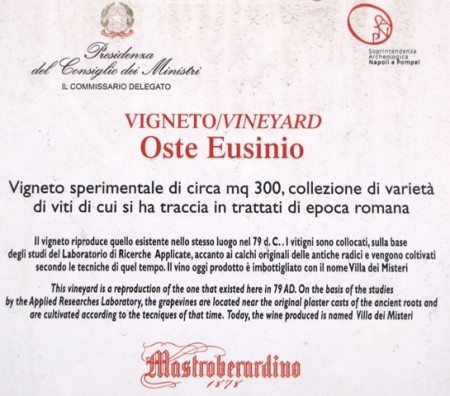
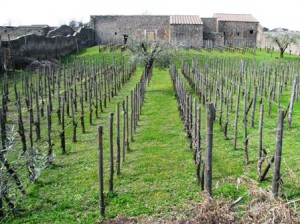
According to Mastroberardino, wine played a central role in the lives of the Vesuvian people. Archaeological excavations, botanical studies, and the discovery of casts of vine roots and their support stakes have confirmed that vines were grown within ancient Pompeii’s city walls, in the gardens and orchards which beautified villas, and especially in the quarters located on the outskirts of the city, near the amphitheatre.
Brainfood: Moroccan almonds, MAS in potato, Mexican maize market, History of agronomy, Malian querns, Hani terraces, Conservation modelling, Wild Cucumis, Pathogens and CC
- Moroccan almond is a distinct gene pool as revealed by SSR. Ok, now what?
- Molecular markers for late blight resistance breeding of potato: an update. Ok, now what?
- Reconstructing the Maize Market in Rural Mexico. Not so free after all.
- Why agronomy in the developing world has become contentious. Neoliberalism, participation and environmentalism. The answer? Political agronomy.
- Millet and sauce: The uses and functions of querns among the Minyanka (Mali). Form depends on more than just function.
- Landscape pattern and sustainability of a 1300-year-old agricultural landscape in subtropical mountain areas, Southwestern China. If it ain’t broke, why fix it?
- Mathematical optimization ideas for biodiversity conservation. Fancy math works sometimes but not always. Wonder if it would work on the Hani terraces above. Or on Mexican maize for that matter.
- Mitochondrial genome is paternally inherited in Cucumis allotetraploid (C. × hytivus) derived by interspecific hybridization. Not the chlororoplast genome though. Weird. But now what?
- Migrate or evolve: options for plant pathogens under climate change. Or, indeed, both. But we need better models, and a better handle on what human interventions can do. Interestingly, pathogen diversity may well increase in some places.