And we interrupt our holidays again for an important announcement. Dr Mike Jackson, who worked at IRRI for some two decades, much of that in the genebank, has been awarded an OBE in the New Year Honours List. Congratulations, Mike!
Mexican dog brainfood
What’s that they say about a little knowledge? I knew the Aztecs ate dogs. I knew they kept a hairless breed of dog. So I naturally assumed they bred the hairless breed for food. So much more convenient not having to deal with all that hair in the kitchen.
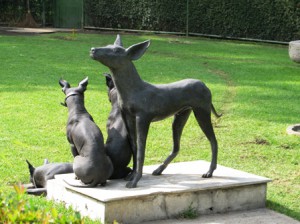 Wrong. I’m sure there’s a name for this kind of logical fallacy. Be that as it may, a recent visit to the Dolores Olmedo Patiño Museum, in Xochimilco, Mexico City, where they keep a pack of that hairless breed, which is called Xoloitzcuintle by the way, quickly disabused me. A notice there points out that the name Xoloitzcuintle makes reference to Xolotl, a god associated with death (among other things). Dogs were supposed to accompany the dead on their way to the next world. Not the done thing to eat them, then, surely. It must have been other breeds that were eaten.
 Well, maybe. The Wikipedia article on Xolotl says that “the meat of the Xoloitzcuintle was very much part of the diet of some of the ancient peoples of the region.” There’s no reference for that, though. What seems clear is that there were, indeed, other dog breeds. Many of the representations of dogs don’t really look like the Xoloitzcuintle at all. Squatter and fatter. Dare I say it? Jucier. There are many of them, mainly in pottery, at the museum, though I was not allowed to photograph the ones indoors.
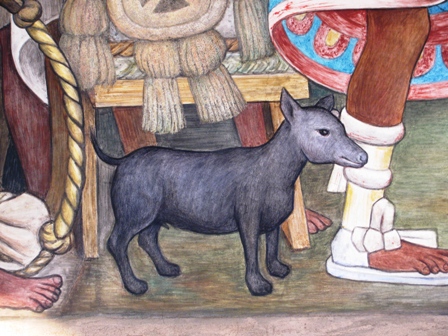
Diego Rivera seems to have had a thing about Aztec dogs, by the way. He painted them a number of times. Here’s an example from the Palacio Nacional mural. Interestingly, though, they look a lot more like the pottery pieces than the actual Xoloitzcuintle specimens roaming around the gardens of his friend Dolores’ house.
Nibbles: Law book, Sheep breeding, Pig breeding, Pink mushrooms, Coconut genome, Cassava genome, Apples in the Big Apple, Street food, Irish corner, Peach palm tissue culture, Seed saving, Kenyan farmers, First farmers, Tenure, Peppermint facts, Mountains, Taro network, Shea
- Juliana Santilli guest-blogs on the book Agrobiodiversity and the Law over at Agrobiodiversity Grapevine.
- ICARDA tells communities how to set up a sheep breeding programme.
- While an Indian institute breeds pigs, with Canadian help.
- Another Indian institute does the same for mushrooms, with no help.
- And yet another sequences the coconut genome.
- While BGI sequences a whole bunch of CIAT cassava stuff. Only yesterday they were doing rice. Yeah, but only 50, and you gotta keep those sequencers going, don’t you? Would be nice to know how much the CGIAR is paying BGI annually. Do they get frequent flyer miles? Have they negotiated a corporate rate?
- A Kazakhstan apple tree grows on the East River. A forest, actually. If it had been in England, it might eventually feature here. Ok, ok, our quest for connections is occasionally overdone. Made you look, though.
- Ah, kimchi! Ah, fish empanadas! So much interesting food, only one stomach lining…
- Danny tells us about Ireland’s CWR database. In other news, Ireland has CWR. Oh, and then he goes crazy on the Biodiversity for Nutrition mailing list. Did he get his goat is what I want to know.
- AoB on in vitro peach palms. Why read the paper, when AoB abstracts the abstract?
- Bifurcated Carrots on seed saving in Canada. Video goodness galore.
- And while we’re talking cinema, here’s news of a movie on a year in the life of four Kenyan farmers.
- From Kenyan farmers to First Farmers. The Womb of Nations. I like that. And more. Agricultural hearths. I like that too.
- Four days of discussion about land tenure. May not be enough, actually.
- “…70 per cent of the peppermint sold in the US is descended from a mutant in a neutron-irradiated source.” Good to know.
- I missed International Mountains Day. Again.
- That EU-funded taro mega-project from a PNG perspective.
- What I like about this Worldwatch series on neglected plants is that they’re not factsheets. Yet.
Nibbles: Maize and beans, Kenyan stories, Mesopotamia, Rice Domestication, Food economics, Pest control
- The climate change boys have been looking for places where maize and beans will, and will not, thrive.
- An Australian journalist reports from Kenya, courtesy of The Crawford Fund.
- Rewriting the metanarrative of The Fertile Crescent.
- Dorian Fuller goes on to examine recent papers on rice and millet domestication … so we don’t have to.
- Back40 previews Tyler Cowan’s new book An Economist Gets Lunch: New Rules for Everyday Foodies. Can I wait until April?
- How to control stemborers and striga with agrobiodiversity. Undated. Is it new?
- Arche Noah revitalized? Again, is this new? C’mon people, date those suckers.
Christmas gifts
Does this avalanche of news articles about frankincense happen every year around Christmas?