- Genebank genomics bridges the gap between the conservation of crop diversity and plant breeding. What do we want? An accurate genotype-to-phenotype map for all seeds stored in the genebank. When do we want it? As soon as we have the money to ensure their conservation.
- The origins of cannabis smoking: Chemical residue evidence from the first millennium BCE in the Pamirs. Well, that’s like your opinion, man. Residues in incense burners used for mortuary rituals, if you must know.
- Patagonian berries as native food and medicine. Good, and good for you.
- Revisiting the Origin of the Octoploid Strawberry. Not 4 separate diploid progenitors, as another paper recently found, but rather 2 extant ones, once you re-do the math.
- The Nutritional Contribution of Potato Varietal Diversity in Andean Food Systems: a Case Study. It’s great, but it’s not enough.
- The origins and adaptation of European potatoes reconstructed from historical genomes. Sequencing of old herbarium specimens, including Darwin’s, shows that early introductions to Europe were from the Andes, and later admixed there with Chilean and wild material, forming a sort of secondary centre of diversity.
- Effect of Intensive Agriculture-Nutrition Education and Extension Program Adoption and Diffusion of Biofortified Crops. Breeding is not enough.
- Morphological characterisation and evaluation of cacao (Theobroma cacao L.) in Trinidad to facilitate utilisation of Trinitario cacao globally. Now we know which ones are the best, for different reasons.
- Evolution of US maize (Zea mays L.) root architectural and anatomical phenes over the past 100 years corresponds to increased tolerance of nitrogen stress. There has been unconscious selection for root traits resulting in better N use efficiency. An old paper, resurrected because of the next one.
- Breeding improves wheat productivity under contrasting agrochemical input levels. Breeding wheat in Europe for good performance under high input levels has not markedly affected its performance under more challenging conditions. Diversity has held up too.
- Positive outcomes between crop diversity and agricultural employment worldwide. Irrespective of input levels and economic growth rates.
- National food production stabilized by crop diversity. Crop diversity is not just good for rural employment (see above), but for year-on-year production stability too.
- Climate change and cultural resilience in late pre-Columbian Amazonia. And it was sort of the same in ancient Amazonia.
- Effects of Fairtrade on the livelihoods of poor rural workers. Fairtrade improves wages of workers in cooperatives, but not on small farms.
The past and future of the Silk Road
An interview with Robert N. Spengler III, author of Fruit from the Sands: The Silk Road Origins of the Foods We Eat 1 reminds me that there have been a couple of interesting papers about that part of the world recently that I was meaning to blog about.
- The domesticated apple originated half way along the Silk Road, and spread in both directions, changing most drastically in Europe due to intensive introgression from the crabapple. And more.
- In contrast, citrus fruits originated in SE Asia, and spread westward, Citrus medica (citron) reaching the Mediterranean first, and C. limon (lemon) second, both in antiquity.
- There were northern and southern routes of crop movement through central Asia, plus a maritime route.
Given the importance of the Silk Road in the domestication and the spread of crops, it is perhaps worth asking if the Belt and Road Initiative could be an opportunity for significant conservation actions. WWF has done a preliminary environmental impact assessment, but not focusing particularly on agricultural biodiversity.
Nibbles: Organic Greek, Mexican maize heirloom, Community seedbank, Arizona chilli, African maize, Chinese trifecta, Sex-changing solanum, Breeding oddities, Breeding costing tool, Chicken project, WFP, Cattle book, Agroforestry database, Minor cereals, Reviewing genebanks, Wheat breeding, Rice seeds
- Greek organic farm resists.
- Communities getting into seed banking all over.
- Saving zapalote chico.
- Would you like chiltepines with that?
- No zapalote chico in South Africa, but lots of other maize.
- Conserving agricultural biodiversity in China.
- Including in Hainan.
- At the same time, China restricts foreign access to human genome data.
- Sexually plastic Australian wild tomato named at long last.
- Breeding flavour crops.
- And figuring out how much it will cost.
- Interesting project on human-chicken interactions.
- Veggie breeder wins World Food Prize.
- New coffee table book on cattle in Africa.
- Flagship agroforestry database gets new version. Anyone wanna test it for us?
- Minor cereals in Europe are anything but minor.
- And lots are conserved in Europe’s increasingly scrutinized genebanks.
- Meanwhile, a major cereals keeps getting the attention it also needs.
- “The candidate markers could be used by any rice genebank to potentially identify varieties with seeds that are particularly short- or long-lived in storage. Viability monitoring intervals could then be customized by variety.” And wheat?
European spud history unthreaded
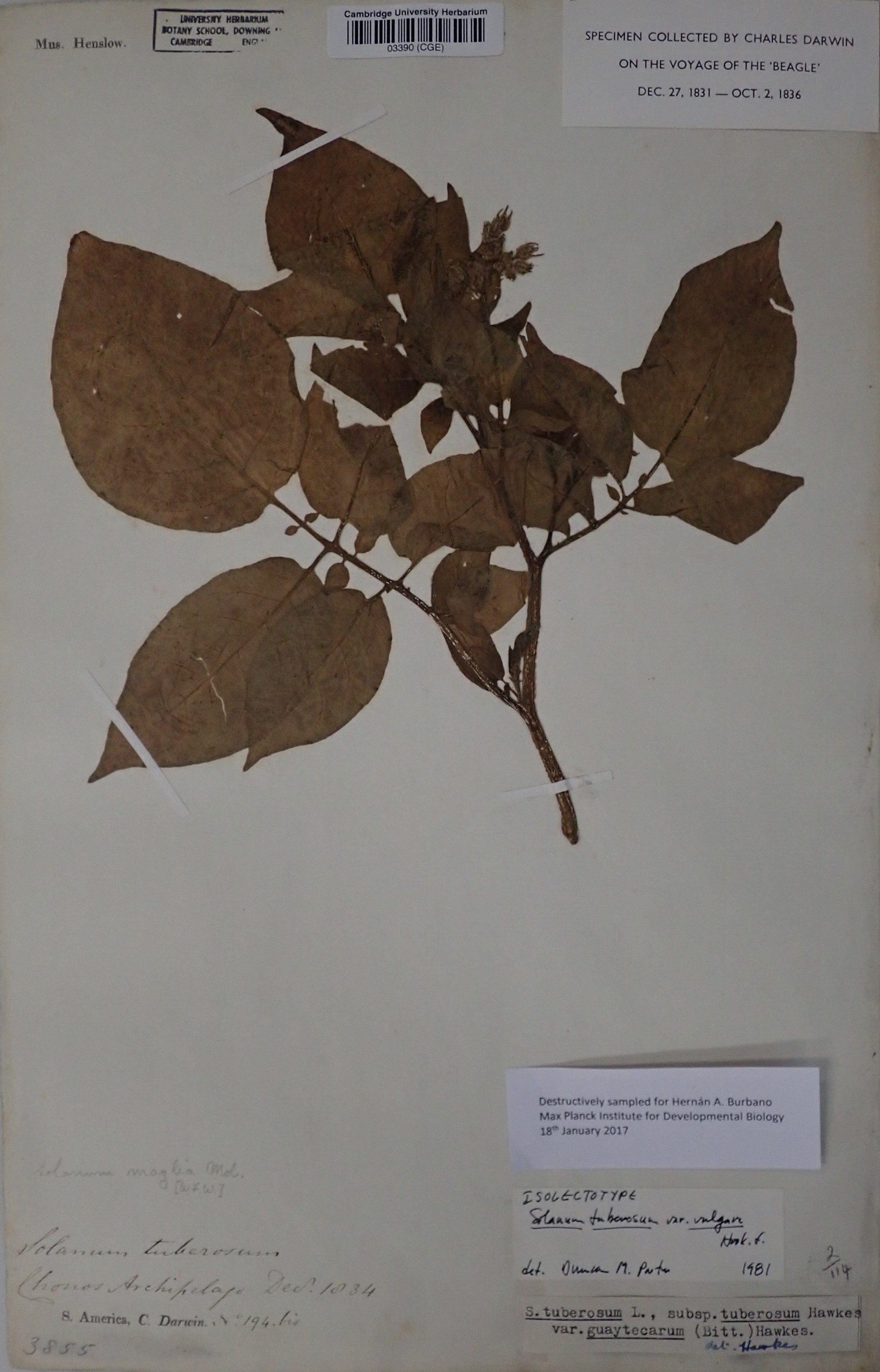
I could blog about the recent paper which used sequencing of old herbarium specimens, including this one collected by Darwin to trace the genetic history of potatoes in Europe. But I think I’ll let one of the authors do it instead, here.
If you don’t like Twitter, you can see the thread unspooled without going anywhere near it.
Brainfood: Macadamia domestication, Middle Eastern wheat, ART virus, Open science, Red Queen, Food system change, Chinese Neolithic booze, Dough rings, Making maps, Biofortification, Endophytes, African maize, Switchgrass diversity, Ancestral legume
- Wild Origins of Macadamia Domestication Identified Through Intraspecific Chloroplast Genome Sequencing. One tree is the basis of the industry.
- The Israeli Palestinian wheat landraces collection: restoration and characterization of lost genetic diversity. Bringing it all back home.
- Using high‐throughput sequencing in support of a plant health outbreak reveals novel viruses in Ullucus tuberosus (Basellaceae). There’s always something…
- Plant health emergencies demand open science: Tackling a cereal killer on the run. …but openness will get us through it.
- Rapid evolution in plant–microbe interactions – a molecular genomics perspective. Until the next one.
- Understanding food systems drivers: A critical review of the literature. Spoiler alert: urbanization, raise in consumer income, population growth, attention paid to diet & health issues, technological innovations, intensification and homogenization of the agricultural sector, increase in frequency and intensity of extreme events, general degradation in soils and agro-ecological conditions, improved access to infrastructure and information, trade policies and other processes influencing trade expansion, internationalization of private investments, concerns for food safety. I guess diversity is in there somewhere.
- The origins of specialized pottery and diverse alcohol fermentation techniques in Early Neolithic China. So good, they invented fermentation twice.
- The Hoard of the Rings. “Odd” annular bread-like objects as a case study for cereal-product diversity at the Late Bronze Age hillfort site of Stillfried (Lower Austria). Unbaked, tarallini-like dried wheat/barley dough rings may have been used ritualistically. No, not like that.
- EviAtlas: a tool for visualising evidence synthesis databases. Everybody likes a map.
- Editorial: Improving the Nutritional Content and Quality of Crops: Promises, Achievements, and Future Challenges. A review of reviews of biofortification, and more.
- Fungal endophyte diversity from tropical forage grass Brachiaria. 38 fungi isolated from 9 Brachiaria species, but unclear if any are beneficial.
- Characteristics of maize cultivars in Africa: How modern are they and how many do smallholder farmers grow? Out of 500 samples in 13 countries, about half were in some way improved, covering about half of the surveyed planted area.
- QTL × environment interactions underlie adaptive divergence in switchgrass across a large latitudinal gradient. You can combine alleles which are locally advantageous in different places to get a
super-biofuel. - Reconstruction of ancestral genome reveals chromosome evolution history for selected legume species. The wild ancestor of peanut, pigeonpea, soybean, beans, mungbean, chickpea, lotus and medics was closest to wild peanuts. Maybe they can synthesize it?