- Worldwide core collections of tea (Camellia sinensis) based on SSR markers. From 788 to 192 doesn’t seem like a great deal.
- Crop Domestication in the Amazon. The first arrivals were not just hunter-gatherers.
- Plant genetic resources and traditional knowledge on medicinal use of wild shrub and herbaceous plant species in the Etna Regional Park (Eastern Sicily, Italy). 71 wild species are used for medicine, but the properties of most are known by only a few informants.
- Traditional knowledge on wild edible plants as livelihood food in Odisha, India. 86 wild species are eaten. No word on the pattern of distribution of knowledge, at least in the abstract.
- Insects in the human food chain: global status and opportunities. The real potential is in animal feed production.
- Energy crops: Prospects in the context of sustainable agriculture. They have a role in Europe to reduce effects of climate change while supporting food security and preserving the environment, but most are in early stages of domestication, and we’ll need more efficient enzymatic systems for the conversion of cellulose, and the development of multiple products.
- Are there systematic gender differences in the adoption of sustainable agricultural intensification practices? Evidence from Kenya. Not for improved seeds, apparently.
- A contemporary decennial global Landsat sample of changing agricultural field sizes. Nine hotspots of field size change, driven by different factors, and not all in same direction. I wonder if you can use this as a proxy for levels of agricultural biodiversity?
- Genome-wide characterization of genetic diversity and population structure in Secale. Limited diversity in improved material, and no structure. Need those genebanks.
- Comparison of the culture performance and profitability of wild-caught and captive pond-reared Chinese mitten crab (Eriocheir sinensis) juveniles reared in grow-out ponds: Implications for seed selection and genetic selection programs. Wild is best. For now.
Nibbles: Australian agrobiodiversity, European forests, Eva, Brazil in Africa, Seasons in the sun, FFS, IRC2014, Shiva farrago, Tricky crops, Genome editing, Amish revolution, Thai rat, Disease spread, Coffee culture
- Bush tucker may be viable business proposition. But doesn’t it taste like crap? And do any crop wild relatives qualify?
- Europe mapping its high value forests. No word on whether crop wild relatives come into the assessment.
- Sorghum breeder reveals all.
- Embrapa supporting African agriculture with help from Gates Foundation.
- How many seasons are there anyway?
- Test yourself on Farmer Field Schools.
- Delve into abstracts for the 4th International Rice Congress (IRC2014).
- New Yorker replies to Vandana Shiva reply to her profile in the New Yorker.
- Some crops resist mechanization.
- Editing the horns from cattle genome.
- A young Amish farmer with big ideas.
- Your organic rat, sir.
- Crop pests and diseases are coming to get you.
- Fun reddit with Peter Giuliano, barista extraordinaire.
Nibbles: Palms, Walnuts, Gardening game, Measuring biodiversity, Promoting biodiversity, Restoring land, Honeybee evolutions, Amaranth recipes, Cider communication
- Someone you know might need to know the difference between a coconut palm and an oil palm.
- Or between English walnuts and French walnuts (and much more besides).
- Is an interactive game really the best way for children to learn about organic gardening?
- Canadian Cattlemen magazine shares a woman scientist’s deep insights into measuring biodiversity.
- And Indian priests used Konnsanchem fest to urge the revival of agrobiodiversity.
- Other Indians are restoring their land by getting rid of an interloper crop.
- DNA suggests a new ancestral home for the honeybee.
- Now I know what to do with the amaranth blocking every pavement in Rome: how to cook this prolific leafy green.
- Nominally about cider and apples, Pete Brown downs Strongbow’s communications in a few quick drafts.
Brainfood: Ethiopian wild veggies, Cold tolerant rice, Chickpea genomics, Improved tilapia, Wild cassava oil, Chinese horses, Chinese melon, Seed sampling, Tomato spp sequencing
- Wild and semi-wild leafy vegetables used by the Maale and Ari ethnic communities in southern Ethiopia. 30 of them.
- Collection and Conservation of Cold Adapted Indigenous Rice Landraces from Western Ghats, South India. 56 of them.
- Exploring Germplasm Diversity to Understand the Domestication Process in Cicer spp. Using SNP and DArT Markers. 3 populations among domesticated types; more diversity in the wilds.
- Genetically-Improved Tilapia Strains in Africa: Potential Benefits and Negative Impacts. Mean present value of introducing an improved strain to Ghana is 1% of GDP, but you could get same with better management. Both would of course be best.
- Diversity in oil content and fatty acid profile in seeds of wild cassava germplasm. Some species could be oil crops.
- The Study of Genetic Diversity and Phylogenetic Evolution in Indigenous Horses (Equus caballus) of Gansu. If I understand the abstract correctly, this suggests, among other things, that some local horse breeds can be traced back to Przewalski’s Horse, maybe.
- Microsatellite Diversity, Population Structure, and Core Collection Formation in Melon Germplasm. In China. Frankly not nearly as interesting as the horse story.
- Optimal sampling of seeds from plant populations for ex-situ conservation of genetic biodiversity, considering realistic population structure. 25–30 individuals per population from few but widely-spaced populations.
- Exploring genetic variation in the tomato (Solanum section Lycopersicon) clade by whole-genome sequencing. 20x more diversity in the wilds than the cultivated, correlated with habitat.
- Understanding Sustainable Diets: A Descriptive Analysis of the Determinants and Processes That Influence Diets and Their Impact on Health, Food Security, and Environmental Sustainability. The determinants of sustainability are agricultural, health, sociocultural, environmental and socioeconomic, and fiddling with one to improve it may screw up another.
- Anchoring durum wheat diversity in the reality of traditional agricultural systems: varieties, seed management, and farmers’ perception in two Moroccan regions. Farmers grow both improved varieties and landraces, the latter mainly for their quality characteristics.
- Unraveling the nexus between water and food security in Latin America and the Caribbean: regional and global implications. Production has increased, but at the cost of the natural capital of the region, and nutritional problems persist.
Baobab, frankincense and croton: private sector brings gifts
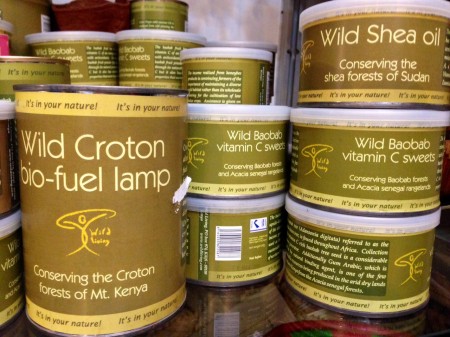
Found these in an up-market curio shop in Nairobi’s Yaya Centre shopping centre. I’ve never come across Wild Living before, but they sound like an interesting outfit, doing some serious value addition to local products by the look of it:
From Baobab and Shea to Leleshwa and Acacia frankinsense forest oils, East Africa, the cradle of mankind, hosts a remarkable diversity of unique natural resources that have provided succour and health during the majority of our evolution.
Whilst traditionally used, the natural benefits of these products, have until now, been unavailable to the global market. Furthermore, Africa’s potential to produce conservation and livelihoods products for its own development has remained unclaimed.
Wild Living realizes this potential by providing a market for over twenty community based projects located throughout East Africa who are being assisted by partner organizations such as WWF and OXFAM to sustainably and ethically produce natural products.
Wild Living publicises the conservation and livelihoods benefits of each of these producers products and through increased sales revenue assists them to continue conserving their unique natural resources whilst building their own lives in a dignified and self-sufficient manner.
Revenues realized by Wild Living through the sale of its brand are used to assist partners in the ethical and sustainable production of goods whilst providing access into an increasingly conscientious consumer market.
Anyone know anything more about them? Are they on the level? In any case, something else to add to those baobab fact sheets.