- Kings, queens and mangosteens. Luigi to report shortly.
- Threshing sorghum? On yer bike!
- Oh rats! Dietary diversity in Niger.
Beer diversity on tap
Dock Street Brewery … announces the release at the West Philadelphia brewery and restaurant of Sudan Grass Sorghum Ale, a draft-only beer “inspired by the traditional fermented sorghum beverages found in Africa”. And that ain’t all.
Tony Knipling of Vecenie Distributing notes that the Millvale distributor has several interesting new brews, including “Pittsburgh’s first Slovenian import,” Lasko Club; Brasserie Pietra brews from Corsica, one brewed with chestnuts and another with with myrtle, strawberry, rockrose and spices; Scottish craft brews (including one made with guarana, kola nuts and poppy seeds) from Brew Dog; and Sah’tea, described as a “modern update of Finnish beer” brewed with black tea, juniper berries and other spices and hot river rocks, from Delaware’s always-edgy Dogfish Head.
Hot river rocks? Luigi will be sampling in due course.
Nibbles: Granaries, Scotland, Heirlooms, Argan
- World’s oldest granaries. Storage predates cultivation.
- Scots go nuts for forested agriculture.
- “I pity the poor servers whose duty it will be to describe not only the vegetables’ provenance, but their pedigree as well.”
- All about argan.
Amadumbe: new readers start here
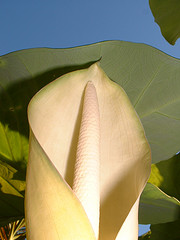
I am currently based in New Zealand and have access to Taro in a few varieties , via the Pacific Island communities, one of which is the wild version, which has notably black stems. This is not true of Madumbi, which also has a flower very similar to the Arum. I would be very keen to grow the South African variety as it is a very different flavour to the common Pacific Taro which as previously noted is very bland. Here is a link to a picture of the flower …
I did some more Googling, and found out a bit more about the project and its originater; depending on the story that’s either “Dr James Hartzell, a self-proclaimed ‘white boy from New York’,” or Professor Thembinkosi Modi, of the University of KwaZulu-Natal’s School of Agricultural Sciences. (Modi won a TWAS (Third World Academy of Science) Young Scientist Award in 2007.) Whatever, the end result was an organic cooperative of growers sending the amadumbe (or amadumbi) to a supermarket chain. Everything seemed rosy, with farmers reporting higher incomes that they were using to improve their lives, buying better houses, medical care, and education for their children. Except that there seems to have been a worm in the amadumbe: free-riders. Who were they?
Members who were male, poorly educated, partially certified, aware of loopholes in the grading system, and who did not trust the buyer.
The authors of the paper quoted above make specific recommendations to deal with the problem, but I cannot discover whether anything came of them. I’m also no aroid taxonomist, and frankly I’m not sure how informative the flower photo is, 1 but there you have it. Now, maybe other people can chime in with more information.
Using local resources to cope with high food prices
The 34th session of the Committee on World Food Security at FAO Headquarters in October 2008 included a side event of the Standing Committee on Nutrition on the Impact of high food prices on nutrition. Pablo Eyzaguirre, Senior Scientist, Bioversity International gave a presentation entitled, Coping with high food prices: making better use of local food sources.
Then he was interviewed. Well worth watching. Thanks, Arwen and Facebook.