- Salt stress under the scalpel – dissecting the genetics of salt tolerance. Could domesticate naturally salt-tolerant species and then breed for agronomic performance.
- Exploring the relationship between agricultural intensification and changes in cropland areas in the US. Higher yields not necessarily associated with less agricultural expansion.
- New tools for crop wild relative conservation planning. Lots of templates.
- Genetic identity and origin of “Piura Porcelana”—a fine-flavored traditional variety of cacao (Theoborma cacao) from the Peruvian Amazon. Similar but not identical to Nacional from Ecuador.
- Cytogenetics and genetic introgression from wild relatives in soybean. Intersubgeneric crossability barrier finally broken.
- Increased temperatures may safeguard the nutritional quality of crops under future elevated CO2 concentrations. Swings and roundabouts.
- Poverty reduction effects of agricultural technology adoption: the case of improved cassava varieties in Nigeria. 1.62 million lifted out of poverty, give or take, depending on the breaks.
- Frequent introgression of European cauliflowers in the present day cultivated Indian cauliflowers and role of Indian genotypes in the evolution of tropical cauliflower. More evidence of interdependence, if any were needed.
- Bambara Groundnut is a Climate-Resilient Crop: How Could a Drought-Tolerant and Nutritious Legume Improve Community Resilience in the Face of Climate Change? Isn’t it obvious?
- Adaption to Climate Change: Climate Adaptive Breeding of Maize, Wheat and Rice. “The good news is that there is significant genetic variation for heat and drought/submergence tolerance in the global maize, wheat and rice gene banks.”
- Crop Diversification Through a Wider Use of Underutilised Crops: A Strategy to Ensure Food and Nutrition Security in the Face of Climate Change. And a good one too. The last three items are from the same edited volume, which looks like should be worth getting: Sustainable Solutions for Food Security.
- Seed degeneration of banana planting materials: strategies for improved farmer access to healthy seed. Decentralize.
- Enset in Ethiopia: a poorly characterized but resilient starch staple. Maybe the above will work for enset too, but it will need better collections.
Nibbles: I say potato, CATIE genebank, Wat, Teff war, Digitizing collections, Black History Month, Crop stats
- Genebanks, crop wild relatives, friends, even a cool title — this one has it all: The New Potato.
- Latest on the CATIE seed collection.
- The wonder of Ethiopian food.
- Which I guess can include teff again now.
- Digitizing the Smithsonian — fast.
- George Washington Carver celebrated.
- Oh look, there’s a new version of SPAM. Let the GISsing begin.
Nibbles: Open data, Banana virus, Potato impact, Peruvian agrobiodiversity, Malagasy Coffea, Evolution experiment, A2S
- “It’s embarrassing if your lab is the only one that isn’t sharing data.” One would hope so, but…
- CRISPR snips out virus from banana genome.
- CIP-related potato varieties are planted on about 1.43 Mha, or 19% of total area.
- Saving Peru’s agricultural biodiversity is more than just about markets.
- I suspect the same is the case for Madagascar’s wild coffees.
- Studying evolution experimentally. Using mice. Plants would have been cooler.
- More on Access to Seeds Index: “Seeds of Nope” seems unnecessarily negative, though.
Brainfood: Sinotato, Photophenomics, Bangladesh lentils, Vernalization gene, Droning on, Pathogen identification, Human domestication, Citrus cryo, Purple rain, Teff diversity, Mining biodiversity lit, Wild dates, Buckwheat improvement, Panicum genome
- Potato and Food Security in China. Huge expansion, mainly due to product diversification, but still room for growth. But how will it end? Like bananas?
- Converging phenomics and genomics to study natural variation in plant photosynthetic efficiency. Chlorophyll fluorescence technologies are revolutionizing phenotyping. Now everyone will want another gadget.
- Is DNA fingerprinting the gold standard for estimation of adoption and impacts of improved lentil varieties? It’s not about yield.
- A florigen paralog is required for short-day vernalization in a pooid grass. Nope, I can’t say it better than the press release: Ancient gene duplication gave grasses multiple ways to wait out winter.
- Drones for Conservation in Protected Areas: Present and Future. Sure, why not. On-farm too?
- Genome-Enhanced Detection and Identification (GEDI) of plant pathogens. Sort of barcoding for bugs.
- Self-domestication in Homo sapiens: Insights from comparative genomics. There’s a domestication syndrome for humans too.
- Cryopreservation of Citrus limon (L.) Burm. F Shoot Tips Using a Droplet-vitrification Method. Well, at least two varieties work.
- Farmers Drive Genetic Diversity of Thai Purple Rice (Oryza sativa L.) Landraces. Well, who else?
- Genetic Diversity of Ethiopian Tef [(Eragrostis tef (Zucc.) Trotter] Released and Selected Farmers’ Varieties along with Two Wild Relatives as Revealed by Microsatellite Markers. The landraces are distinct from the released varieties, and more diverse.
- Biodiversity Observations Miner: A web application to unlock primary biodiversity data from published literature. Nice enough, but you need to upload a PDF corpus. Why not let it loose on the internet?
- Cross-species hybridization and the origin of North African date palms. I always knew that P. theophrasti would come in useful.
- Revisiting the versatile buckwheat: reinvigorating genetic gains through integrated breeding and genomics approach. Start with a database, core collection, and wild relatives. Gratifyingly old-fashioned.
- The genome of broomcorn millet. That would be Panicum miliaceum.
Global seed companies and the pragmatic agrobiodiverse portfolio
Coosje Hoogendoorn, Senior Research Lead on the Access to Seeds Index at the Royal Tropical Institute (KIT), and an old friend of the blog, has a bone to pick with us on a recent Nibble: “I don’t really agree with your ‘Not much change, alas’ – companies are doing more, and telling us a lot more. The order of companies has not changed a lot, same champions. Although we have runners up. The champion, East-West Seed, is however hard to catch in Asia and worldwide. And for your information, there are indeces for Sub-Saharan Africa forthcoming (March), and a synthesis report that brings the whole story together.” And to help us along, she is contributing the following blog post, and is looking forward to feedback. Thanks, Coosje.
Seed companies are often seen as the nemesis of agricultural biodiversity. At the same time, farmers around the world, big and small, are in dire need of good quality seed to produce the food needed for 9 to 10 billion people. What is the state of the balance between agrobiodiversity, world food production, and the seed industry? The Global Access to Seeds Index 2019, published on 28 January 2019, provides some insights on this dilemma.
The Index takes stock of to what extent, and how, the seed industry provides good quality seed of suitable crops and varieties to smallholder farmers – the base of the world’s agricultural pyramid.
Overall, 13 leading global seed companies were found to address climate change and nutrition needs, but to reach only around 10% of the world’s small farmers. Lack of crop diversity is a major constraint; hybrid seed dominates while legumes are largely ignored.
While the focus of the Index is wider, insights on how seed companies deal with agrobiodiversity is part of the picture. In this blog post I provide a preliminary analysis.
Companies have diverse portfolios, sort of
The Access to Seeds Index investigated whether companies sell major field crops and vegetables, ones that are important for food and nutrition security and require at least annual replanting. Companies were found to develop and market varieties of many such crops, but with a very clear gap for dry legumes. Not one company was found to market groundnut, pigeonpea or cowpea, and only single companies have dry bean and chickpea in their portfolio.
Neglected crops are getting attention: about half of the companies invest in local crops, providing professional quality seed and/or setting up breeding programs. Most local crops – 15 – were found in company portfolios in South and Southeast Asia; there were only two such crops in Latin American portfolios. East-West Seed, across the world, with 14 local crops, and Limagrain with seven local crops in its portfolio, are leading in investments in agrobiodiversity through local crops. Yardlong bean can be called a ‘global-local’ crop, since it is being sold in all four regions, and by three companies.
As far as variety development is concerned, in addition to yield, companies give very high priority to breeding for local adaptation through breeding for tolerance to abiotic stress and pest and disease resistance. But fewer than half breed for local tastes and preferences.
Global seed companies contribute to formal genetic resources conservation
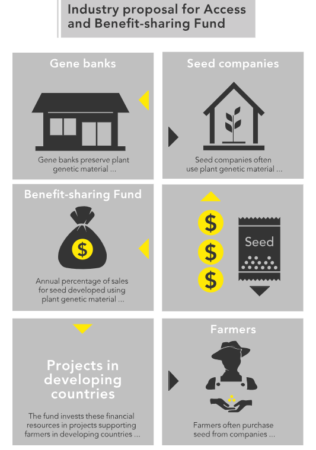 To a large extent, companies are actively involved in developing workable global Access and Benefit Sharing arrangements, and have suitable track and trace systems. Most collaborate with CGIAR in genetic resources matters. A majority have active ‘in-kind’ collaborations, for example through testing and multiplication of (local) genebank materials. Some have made considerable financial donations to the Plant Treaty’s Benefit Sharing Fund and/or the Global Crop Diversity Trust. But no company was found to support in situ conservation efforts or community genebank initiatives.
Companies are flexible on intellectual property when it concerns small farmers
Most companies support the breeders’ exemption under plant variety protection regulations, allowing varieties to be used by other breeders. Also, most companies do not block on-farm seed saving of their commercial varieties, with several being particular lenient when it concerns smallholder farmers. However, a focus on developing hybrids, as opposed to ensuring the availability of OPVs, effectively restricts the practice. Only East-West Seed, Advanta, Sakata and Limagrain have a company policy to sell OPVs in addition to hybrids because of their smallholder farmer clientele.
Agrobiodiversity is on company radar screens, but…
What did we learn? The global companies studied were found to take agrobiodiversity seriously, both expressed by company portfolios and by the sector’s willingness to contribute to ABS, its recognition of the breeder’s exemption and – with some clear reluctance – its respect for non-commercial on-farm seed saving. But obviously there are gaps. There is a clear lack of interest in in situ and community conservation of genetic resources, showing that companies prefer to stay on one side of the line between formal and informal genetic resources conservation activities. And companies are shying away, probably presently for good commercial reasons, from legumes.
This story isn’t finished yet. What is the contribution of regional and local seed companies to conservation and use of agrobiodiversity? The final synthesis report of the Access to Seeds Index 2019, that will bring insights together across regions, and across global, regional and local companies, will be released in May 2019. So watch this space for further updates, and in the meantime keep checking out the Access to Seeds Index website.
LATER: Coosje’s colleague Ido Verhagen adds his own take in this interview.