- Psst, you have any examples of investments for healthy food systems? What do you mean, you don’t.
- Paint it henna.
- Pleading for pseudocereals. In Switzerland?
- Mapping India’s trees. Among other things.
- To save biodiversity, look on the bright side. Easy for you to say.
- The genetic level of biodiversity makes important contribution to ecosystem services. In birds. Right.
- Taste the forest. In cocktails.
Exploring global diets
You may remember the paper Increasing homogeneity in global food supplies and the implications for food security, which we blogged about a couple of times when it first came out in 2014. National Geographic did a pretty good job of visualizing some of the data online, but CIAT have blown them out of the water now with a fabulous interactive website.
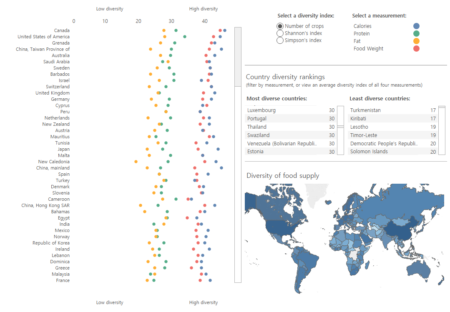
You can listen to Colin Khoury, the brains behind the whole thing, on Jeremy’s latest Eat This Podcast. And you can read about the most surprising results on CIAT’s blog. Spoiler alert:
1. Almost everybody eats a lot more food than their grandparents did. And it’s more diverse.
2. African, Asian, and small island countries have the world’s most diverse food supplies. Also the least.
3. Crop immigrants are the key to dietary diversity.
4. The world’s average diet means eating like people do in Cape Verde, Colombia, and Peru.
5. Political unrest can lead to greater diversity in people’s diets, or less.
There’s also a companion piece by Colin on the Global Plant Council website. And this is what Colin says on his Facebook page:
We built a big data website! When we published our findings of increasing homogeneity in global food supplies, we hadn’t yet found a good way to make the underlying national-level data readily visible to interested readers. This is why I’m tremendously excited to announce the publication of our new Changing Global Diet website, which provides interactive visuals for 152 countries over 50 years of change. We that hope you will enjoy your own investigations of dietary change over time. Perhaps you can tell us where you think the changing global diet is headed.
If you do play around with the website, you can share any interesting stuff you find using the hashtag #changingglobaldiet on Twitter. Me, I’m going to have a bandeja paisa and feel like a proud citizen of nowhere.
Nibbles: Treaty & UPOV, Minor millets redux, Maize replacement, Amaranth et al., Squash story squashed, Potato podcast, Food security webinar, Plants Day, Repast magazine, German beer, Coffee strategy, ILRI genebank
- The ITPGRFA and UPOV need to sort out their connection.
- Bring back our millets.
- And our sorghum and pigeonpeas too.
- And the milpa.
- And speaking of milpa crops, the real story of that large, old squash.
- Since we’re at it, bring back the potato too. To the people.
- Yet another interesting webinar which I missed. Wonder whether they talked about the above. Anyone?
- Still have time to prepare for “Fascination of Plants Day” on 18 May 2017, though.
- Repast: “the First-Ever Food History Magazine”. ‘Nuff said.
- Gotta love those German purity laws.
- A strategy for conserving coffee genetic resources takes shape. Now for the money…
- New forages genebank opens at ILRI in Ethiopia.
Brainfood: Tomato chemicals, Photoperiod, Grain phenotyping, Hawaiian ag, Domestication primer, Symbionts, Turkish wheat, Yam bean diversity, Crop health, Walnut diversity, Agrobiodiversity theorising, Sea pigs, NERICA impacts, Nutrient production
- Multi-perspective evaluation of phytonutrients – Case study on tomato landraces for fresh consumption. Fancy maths proves different tomato varieties taste different.
- Adaptation to the Local Environment by Modifications of the Photoperiod Response in Crops. It’s all down to a few mutations in all crops.
- Evaluation of the SeedCounter, A Mobile Application for Grain Phenotyping. Seems like a lot of work to just be able to measure wheat seeds, but boys will have their toys.
- Indigenous Polynesian Agriculture in Hawaiʻi. Both intensive and extensive.
- How to make a domesticate. It takes a long time, and involves lots of genes.
- Symbiosis limits establishment of legumes outside their native range at a global scale. Non-symbiotic legumes have spread further than symbiotic ones into non-native areas.
- Wheat Landraces Currently Grown in Turkey: Distribution, Diversity, and Use. More than half of morphotypes (59%) lost since 1920 overall, but none in some areas.
- Ecotypic differentiation under farmers’ selection: Molecular insights into the domestication of Pachyrhizus Rich. ex DC. (Fabaceae) in the Peruvian Andes. Separate Amazonian and Andean lineages, and P. tuberosum arising from P. ahipa.
- Crop health and its global impacts on the components of food security. To better understand acute impacts, model systemic ones.
- Climate-Related Local Extinctions Are Already Widespread among Plant and Animal Species. About half of about 1000 species showed local extinction.
- Rethinking the history of common walnut (Juglans regia L.) in Europe: Its origins and human interactions. Expansion from glacial refugia, followed by human exploitation. Compare and contrast with Asia. Or read about the whole thing in AramcoWorld.
- Agrobiodiversity and a sustainable food future. Apparently all you need to do to support the “use of biological diversity in sustainable agricultural and food systems” is to recognize that there are 4 interconnected themes: (1) genetic resources, ecology and evolution; (2) governance policy, institutions and legal agreements; (3) food, nutrition, health and disease; and (4) global change drivers with social ecological interactions.
- Eastern Mediterranean Mobility in the Bronze and Early Iron Ages: Inferences from Ancient DNA of Pigs and Cattle. Anatolia to southeastern Europe and back to the Levant across the Bronze-Iron Age transition. The Sea Peoples had pigs?
- Contribution of improved rice varieties to poverty reduction and food security in sub-Saharan Africa. NERICA adoption increased annual per capita income by US$4 per year from 2000, despite yields going down a bit.
- Farming and the geography of nutrient production for human use: a transdisciplinary analysis. Need to try to maintain production diversity as farm size increases. But let Jess Fanzo explain it better.
Brainfood: Insurance value, Forages/invasives, Chenopod crops, Non-descript goats, Holy grapes, Black maize, Wild rice diversity, Cassava seedlings, Knotweed domestication syndrome, Wild potato use, Farmers/researchers, Winged yam diversity, Genes to ecosystems, Wild carrots
- The Value of Biodiversity as an Insurance Device. So apparently the “Epstein-Zin-Weil specification of the utility function allows us to disentangle the effects of risk aversion and aversion to fluctuations.” Good to know.
- The Invasive Legacy of Forage Grass Introductions into Florida. Sometimes biodiversity is bad for you, Epstein-Zin-Weil specification or not.
- Cultigen Chenopods in the Americas: A Hemispherical Perspective. Why did the North American one not do a quinoa?
- The potential of landscape genomics approach in the characterization of adaptive genetic diversity in indigenous goat genetic resources: A South African perspective. “[N]on-descript indigenous veld goats” no longer.
- Collection and characterization of grapevine genetic resources (Vitis vinifera) in the Holy Land, towards the renewal of ancient winemaking practices. Some of the local varieties could make a decent tipple.
- Genetic studies regarding the control of seed pigmentation of an ancient European pointed maize (Zea mays L.) rich in phlobaphenes: the “Nero Spinoso” from the Camonica valley. But do we really want to promote a landrace as a functional food?
- Genetic diversity patterns in ex situ collections of Oryza officinalis Wall. ex G. Watt revealed by morphological and microsatellite markers. Malesia separates out from SE Asia, and similarities between PNG and Philippines points to long-distance dispersal by birds. Or germplasm collectors.
- Perceptual selection and the unconscious selection of ‘volunteer’ seedlings in clonally propagated crops: an example with African cassava (Manihot esculenta Crantz) using ethnobotany and population genetics. Occasional seedlings are allowed to survive not so much because they look different, but because they look similar, to existing landraces, even though they may be genetically distinct.
- Evolutionary “Bet-Hedgers” under Cultivation: Investigating the Domestication of Erect Knotweed (Polygonum erectum L.) using Growth Experiments. Experimental domestication pretty quickly gets rid of that peskily bet-hedging germination heteromorphism.
- Are We Getting Better at Using Wild Potato Species in Light of New Tools? Not until we move on from conserving populations and start documenting individual plants in depth.
- Crucible of Crop Diversity: Forging Partnership with Farmer Breeders and Innovators for Higher Climate Resilience. Experience of the Honey Bee Network in bringing together farmers and researchers.
- Understanding the genetic diversity and population structure of yam (Dioscorea alata L.) using microsatellite markers. 17 groups among 384 global accessions, reflecting geography, ploidy and morpho-agronomy.
- Harnessing diversity from ecosystems to crops to genes. “…currently, approximately 75% of the genetic diversity of crops may have been lost.” I do like that “may.”
- Multivariate analysis of morphological diversity among closely related Daucus species and subspecies in Tunisia. The revenge of morphology: D. sahariensis, plus 4 subspecies of D. carota.