Another Committee on World Food Security report

I knew I’d forget one:

The webcast is live now.

Also, since I’m at it, here’s a useful blog post on the other CFS report, the one on “Nutrition and Food Systems,” from one of the authors, summarizing eight ways why the report is different. This is what resonated with me most:

Third, it is, subversively, a bit radical. Statements such as “The risks of making well intentioned but inappropriate policy choices are much smaller than the risks of using a lack of evidence as an argument for inaction” are fairly heretical for many nutrition investors guided by Lancet 2008 and 2013. For the more market based interventions within the food system the hard evidence is usually not present and one has to trust educated best guesses and calculated risks as a guide to action.

Sometimes, you just have to do it.
Is data a bottleneck to PPP in conservation too?

Lawrence Haddad of GAIN has a blog post out on the “the data gaps that inhibit productive engagement between the public and the private spheres to advance nutrition.” It’s nicely summarized in a tweet.

Strikes me that many of the same things could be said about public-private partnerships in conservation of agricultural biodiversity too. Only more so.

Reports galore for the CFS

It’s the time of year for major reports, I guess. Here’s what’s on the table:

You can follow the discussion on all these and more on the webcast of the 44th session of the Committee on World Food Security.

Maybe we should just have stayed hunters and gatherers?

Agricultural biodiversity wades into the mainstream at long last

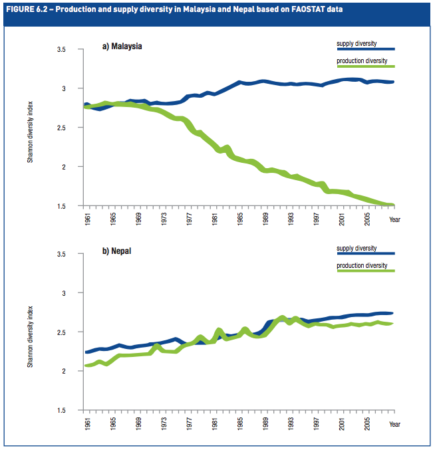
I really haven’t done sufficient justice to the new book from Bioversity, Mainstreaming Agrobiodiversity in Sustainable Food Systems: Scientific Foundations for an Agrobiodiversity Index, whose moving dedication I reproduce above. It’s a great review of the diverse reasons why agricultural diversity is important to us. But also of the complexities involved in translating diversity in farmers’ fields, let alone in genebanks, into development outcomes like better nutrition, as clearly shown by the diagram below.