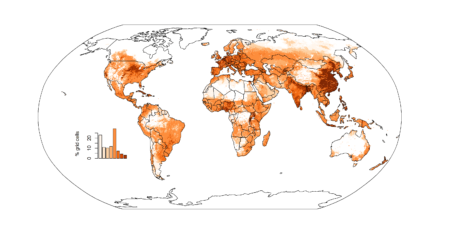
- Mapping climatic mechanisms likely to favour the emergence of novel communities. New climate combinations are rare (3.4% of evaluated cells), but mean displacement moderately rapid (3.7 km per decade) and divergence high (>60° for 67% of cells). What will all this mean for CWR? As many are ruderals, maybe nothing?
- Why biodiversity matters. Inaugural issue of Nature Ecology & Evolution. Not much on agricultural biodiversity, alas.
- Bridging the practitioner-researcher divide: Indicators to track environmental, economic, and sociocultural sustainability of agricultural commodity production. Again, no surprise that biodiversity is hardly considered by either researchers or practitioners in monitoring sustainability, though that’s not the point of the paper.
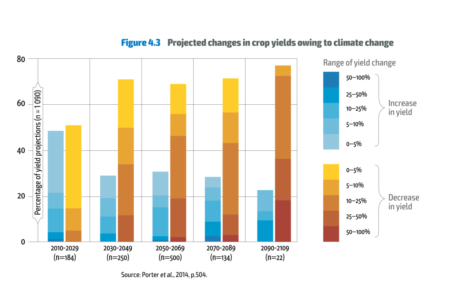
- Plausible rice yield losses under future climate warming. More even than IFPRI thought: −8.3 ± 1.4% per degree.
- Recent breeding programs enhanced genetic diversity in both desi and kabuli varieties of chickpea (Cicer arietinum L.). But from a low baseline?
- EU-Forest, a high-resolution tree occurrence dataset for Europe. Want European tree diversity, go to the Pyrenees.
- Farmer fidelity in the Canary Islands revealed by ancient DNA from prehistoric seeds. New barley same as old barley.
- Evaluation of 19,460 Wheat Accessions Conserved in the Indian National Genebank to Identify New Sources of Resistance to Rust and Spot Blotch Diseases. 45 accessions had known resistance genes against all three rusts as well as a QTL for spot blotch resistance.
- Promoting the Use of Common Oat Genetic Resources through Diversity Analysis and Core Collection Construction. Interesting, but 21 out of 91 is hardly a core collection.
- Utilization of genetic resources and associated traditional knowledge in academic research. A good practice guide for access and benefit-sharing. Well there’s no excuse now.
- Identifying species threat hotspots from global supply chains. Global maps of which countries, and which commodities they consume, most endanger threatened species around the world.
Nibbles: Catching up edition
- And we’re back.
- India wants to set up a fish genebank. Because climate change, which is scrambling up climates everywhere. And fish are important, so don’t scoff.
- Nepal’s community seed banks in the news. Also Brazil’s. And New Zealand’s, since we’re at it.
- Don’t forget India’s. And not just the community sort, either.
- Our friends at Kew on the wonders of genebanks.
- Someone mention genebanks? Latest photos from Ft Collins.
- You can make your own. Genebank, that is.
- Podcast on a really long-term seed viability experiment.
- It’s not just about the genebanks, though. Or all that biotechnology for that matter. Indeed not, as iPES-Food reminds us.
- Italian monks help rebuild earthquake-hit town. With beer.
- French monks are at it too. Beer, that is.
- Go ahead, have that piece of cheese with that monk-brewed beer.
- Or with a nice IPA for that matter.
- Or a banana beer.
- Sure, take all the romance out of beer, why don’t you.
- The Mesoamerican, entomological roots of the colour scarlet.
- Don’t keep people out if you want to protect forests. I can’t understand why this still needs to be said.
- The story of the quest for super-sweet corn. And a celebration of the life of a giant of corn (as in maize) research.
- And for the “ultimate” avocado.
- How about ultimate dope?
- The traditional, end-of-year, save-the-apple and the-end-of-frankincense stories. Actually there were two on apples. And it’s not all bad news for frankincense.
- Saving the Tamworth pig in Australia. And the camel in Rajasthan.
- Cool map of French traditional foods.
- For your next Saturnalia feast.
- The Met has a “corne field.”
- Earliest evidence of potatoes from the central Andes. What, not Canada?
- Neolithic hunter-gatherers of the Libyan Sahara liked their veggies. Which we all should. But not at these prices. Ah, wait, though, is the melon a vegetable, or a fruit?
- Some crops come, some go.
- Which seems a good place to bring this first, gigantic Nibble of 2017 to a close. Did you miss us? I know you did. But did we miss anything over the holidays? Let us know.
Brainfood: Rucola, PGR history, Camels & CC, Quality seed, Co-evolution, Dormancy
- Changes in rocket salad phytochemicals within the commercial supply chain: Glucosinolates, isothiocyanates, amino acids and bacterial load increase significantly after processing. Sitting around is good for rucola’s nutritional value.
- From “Genetic Resources” to “Ecosystems Services”: A Century of Science and Global Policies for Crop Diversity Conservation. Not just stuff to mine.
- Camels and Climate Resilience: Adaptation in Northern Kenya. Increasing focus on camel herding a reasonable climate resilience strategy, but only under some scenarios, for some communities. And what is it doing to diversity?
- A review of factors that influence the production of quality seed for long-term conservation in genebanks. What’s best for commercial seed production is not necessarily best for long-term conservation. Though it won’t hurt.
- The eco-evolutionary impacts of domestication and agricultural practices on wild species. Agriculture (plant breeding, agricultural practices and gene flow with crops) can have evolutionary consequences for wild species that undermine the success of agriculture.
- Multiple alleles at a single locus control seed dormancy in Swedish Arabidopsis. Careful with that GWAS!
Sidestreaming agriculture in biodiversity action plans
It turns out I don’t have to get an intern to go through a whole bunch of NBSAPs to fillet out how agriculture is being mainstreamed into biodiversity conservation plans. That’s because Bioversity have done it for me. The bottom line?
Very few of the reviewed NBSAPs include explicit plans to use genetic resources for food and agriculture (GRFA), for climate change adaptation or for diversified diets and improved nutrition.
Why am I not surprised?
Brainfood: Aichi 14, Dwarf coconut diversity, Food system sustainability, African data, Pepper core, Australian flora, EU seed law, Rice conservation, Israeli genebank, ICRISAT pearl millet diversity
- Status and Trends in Global Ecosystem Services and Natural Capital: Assessing Progress Toward Aichi Biodiversity Target 14. 21 datasets, and the only “state” indicator for the “food” service is fisheries stocks?
- SSR markers reveal the population structure of Sri Lankan yellow dwarf coconuts (Cocos nucifera L.). They’ve been naughty with the talls.
- Identifying attributes of food system sustainability: emerging themes and consensus. Diversity, modularity, transparency, innovation and congruence. You had me at diversity.
- CELL5M: A geospatial database of agricultural indicators for Africa South of the Sahara. 134 data layers for harvested crop area.
- Genetic diversity and population structure analysis to construct a core collection from a large Capsicum germplasm. Based on transcriptome, no less.
- Genetic diversity and structure of the Australian flora. Meta-analysis finds some surprises. But for CWR?
- Securing Crop Genetic Diversity: Reconciling EU Seed Legislation and Biodiversity Treaties. EU seed law is an ass.
- Diversity Among Rice Landraces Under Static (Ex Situ) and Dynamic (On-Farm) Management: A Case from North-Western Indian Himalayas. For two landraces, more alleles per locus in situ compared to ex situ. And?
- Strategies and priorities in field collections for ex situ conservation: the case of the Israel Plant Gene Bank. Sort of a core collection of the whole flora.
- Adaptation Pattern and Genetic Potential of Indian Pearl Millet Named Landraces Conserved at the ICRISAT Genebank. Agronomically derived clusters show geographically structured distributions.