- CIAT genebank looking for a leader.
- IRRI soon-to-be-former (Thanks, Mike) DG looking for a new Green Revolution.
- Looking for pomegranates? Look no further.
- Cleome looking for markets. With genomics.
- Looking to the floating gardens of Bangladesh for answers.
- Looking for the origin of lager yeasts. And finding two of them.
- Looking to understand amaro.
- A good look at biofortification.
Nibbles: Kinky crops, Hot pepper, Cary Fowler, Gin history, Open data, Quaker food, QPM in Ethiopia, Botany app, Old seeds, New tomato
- Why aren’t there more crops among the orchids?
- This pepper is not so much a crop as a weapon of mass destruction.
- Now here’s a crop. New tomato has taste, storability, looks. But I think it’s dating.
- Maize with cool amino acids reaches Ethiopia. Must have walked there.
- Really old squash seeds.
- Cary Fowler on the Weather Channel. You heard me.
- Quakers have an opinion on the right to food and climate change. Well, why shouldn’t they? They also have a UN office, but that’s another story. No word on whether they made the Weather Channel.
- Ok, so apparently the answer is data. Says a data company. And open data at that. Quakers nonplussed.
- Botanizing in N or S America? There’s an app for that.
- The rise and rise of gin. And I certainly need one.
Many happy returns

A very happy birthday to MS Swaminathan, Father of the Green Revolution in India. How many people get a hashtag on their birthday?
Tourism and conservation
The Convention on Biological Diversity has just published its User’s Manual on the CBD Guidelines on Biodiversity and Tourism Development. It seems very thorough, as far as it goes — but does it go far enough? In particular, what about tourism offers based on agricultural biodiversity? This is what the guide says about how tourism could help achieve the Aichi Targets:
It has been shown that effective tourism planning and actions can contribute to achieving at least 12 of the 20 Aichi Biodiversity Targets contained in the [Strategic Plan for Biodiversity 2011-2020]. For some Targets (5, 8, 9, 10 and 12) this is primarily about greater control and management to reduce damage to biodiversity from tourism. For others (1, 11, 15, 18, and 20) this is about pursuing the positive contribution of tourism to biodiversity awareness, protected areas, habitat restoration, community engagement, and resource mobilization. A further dimension is the better integration of biodiversity and sustainability into development policies and business models that include tourism, thereby supporting Aichi Targets 2 and 4.
But what about Target 13? Remember that?
By 2020, the genetic diversity of cultivated plants and farmed and domesticated animals and of wild relatives, including other socio-economically as well as culturally valuable species, is maintained, and strategies have been developed and implemented for minimizing genetic erosion and safeguarding their genetic diversity.
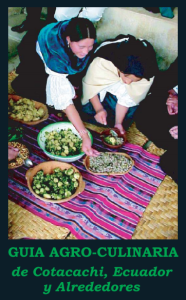 Surely agritourism is potentially just as valuable a tool for conserving biodiversity as trekking in protected areas. Shouldn’t the user’s manual, and indeed the guidelines, address the needs of this sector, or at least recognize that it exists? It seems that the CBD has trouble thinking of agricultural landscapes as harbouring biodiversity worthy of being conserved — and visited.
Nibbles: Conservation genetics, African fish farming, Ecological intensification, Elderly diets, Organic breeding, Conference tweeting, Mexican maguey, African PBR
- Conservation genetics papers from Latin America, courtesy of special issue of the Journal of Heredity. No ag, but no problem.
- African aquaculture takes off. Or perhaps rises to the surface would be more appropriate.
- Expert parses what experts said “sustainable intensification” means.
- Leafy greens and wine good for oldies. Good to know.
- Student Organic Seed Symposium to discuss “Growing the Organic Seed Spectrum: A Community Approach” in a few days’ time.
- How to tweet. At scientific conferences, that is.
- Maguey genebank in the offing. Well worth tweeting about.
- Arusha Protocol on the Protection of New Plant Varieties (Plant Breeders’ Rights) adopted. Basically UPOV 1999 for Africa. But I suspect the polemics are only just starting.